 blog
blog
Digital Journals for Mental Clarity: 2026 Guide
Table of Contents
- Why Digital Journals Work: Cognitive Offloading and Emotional Regulation
- How to Choose a Digital Journal: Privacy, Portability, and Usability
- Best Journaling Apps for Mental Health: Features That Matter
- Guided Journaling Prompts for Stress Relief: 10-Minute Practices
- Daily Habits for Intentional Parenting: Modeling Mindfulness
- Neurodivergent-Friendly Journaling: Techniques That Stick
- Conclusion: Your Next 10 Minutes
- Frequently Asked Questions
Last Updated: September 23, 2026
Why Digital Journals Work: Cognitive Offloading and Emotional Regulation
Digital journals for mental clarity work because they move racing thoughts out of your head and into a searchable, organized space. This guide from SSBGMARKETINGINC. breaks down the science, the tools, and the 10-minute habits that make journaling stick for busy mothers.
Cognitive offloading is the practice of transferring information from your mind to an external system so your brain has more room for decisions that actually matter. A grocery list does this. So does a digital journal.
The concept isn't new. What's changed is how accessible it's become. A digital journal lives on the phone already in your hand. No lost notebooks, no guilt about abandoned paper planners collecting dust.
Here's what most people get wrong about journaling: they treat it as a diary. A record of what happened. That's one use. But the real value for mental clarity comes from using it as a processing tool. You write to think, not to archive.
How to Choose a Digital Journal: Privacy, Portability, and Usability
Choose a digital journal by prioritizing three things: privacy controls, cross-platform synchronization, and an interface that doesn't require a tutorial. Everything else is secondary.
Privacy matters more than most people realize. Your journal contains your unfiltered thoughts. Look for apps with end-to-end encryption, passcode locks, and clear data policies. If the app can read your entries to serve ads, that's not a journal. That's a data collection tool. A practical test: check whether the app's privacy policy explicitly states that entries are encrypted at rest and in transit. If the policy is vague about how entries are stored or shared, treat that as a red flag.
Portability means your journal works on your phone, tablet, and laptop. You should be able to start a thought on your commute and finish it at your kitchen table. Cross-platform synchronization makes this possible. But sync quality varies. Some apps sync instantly; others batch updates every few minutes and can create duplicate entries if you edit on two devices at once. Before committing, test sync by writing on one device and immediately opening the app on another.
Usability is the make-or-break factor. The Nielsen Norman Group's usability research consistently shows that interfaces requiring more than minimal cognitive load get abandoned. If your journal app has 12 menu options before you can type, you'll stop using it.
Data Portability and Export: Your Journal, Your Data
Data portability means you can export your journal entries in a standard format (PDF, plain text, or CSV) and take them to another platform if you choose. Many journaling apps don't offer this. Your entries stay locked inside their system.
- Export format: Plain text and CSV are the most portable. PDF is readable but harder to re-import into another app. Some apps only export to their own proprietary format, which defeats the purpose.
- Export scope: Can you export all entries at once, or only one at a time? Bulk export saves hours if you ever switch tools.
- Metadata retention: Do mood tags, timestamps, and prompt responses survive the export? If not, you lose the pattern data that makes journaling useful.
- Import support: Some apps let you import from competitors. This reduces switching costs and gives you leverage if a platform changes its pricing or privacy terms.
Best Journaling Apps for Mental Health: Features That Matter
The best journaling app for mental health is the one you'll actually open every day. Features matter less than consistency. That said, certain capabilities separate tools built for psychological well-being from generic note-taking apps.
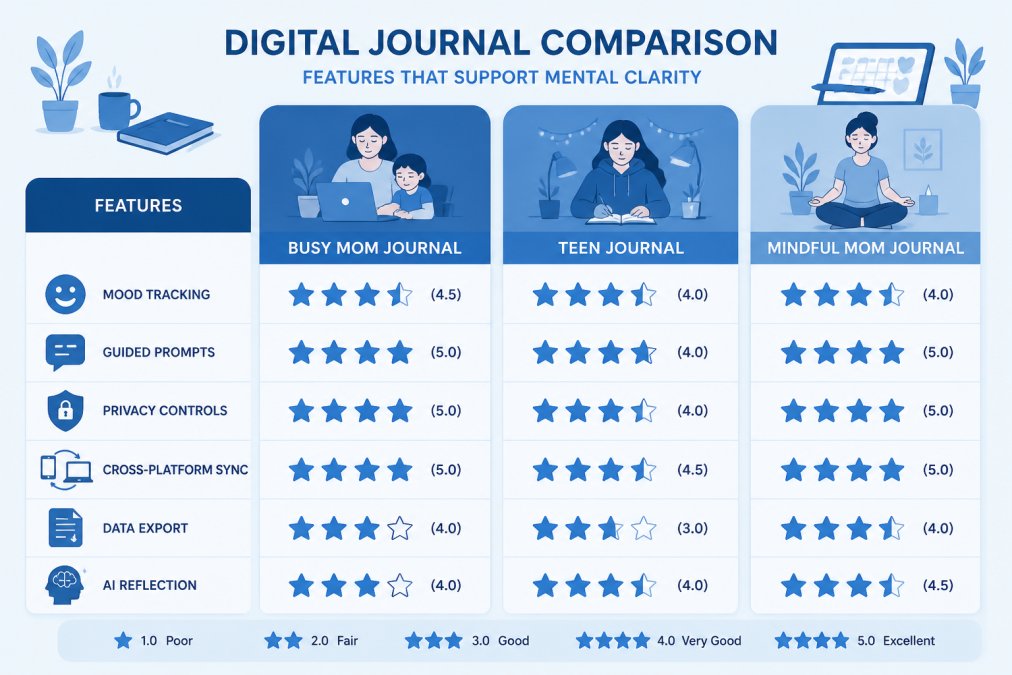
Here's how the main feature categories compare:
| Feature | What It Does | Why It Matters |
|---|---|---|
| Mood tracking | Logs emotional state daily | Reveals emotional patterns over time |
| Guided prompts | Provides structured writing cues | Removes blank-page paralysis |
| Privacy controls | Encrypts entries, requires passcode | Protects unfiltered thoughts |
| Cross-platform sync | Works across phone, tablet, desktop | Fits into fragmented daily routines |
| Data export | Allows backup in standard formats | Ensures you own your journal |
| AI reflection | Offers prompted insights | Adds behavioral insights without a therapist |
| Voice-to-text | Converts speech to written entries | Removes typing as a barrier |
| Tap-based mood logging | One-tap emoji or color mood tags | Works when writing feels impossible |
Neurodivergent-Friendly Selection Criteria
If you have ADHD, anxiety, or a brain that resists routine, standard app-selection advice often backfires. The features that matter most shift. Here's what to prioritize instead:
- Low activation energy: The app should open to a blank entry in one tap. No dashboards, no onboarding screens, no decision trees. If you have to choose a journal type before you can type, you've already lost momentum.
- Voice-to-text that actually works: For many people with ADHD, the barrier isn't the thought, it's the physical act of typing. An app with reliable dictation lets you speak an entry in 30 seconds and move on.
- Tap-based mood tracking: A row of emoji or color-coded buttons lets you log emotional state without writing a single word. This matters on high-fatigue days when words won't come.
- Forgiving streaks: Avoid apps that punish missed days with broken-streak guilt. Look for apps that show a weekly or monthly view instead of a daily chain. The goal is a pattern, not a perfect record.
- Searchable entries: When your brain jumps between topics, search becomes a retrieval tool. Being able to search "anxiety" or "sleep" across months turns your journal into a personal database.
The Cognitive Offloading Mechanism
Most articles frame journaling as a wellness practice. The actual mechanism is cognitive offloading, transferring information from your mind to an external system so your brain has more room for decisions that matter.
Get the 3-step manifestation ebook now →
Guided Journaling Prompts for Stress Relief: 10-Minute Practices
Guided journaling prompts for stress relief work by removing the hardest part of journaling: deciding what to write about. When your brain is already overloaded, even choosing a topic feels like one more decision.
A 10-minute practice looks like this:
- Minutes 1-2: Write three things you're grateful for right now. Specific, not generic.
- Minutes 3-5: Name one emotion you're carrying today and where you feel it in your body.
- Minutes 6-8: Write one sentence about what you can control and one about what you can't.
- Minutes 9-10: Set one intention for tomorrow. One sentence.
That's it. No essays. No pressure to be profound.
Daily Habits for Intentional Parenting: Modeling Mindfulness
Daily habits for intentional parenting start with one principle: your children learn more from what you do than what you say. If you want your teenager to develop emotional awareness, she needs to see you practicing it.
Neurodivergent-Friendly Journaling: Techniques That Stick
Neurodivergent-friendly journaling removes the rules that make traditional journaling feel impossible. If you have ADHD, anxiety, or a brain that resists routine, standard journaling advice often backfires.
Here's what works instead:
- Skip the daily requirement. Aim for "most days" instead of "every day." Missing a day doesn't mean failure.
- Use voice-to-text. If writing feels like a barrier, speak your entry and let the app transcribe it.
- Set a two-minute timer. The goal is starting, not finishing. Two minutes of writing counts.
- Use structured prompts only. Open-ended journaling overwhelms. Guided prompts give your brain a track to run on.
- Track mood with taps, not words. A simple mood tracker with emoji or color-coded buttons removes the writing barrier entirely.
Conclusion: Your Next 10 Minutes
The hardest part of journaling isn't finding the right app or the perfect prompt. It's starting. Most busy mothers already know they need mental clarity. The gap is between knowing and doing.
Frequently Asked Questions
Is there a digital journal specifically for mental health?
Yes. Many digital journals are built with mental health in mind. They include mood tracking, guided prompts, and reflection tools. Some focus on cognitive behavioral therapy techniques, while others emphasize mindfulness practice. The best option depends on your goals. If you want structure, look for apps with daily check-ins and emotional pattern insights. If you prefer flexibility, a simple notes app with templates can work. For busy parents, a 10-minute guided format often fits best. Always check privacy policies before sharing sensitive thoughts.
What type of journaling is best for mental clarity?
Guided journaling with prompts tends to work well for mental clarity. It reduces decision fatigue and helps you focus on specific topics like stress or gratitude. Expressive writing, where you write freely about emotions, also supports emotional regulation. For quick daily practice, try a three-step format: a brain dump, a gratitude note, and one intention. This combines cognitive offloading with positive focus. Consistency matters more than length. Even five minutes a day can build the habit and reduce overwhelm.
How do digital journals help with anxiety and overwhelm?
Digital journals help by giving you a place to offload racing thoughts. This process, called cognitive offloading, frees mental resources. Many apps include mood tracking and breathing exercises that calm the nervous system. Guided prompts can redirect anxious thinking toward problem-solving. For parents, a quick daily check-in can reduce the feeling of being scattered. Over time, reviewing past entries reveals emotional patterns and triggers. This awareness is the first step to managing anxiety more effectively.
Can digital journals help with intentional parenting and teen bonding?
Yes. When parents model a daily journaling habit, it shows kids that reflection is normal. Shared prompts can open conversations. For teens, a guided journal with age-appropriate prompts can build self-esteem and emotional skills. Some families set aside ten minutes for parallel journaling. This creates a calm routine and a sense of connection. It also gives teens a private outlet for stress. The key is consistency and keeping it low-pressure, not another chore.