 blog
Simple Ways to Reduce Parenting Burnout Fast
Table of Contents
- Why Parenting Burnout Hits Harder Than Regular Tiredness
- Parental Burnout Symptoms You Should Not Ignore
- How to Stay Calm as a Parent When You Feel Overwhelmed
- Self-Care for Overwhelmed Moms: Low-Effort Habits That Fit Real Life
- How to Ask for Help as a Parent Without the Guilt
- A Step-by-Step Plan to Recover and Prevent Burnout
- Frequently Asked Questions
Last Updated: October 13, 2026
Why Parenting Burnout Hits Harder Than Regular Tiredness
Parenting burnout is a state of deep physical and emotional exhaustion caused by long-term caregiving stress, and it does not fade after a good night's sleep. Regular tiredness lifts with rest. Parenting burnout keeps going, even on the calm days.
That difference matters. Many parents blame themselves for feeling worn down when the real issue is chronic stress, not weakness.
So what actually separates the two?
- Regular tiredness: you rest, you recover.
- Parenting burnout: rest helps for a day, then the heaviness returns.
- The warning sign: you feel detached, numb, or short-tempered with the people you love most.
The American Psychological Association's stress resources notes that ongoing stress without recovery wears down both body and mind. Parenting is a job with no off switch, which is why it hits harder than most.
Below, we'll walk through the signs, the fixes, and a simple plan you can start tonight.
Parental Burnout Symptoms You Should Not Ignore
Parental burnout symptoms show up in your body, your mood, and your relationships. Catching them early makes recovery faster.
Here is what to watch for.
Emotional and Physical Signs
Emotional exhaustion is the first sign for most parents. You feel drained before the day even starts.
Watch for these:
- Feeling overwhelmed by small tasks
- Guilt about not doing enough
- Frustration that flares fast
- Trouble sleeping, even when you're exhausted
- Headaches, tight shoulders, or low energy
- Losing joy in things you used to like
If three or more of these sound familiar, you are not failing. Your body is asking for help.
How Burnout Shows Up Differently Across Parenting Situations
Burnout does not look the same for every parent. The mental load changes with your situation.
- Moms of teens: worry about grades, friendships, and screen time.
- Parents of young kids: physical exhaustion from constant hands-on care.
- Working parents: the guilt of splitting time between job and home.
- Single parents: no backup, so rest rarely happens.
Naming your version helps you target the right fix instead of guessing.
How to Stay Calm as a Parent When You Feel Overwhelmed
Learning how to stay calm as a parent starts with one move: pause before you react. A ten-second gap can change the whole tone of a hard moment.
Try these quick resets:
- Breathe slow. In for four counts, out for six.
- Name the feeling. "I'm frustrated" lowers its grip.
- Step away if you can. Even 60 seconds in another room helps.
- Lower the bar in the moment. Cereal for dinner is fine tonight.
You will not get this right every time. That is not the goal. The goal is to recover faster after you slip.
Self-Care for Overwhelmed Moms: Low-Effort Habits That Fit Real Life
Self-care for overwhelmed moms works best when it takes ten minutes or less. Long spa days are not realistic. Small, repeatable habits are.
Pick one from this list and start there:
- A 10-minute morning journal with three lines of gratitude
- A short walk around the block, no phone
- Five minutes of quiet before the house wakes up
- One cup of tea, sitting down, not standing
- A two-minute stretch before bed
The CDC's guidance on sleep and health points out that sleep, movement, and stress management all support emotional wellbeing. None of that requires a big time block.
This is where our 10-Minute Manifestation Journal for Busy Moms fits. It gives you a simple three-step daily reset you can do before the coffee finishes brewing.
How to Ask for Help as a Parent Without the Guilt
Learning how to ask for help as a parent comes down to one shift: be specific. "I need help" is easy to brush off. "Can you take the kids Saturday from 9 to 11?" gets a yes.
Try these scripts:
- "I'm running low this week. Could you handle bedtime Tuesday?"
- "Can you pick up groceries on your way home?"
- "I need one hour alone on Sunday. Can you cover it?"
Guilt usually shows up here. Notice it, then act anyway. Asking for support is not weakness. It is how you stay well enough to keep showing up.
Sharing the Mental Load With Your Partner
The mental load is the invisible work of planning, remembering, and worrying, the permission slips, the pediatrician follow-ups, the birthday gift nobody else remembered. The mental load is often heavier than the physical chores because it never clocks out.
Get the 3-step manifestation ebook now →
To share it, hand over whole tasks, not just steps. "Help more" fails. "You own school forms, start to finish" works, because ownership includes noticing, planning, and following through.
A simple delegation framework:
- List it. For one week, write down every task that lives only in your head.
- Sort it. Mark each item as mine, shared, or transferable.
- Transfer whole tasks. Hand over the noticing, the planning, and the doing, not just the errand.
- Set a check-in. A five-minute Sunday review catches anything that slipped.
Sample conversation:
"I'm carrying most of the planning right now, and it's wearing me down. I'd like you to own school forms and appointments completely, including remembering them. Can we try that for a month and check in on Sundays?"
Task-sharing checklist:
- One partner owns school forms and permission slips
- Appointments rotate monthly, with the owner responsible for scheduling
- Bedtime splits so one person gets a real break
- A shared calendar holds every commitment, nothing lives only in one head
- One person owns gifts, cards, and social obligations
The goal is not a perfect 50/50 split. It is fewer things living only in your brain. Even shifting two or three whole tasks can free up real mental space within a week.
A Step-by-Step Plan to Recover and Prevent Burnout
A burnout recovery plan works best in four small phases. You do not need to do them all at once.
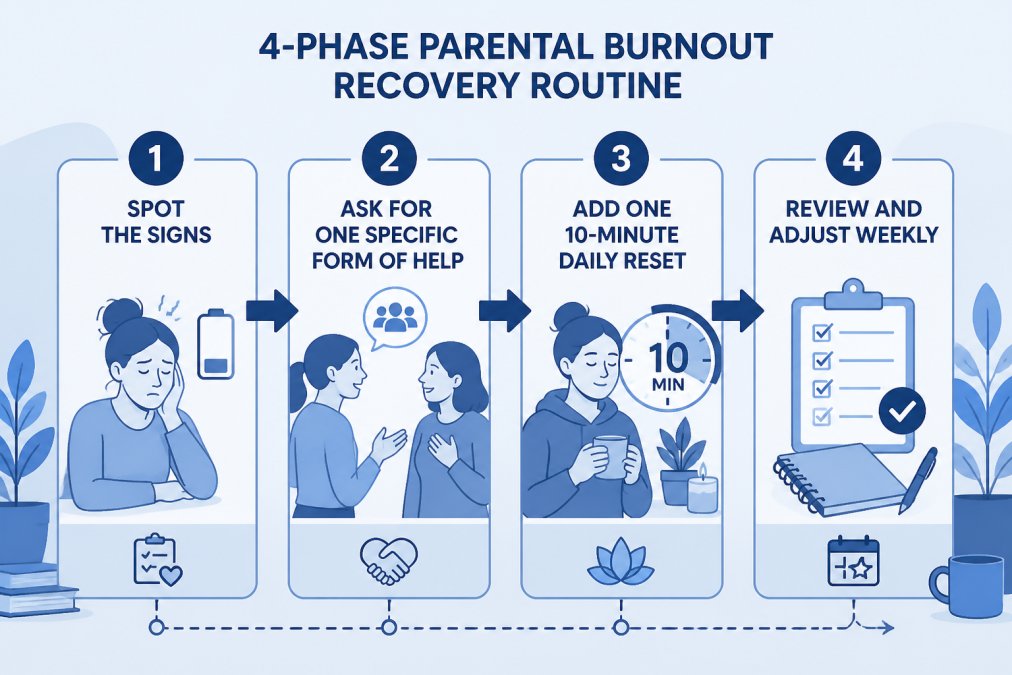
Here is the full routine:
- Spot the signs. Write down your top three burnout symptoms.
- Ask for one thing. Make one specific request this week.
- Add one reset. Pick a single 10-minute daily habit.
- Review weekly. Keep what helps, drop what doesn't.
| Phase | Action | Time Needed | How Often |
|---|---|---|---|
| 1 | Name your top 3 symptoms | 10 minutes | Once |
| 2 | Make one specific ask | 5 minutes | Weekly |
| 3 | Add one 10-minute reset | 10 minutes | Daily |
| 4 | Review and adjust | 15 minutes | Weekly |
A Low-Effort Plan by Time Available
Most advice says "take a break" without showing you where the break fits. Here is what actually helps at each time budget.
If you have 5 minutes:
- Box-breathe in the car before walking in the door
- Drink one glass of water, sitting down
- Step outside and stand in the sun
- Text one person a single honest sentence about your day
If you have 15 minutes:
- Walk around the block without your phone
- Lie down with your eyes closed, not to sleep, just to stop
- Do one small task you've been dreading, then stop
- Call a friend and talk about anything except parenting
If you have an hour:
- Hand off the kids and leave the house
- Take a nap with a real alarm set
- Do something that has nothing to do with being a parent
- Meet another parent for coffee and say the true thing out loud
The point is not to optimize. It is to pick the smallest action that fits the time you actually have.
When to Seek Professional Help
Self-help strategies are coping tools, not treatments. They help you function; they do not resolve every cause of burnout, and they cannot fix structural stressors like an unaffordable childcare market or a job with no flexibility. Recovery is not instant, and needing more support is not a personal failure.
Reach out to a doctor or licensed therapist if any of these apply:
- Symptoms have lasted several weeks and are not easing
- You feel detached from your children most days
- You are unable to function at work or at home
- You feel hopeless, numb, or like your family would be better off without you
- You are having thoughts of harming yourself or your children
If you are in crisis or having thoughts of suicide, call or text 988 to reach the Suicide & Crisis Lifeline. The Substance Abuse and Mental Health Services Administration's helpline also offers free, confidential support.
Seeing a clinician is a smart next step, not a last resort. A therapist can help you separate burnout from depression or anxiety, which often look similar and need different care.
For parents who want a gentle daily structure, our Teen Girl Glow Up Journal also gives you a way to build calm habits alongside your daughter instead of separately.
Frequently Asked Questions
How can I reduce parenting burnout when I have no time for myself?
Start with micro-habits that take under 10 minutes. A short breathing exercise before school pickup, a 5-minute journal entry after bedtime, or a solo cup of coffee before anyone wakes up all count. The goal is not a spa day; it is consistent small moments of rest. Pair one micro-habit with one practical change, like asking a partner to handle bedtime twice a week, so you get real recovery time without rearranging your entire schedule.
What are the early signs of parental burnout I should watch for?
Watch for emotional exhaustion that sleep does not fix, feeling detached from your kids, and a sense that nothing you do matters. You might snap over small things, dread the morning routine, or feel guilty constantly. Physical signs include headaches, trouble sleeping, and low energy. These parental burnout symptoms build gradually, so catching them early makes recovery faster. If they last more than a few weeks, consider talking to a doctor or therapist.
How do I ask for help without feeling like I'm failing as a parent?
Reframe asking for help as modeling healthy behavior for your kids, not admitting defeat. Be specific: instead of saying 'I need help,' try 'Can you take the kids Saturday morning so I can sleep in?' or 'Could you handle dinners Tuesday and Thursday this week?' Specific requests are easier for partners and family to say yes to. Start with one person and one task. Most parents find the guilt fades once they see how much calmer they feel.
When should a parent seek professional help for burnout?
Seek professional support if exhaustion, detachment, or feelings of hopelessness last more than two to three weeks, or if you have thoughts of harming yourself or your children. A therapist trained in cognitive behavioral therapy can help you rebuild emotional resilience and coping strategies. Your primary care doctor can also rule out thyroid issues, anemia, or depression, which share symptoms with parental burnout. Asking for professional help is a practical step, not an overreaction.
Parenting burnout does not fix itself with one good nap. It eases when you name it, ask for real help, and build small habits that fit the life you actually have. That is the whole idea behind SSBGMARKETINGINC.: simple, three-step tools that work in ten minutes, not ten hours. Our 10-Minute Manifestation Journal for Busy Moms and Teen Girl Glow Up Journal give you a daily reset you can actually keep. Get the 3-step manifestation ebook now and start your first ten-minute reset tonight.