 ultimate-guide
Overcoming Parental Burnout: 2026 Strategies That Work
Table of Contents
- Recognizing the Signs: When Exhaustion Becomes Parental Burnout
- How to Stop Feeling Overwhelmed Daily: 3 Foundational Shifts
- Mindfulness Habits for Busy Moms: Micro-Support Networks and Non-Negotiable Rest
- The Parental Burnout Recovery Timeline: What to Expect Week by Week
- 2026 Strategies for Managing the Mental Load and Digital Overload
- When Neurodivergence and Financial Barriers Change the Burnout Equation
- Preventing Relapse: Building Long-Term Resilience and Self-Compassion
- Conclusion: Moving from Survival Mode to Intentional Living
- Frequently Asked Questions
Last Updated: September 27, 2026
Recognizing the Signs: When Exhaustion Becomes Parental Burnout
Parental burnout is a state of profound physical and emotional exhaustion caused by chronic parenting stress, where a parent feels depleted, detached from their children, and doubtful of their own ability to cope. The World Health Organization recognizes it as an occupational phenomenon, and the American Psychological Association's resources on stress and burnout notes that it builds gradually rather than appearing overnight.
Watch for these signs:
- Emotional exhaustion that sleep doesn't fix
- Feeling distant or irritable with your children
- A nagging sense that you're failing as a parent
- Physical symptoms like headaches, appetite changes, or frequent illness
How to Stop Feeling Overwhelmed Daily: 3 Foundational Shifts
The fastest way to stop feeling overwhelmed daily is to stop treating overwhelm as a scheduling problem. It's usually a capacity problem, and capacity looks different depending on how your brain is wired. Three shifts do most of the work, but each one has a neurodivergent-aware version, because the standard advice often fails parents with ADHD, autism, or sensory processing differences.
- Shrink the unit of action. Instead of "get organized," pick one task that takes under 10 minutes. Completion rebuilds a sense of control faster than planning does. For parents with executive dysfunction, the barrier isn't knowing what to do, it's initiating. Pair the task with an existing habit (start the dishwasher while the coffee brews) so the cue does the initiating for you.
- Separate the urgent from the loud. Most parenting stress comes from things that feel urgent but aren't. Write them down and rank them once, in the morning, not in your head at 2 a.m. If written lists get lost, use a single whiteboard on the fridge or a phone note you actually open, the medium matters less than the one-time decision.
- Protect one input. Choose a single daily input you refuse to sacrifice, whether that's 10 minutes of quiet, a short walk, or a journal page. For sensory-sensitive parents, this often means reducing input rather than adding it: noise-canceling headphones during the dinner rush, or dimming lights in one room.
The 10-Minute Reset: A Daily Practice for Mental Clarity
The 10-minute reset works because it's small enough that you can't talk yourself out of it. Sit somewhere quiet, set a timer, and move through three steps: write down what's actually on your mind, choose the one thing that matters most today, and take three slow breaths before you stand up. The 10-Minute Manifestation Journal for Busy Moms from SSBGMARKETINGINC. is built around exactly this format.
Cognitive Reframing for the Chronically Stressed Parent
Cognitive reframing means deliberately changing the story you tell yourself about a stressful moment. When your teenager slams a door, the automatic thought might be "I'm losing her." The reframe isn't fake positivity. It's accuracy: "She's overwhelmed, and she'll come back." In practice, this means catching the thought, naming it, and replacing it with something you actually believe.
Mindfulness Habits for Busy Moms: Micro-Support Networks and Non-Negotiable Rest
Mindfulness for busy moms works best when it's measured in minutes, not hours, and when it doesn't assume a budget. The two habits that carry the most weight are a micro-support network and a non-negotiable rest window. Neither requires a lifestyle overhaul, and both can be built with zero dollars.
Building Your Micro-Support Network in 15 Minutes or Less
- List three people who could help in a pinch, no explanations needed
- Send one short message today: "Can I put you on my short list for occasional help?"
- Offer something specific back, even small, a carpool swap, a meal, an hour of childcare
- Save their numbers in one place on your phone
- Set a monthly reminder to check in
That's the whole exercise. The point isn't a big network. It's a reachable one. If you're new to an area or estranged from family, the entry point is often a school parent group, a faith community, or a neighborhood app, one message is enough to start.
The Parental Burnout Recovery Timeline: What to Expect Week by Week
The first two weeks are the hardest because rest feels unproductive.
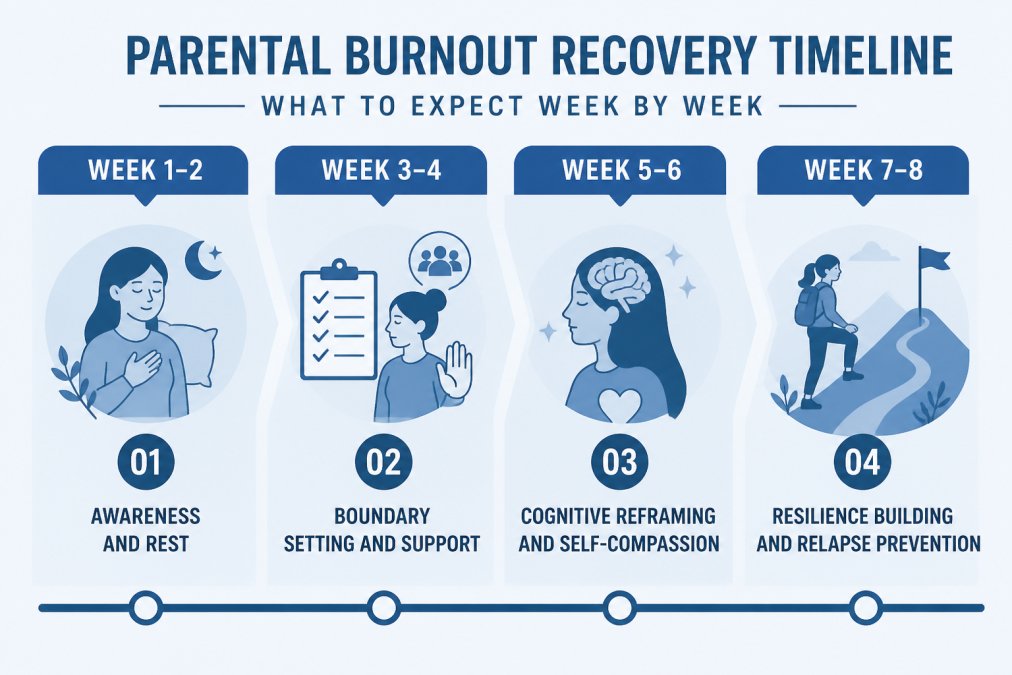
Here's the rough shape:
| Phase | Focus | What Progress Looks Like |
|---|---|---|
| Weeks 1-2 | Awareness and rest | Sleeping more, noticing triggers |
| Weeks 3-4 | Boundary setting and support | Saying no once a day, using your network |
| Weeks 5-6 | Cognitive reframing and self-compassion | Fewer guilt spirals, faster recovery from bad days |
| Weeks 7-8 | Resilience and relapse prevention | Routines hold on hard weeks |
2026 Strategies for Managing the Mental Load and Digital Overload
The mental load is the invisible work of tracking everyone's needs, and in 2026 it's compounded by digital overload, the constant low-grade pull of notifications, group chats, and school apps. Managing both means treating your attention as a resource with a budget.
Workplace Integration: Setting Boundaries That Protect Your Energy
Workplace integration means deciding in advance where work ends and home begins, then defending that line with a script. "I'm offline after 6, but I'll reply first thing" is a complete sentence. It works better than silence, and it works better than apologizing. If your workplace culture makes that impossible, that's information about the job, not about you.
When Neurodivergence and Financial Barriers Change the Burnout Equation
Two factors change the recovery math, and most guides skip both.
Get the 3-step manifestation ebook now →
Preventing Relapse: Building Long-Term Resilience and Self-Compassion
Self-compassion matters here more than most parents expect. Research on self-compassion consistently links it to lower anxiety and greater resilience, and the CDC's guidance on managing stress reinforces that ongoing stress needs ongoing management, not one-time fixes. The goal isn't never feeling overwhelmed again. It's noticing sooner and recovering faster.
Conclusion: Moving from Survival Mode to Intentional Living
The hardest part of overcoming parental burnout isn't learning the strategies. It's believing you're allowed to use them before everything else is handled. You're not.
Get started with SSBGMARKETINGINC.
Frequently Asked Questions
What are the primary signs of parental burnout?
Parental burnout shows up as emotional exhaustion, depersonalization (feeling detached from your children), and a sharp drop in parental efficacy, the sense that you are no longer effective as a parent. You may notice chronic stress, parental fatigue, and a persistent feeling of parental overwhelm that does not improve with a single good night's sleep. Unlike typical stress, these symptoms last for weeks or months and interfere with your ability to function at home or work. Recognizing these signs early is the first step toward burnout recovery.
How does parental burnout differ from general stress?
General stress is usually tied to a specific event and fades when the situation resolves. Parental burnout, by contrast, is a state of chronic stress that has overwhelmed your coping mechanisms. It brings emotional exhaustion, psychological distress, and a sense of parental identity loss that does not lift after a vacation or a quiet weekend. The World Health Organization classifies burnout as an occupational phenomenon, but researchers now apply the same framework to parenting. If you feel empty rather than just tired, that distinction matters.
How can I stop feeling overwhelmed daily as a parent?
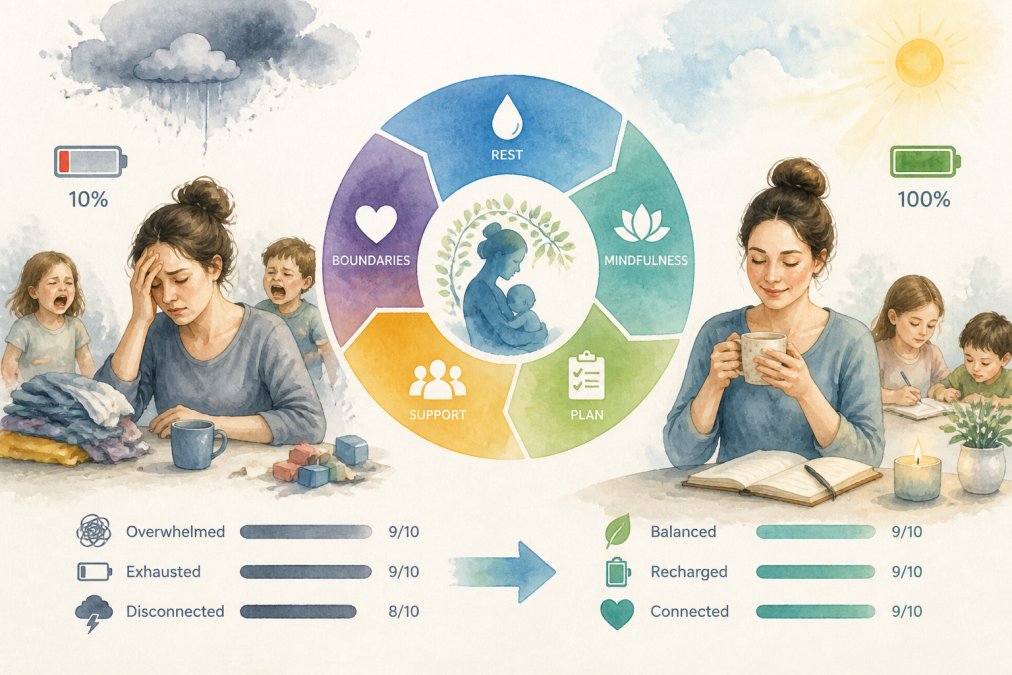
Start with three foundational shifts: reduce the mental load by writing down everything competing for your attention, then eliminate or delegate at least one item; practice a 10-minute mindfulness habit such as a gratitude journal or a short breathing exercise; and set one non-negotiable boundary each week, like no work emails after 8 PM. These small, evidence-based strategies build emotional regulation over time. The goal is not to do more but to create micro-support networks and non-negotiable rest that protect your well-being.
What is the 42% rule for burnout?
The 42% rule is a popular framework suggesting that when your stress level consistently exceeds 42% of your capacity to cope, you enter the burnout zone. While the exact percentage is not a clinical diagnostic tool, the underlying principle is useful: burnout happens when demands outpace your resources for too long. Track your energy daily on a simple 1-10 scale. If you are running at a 7 or higher for more than two weeks, that is a signal to implement preventative measures like boundary setting, rest, and professional support.
What is the 7-7-7 rule for parenting stress management?
The 7-7-7 rule is a simple stress management framework: aim for 7 hours of sleep, 7 minutes of mindfulness or quiet reflection, and 7 minutes of meaningful connection with your child each day. It is not a clinical prescription but a practical checklist for busy parents. The sleep component addresses parental fatigue, the mindfulness piece supports emotional regulation, and the connection time strengthens the parent-child relationship. Small, consistent habits like these are more sustainable than overhauling your entire routine at once.
When should a parent seek professional help for burnout?
Seek professional help if burnout symptoms persist for more than a few weeks, if you experience persistent sadness, anxiety, or intrusive thoughts, or if you are relying on alcohol, substances, or other unhealthy coping mechanisms to get through the day. A therapist or counselor can provide evidence-based strategies such as cognitive behavioral therapy, which is effective for chronic stress and burnout recovery. If you have thoughts of harming yourself or your child, contact the 988 Suicide and Crisis Lifeline immediately. Asking for help is a sign of resilience, not failure.
How long does parental burnout recovery take?
Parental burnout recovery is not linear. Full recovery depends on the severity of burnout, your support network, and whether underlying issues like neurodivergence or financial barriers are addressed.
What are effective 2026 strategies for managing mental clutter?
Effective strategies for managing mental clutter in 2026 include a daily brain dump (writing every task and worry on paper for 5 minutes), digital boundaries such as turning off non-essential notifications and scheduling social media use, and the two-minute rule, where you handle anything that takes less than two minutes immediately. These methods reduce the cognitive load that fuels parental overwhelm. Pair them with a weekly review to reset your priorities. The goal is not a perfectly organized mind but a calmer, more intentional one.