 ultimate-guide
How to Connect With Your Teenager: A Practical Guide
Last Updated: October 30, 2026
Quick Summary
To connect with teenager, stop trying to be the perfect parent and start being a present one, building connection through small repeatable habits rather than grand gestures. Ask one open-ended question and then stay silent, and talk side-by-side during car rides or chores instead of face-to-face. Validate feelings before offering advice, and keep showing up in ordinary moments without demanding a reward.
- Teens often open up sideways during car rides, while folding laundry, or late at night.
- Use the one question, one exit rule so questions feel like offers, not interrogations.
- Jumping straight to advice is the most common way parents lose a teen mid-sentence.
- Apologize specifically for your part, such as raising your voice, to rebuild trust.
- If shut-down lasts more than two or three weeks with withdrawal, involve a professional.
Table of Contents
- Why Connection With Your Teenager Takes Intention, Not Perfection
- How to Get Your Teenager to Open Up Without Forcing It
- Parent-Teen Communication Tips That Lower the Temperature
- Activities to Do With Teenagers That Spark Real Conversation
- How to Build Trust With Your Teenager Over Time
- Connecting With Teens Who Have Different Needs or Communication Styles
- When to Bring in Extra Support for Your Teen
- Start Your 3-Step Connection Reset This Week
- Frequently Asked Questions
Why Connection With Your Teenager Takes Intention, Not Perfection
Most parents learn how to connect with teenager the hard way: by getting it wrong first. The slammed door, the one-word answers, the silence at dinner. None of that means the relationship is broken. It means the old script stopped working.
At SSBGMARKETINGINC., we work with busy moms who want a real relationship with their teen, not a performance of one. The shift starts when you stop trying to be the perfect parent and start being a present one. American Psychological Association guidance on adolescent development describes this stage as one where teens push for autonomy while still needing a secure base.
Connection isn't a personality trait some parents have and others don't. It's a set of small, repeatable habits. The parents who feel close to their teens aren't doing anything magical; they're showing up in ordinary moments, again and again, without demanding a reward.
If you're running on empty, start there. Simple ways to reduce parenting burnout fast can free up the energy connection actually requires.
How to Get Your Teenager to Open Up Without Forcing It
Teens talk when they feel safe, not when they're cornered. The fastest way to shut down a conversation is to demand one.
A common mistake is treating every exchange as a debrief. "How was school?" gets a grunt because it's a status report, not an invitation. Instead, ask fewer questions and make them count. One open-ended question, then silence, works better than five rapid-fire ones.
Here's what most guides miss: teens often open up sideways, during a car ride, while folding laundry, or late at night. Face-to-face pressure feels like an interview. Side-by-side conversation feels like company.
Try this sequence:
- Pick a low-stakes moment, not a sit-down "talk."
- Ask one open question about something they care about.
- Listen without planning your response.
- Resist the urge to fix, criticize, or lecture.
What to Do When Your Teen Refuses to Talk
Say less and stay available.
Don't chase. Name the door as open and walk away: "I'm around if you want to talk, no pressure." Then mean it.
But persistent silence deserves a plan, not just patience.
Third, use the "one question, one exit" rule. Ask a single open question and give them a clear way out: "How's the project going?
Fourth, keep a low-stakes ritual on the calendar. A weekly drive to practice, a Sunday bagel run, a dog walk at the same time each week.
Fifth, watch your own reaction. If your teen senses that silence makes you anxious, they may avoid you to avoid managing your feelings.
Finally, don't measure success by whether they talked today. Measure it by whether they still come to the kitchen when you're cooking, still text you a meme, still let you drive them to practice. Those small acceptances are the relationship staying open. The conversation usually follows.
Parent-Teen Communication Tips That Lower the Temperature
De-escalation is a skill, and it follows a predictable sequence. When a conversation heats up, most parents speed up. Do the opposite.
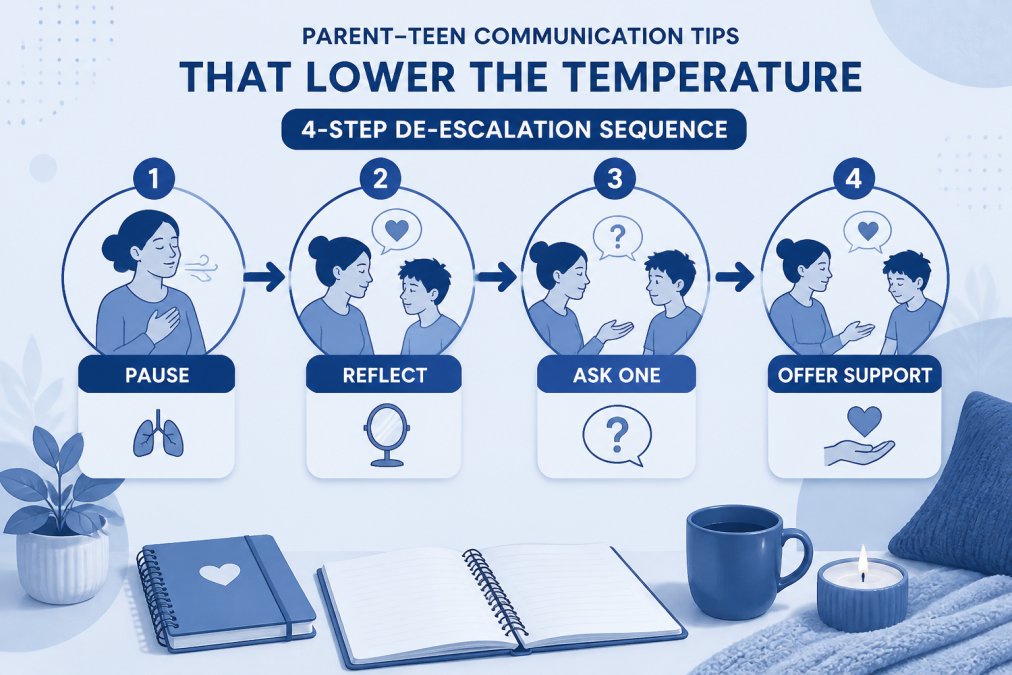
The four moves are simple: pause and breathe, reflect the feeling back, ask one open question, and offer support only if invited. "That sounds really frustrating" often defuses tension better than "Well, have you tried...". Validation isn't agreement; it's proof you heard them.
Watch out: jumping straight to advice is the single most common way parents lose a teen mid-sentence. Advice lands only after the feeling is acknowledged.
Repairing Conflict and Rebuilding Trust After a Blowup
Repair matters more than avoiding conflict. Every family fights; the ones that stay close are the ones that come back together afterward.
Apologize for your part specifically, not vaguely. "I raised my voice and that wasn't fair" rebuilds more trust than "I'm sorry we fought." Then let them have their version of events without correcting it. Trust rebuilds through consistency: same calm response, same follow-through, week after week. Search Institute research on developmental relationships frames this as the everyday interactions that make a young person feel seen and supported.
Activities to Do With Teenagers That Spark Real Conversation
Shared activities beat face-to-face interrogations every time. The best conversations happen while hands are busy and eyes are elsewhere.
Cooking together, walking the dog, driving to practice, working on a project: these side-by-side moments lower the pressure. Follow their lead on what to do. If your teen loves a show, a game, or a hobby, join it on their terms, even if it's not your thing.
Get the 3-step manifestation ebook now →
For structured ideas, our guide on how to practice mindfulness with teenagers in 7 steps gives you concrete activities to try together. Parents of daughters may also like these mindfulness activities for teen daughters built for shared practice.
How to Build Trust With Your Teenager Over Time
Trust is built in small deposits and withdrawn in big ones. There's no shortcut, and that's actually good news: it means ordinary consistency is enough.
Keep your word on small things. Respect their privacy unless safety is at stake. Let them make low-stakes decisions and live with the results. When they take a risk and tell you about it, reward the honesty instead of punishing the disclosure, or you'll teach them to hide.
Encouragement goes further than correction. Notice what they do well out loud, and be approachable when they get it wrong. A teen who trusts you will bring you the hard stuff, eventually.
Connecting With Teens Who Have Different Needs or Communication Styles
Not every teen connects through conversation, and that's not a failure. Some need quieter, more indirect routes to feeling close.
Here is how to adapt the core moves to different needs.
For a teen with social anxiety: face-to-face conversation can feel like a performance. Lower the audience.
For a neurodivergent teen (autism, ADHD, or sensory differences): be literal and specific.
For a teen showing signs of depression: connection may look like presence rather than conversation.
For a teen with a disability or chronic illness: follow their lead on what feels accessible and dignified.
For cultural or language differences: don't assume silence means disengagement.
If your teen struggles with self-worth, connection and confidence grow together. Our guide to building teen self-esteem goes deeper on the parent's role in that process.
When to Bring in Extra Support for Your Teen
Some struggles need more than a parent's best efforts, and recognizing that is strength, not surrender. Persistent withdrawal, dropping grades, loss of interest in friends, sleep changes, or talk of hopelessness are signals to involve a professional.
Start with your pediatrician or school counselor, who can point you toward appropriate care. National Institute of Mental Health information on teen mental health outlines warning signs worth taking seriously. You don't have to diagnose anything yourself; you just have to notice and act.
If you're carrying guilt about needing help, non-judgmental parenting support resources for moms can lighten that load while you find the right support for your teen.
Start Your 3-Step Connection Reset This Week
Connection doesn't require a overhaul of your parenting. It requires three small, repeatable moves you can start today.
| Step | What You Do | When | Why It Works |
|---|---|---|---|
| 1. Listen first | One open question, then silence | Daily, 10 minutes | Lowers defensiveness |
| 2. Validate | Reflect the feeling back | During conflict | Builds feeling heard |
| 3. Show up | Side-by-side activity, no agenda | Weekly | Builds trust over time |
Pick one step and practice it for a week before adding the next. Small and consistent beats big and sporadic.
The hardest part of connecting with a teenager isn't knowing what to do; it's finding the calm and energy to do it while everything else competes for your attention. That's where we come in.
Frequently Asked Questions
How do I get my teenager to open up to me?
Stop asking direct questions in face-to-face settings. Teens tend to talk more during side-by-side activities like driving, walking, or cooking, when eye contact feels less like an interrogation. Ask one open-ended question, then stay quiet longer than feels comfortable. If your teen gives a one-word answer, let it go and try again another day. Consistency matters more than any single conversation. Many parents find that a short daily check-in, even five minutes, builds the habit of talking over weeks rather than forcing a breakthrough in one sitting.
What are simple ways to spend quality time with a teenager?
Pick activities that already fit your week instead of adding a big event. Car rides to school, walking the dog, cooking dinner together, or running errands side by side all create natural conversation windows. Let your teen choose the activity sometimes, even if it is not your favorite. Shared interests, whether that is a show, a game, or a hobby, give you something to return to regularly. The goal is repeated low-pressure time together, not one perfect outing.
How can I communicate with my teenager without arguing?
Lead with understanding before advice. Reflect back what you heard, validate the feeling, and ask whether your teen wants help solving it or just wants to vent. Avoid jumping in to fix, criticize, or lecture, since those responses shut down conversation fast. Keep your questions fewer and more open-ended. When conflict does happen, repair it afterward by naming what went wrong and apologizing for your part. Teens notice when parents own mistakes, and that repair builds trust for the next hard conversation.
What should I do when my teen refuses to talk?
Respect the silence first. Say something like, I am here when you are ready, and then leave the door open without pressing. Some teens need hours or days to process before they can talk. Try a side-by-side activity instead of a face-to-face sit-down, since that setting feels less confrontational. If the refusal lasts weeks and comes with withdrawal from friends, sleep changes, or dropping grades, that is a signal to seek additional support from a school counselor or pediatrician rather than waiting it out.
How do I build trust with my teenager?
Trust comes from small, repeated actions rather than one big conversation. Keep promises, follow through on what you say, and avoid reacting with criticism when your teen shares something difficult. Respect growing independence by letting your teen make age-appropriate decisions and live with the outcome. When you do need to set a boundary, explain the reason instead of just issuing a rule. Teens are more likely to trust a parent who treats them as a person learning to handle more responsibility, not a child to be managed.
How can I connect with my 14-year-old son?
Boys at 14 often talk more easily while doing something active than sitting across a table. Try shooting hoops, working on a project, or driving together, and let the conversation start naturally. Take a genuine interest in his hobbies even if you do not share them, and ask him to teach you something. Keep questions short and avoid turning every chat into a lecture. If he is not talking much, stay steady and available rather than pulling back, since many teen boys open up in short bursts at unexpected times.