 ultimate-guide
Daily Habits for Intentional Parenting: A Practical Guide
Last Updated: November 12, 2026
Quick Summary
Intentional parenting means making deliberate, purposeful choices about how you respond to your child instead of running on autopilot. The most workable plan uses three anchor points: ten minutes in the morning, a connection window after school or during dinner, and five minutes at bedtime. These small, repeatable habits build connection without extra hours.
- Ten minutes of undivided attention before the day splinters off does more than an hour of distracted time later.
- The after-school window is where most families lose connection to logistics, so try a five-minute first-thing ritual before homework.
- Bedtime is the natural repair window: five minutes, lights low, and one sentence of apology.
- Attach new habits to existing transitions so they do not depend on memory or willpower.
- Track consistency, not streaks, because missing a day is data, not failure.
Table of Contents
- What Intentional Parenting Actually Looks Like Day to Day
- A Time-Based Daily Plan for Busy Parents
- Intentional Parenting Examples You Can Copy Tonight
- Daily Parenting Routines That Build Connection Without Extra Hours
- Age-Specific Adaptations: Tweens, Teens, and Big Feelings
- Using an Intentional Parenting Journal to Track What Works
- Repair After Conflict: What to Do When You Lose Your Cool
- Finding a Practical Intentional Parenting PDF and Measuring Progress Without Perfectionism
- Frequently Asked Questions
What Intentional Parenting Actually Looks Like Day to Day
Intentional parenting means making deliberate, purposeful choices about how you respond to your child instead of running on autopilot. The daily habits are small and repeatable: a ten-minute morning check-in, undivided attention after school, a repair conversation at bedtime.
The gap between wanting to parent with purpose and actually doing it comes down to routine.
Purposeful Choices vs. Autopilot Reactions
Autopilot looks like snapping at a child over shoes in the doorway. Purposeful parenting looks like pausing for three seconds and naming what you see: "Shoes on, then we go." The difference is not temperament.
A common mistake is treating intentional parenting as a personality trait you either have or don't. It is a set of habits, and habits respond to repetition, not resolve.
A Time-Based Daily Plan for Busy Parents
The most workable intentional parenting plan uses three anchor points rather than an all-day overhaul. Ten minutes in the morning, a connection window after school or during dinner, and five minutes at bedtime. Everything else in the day can be ordinary.
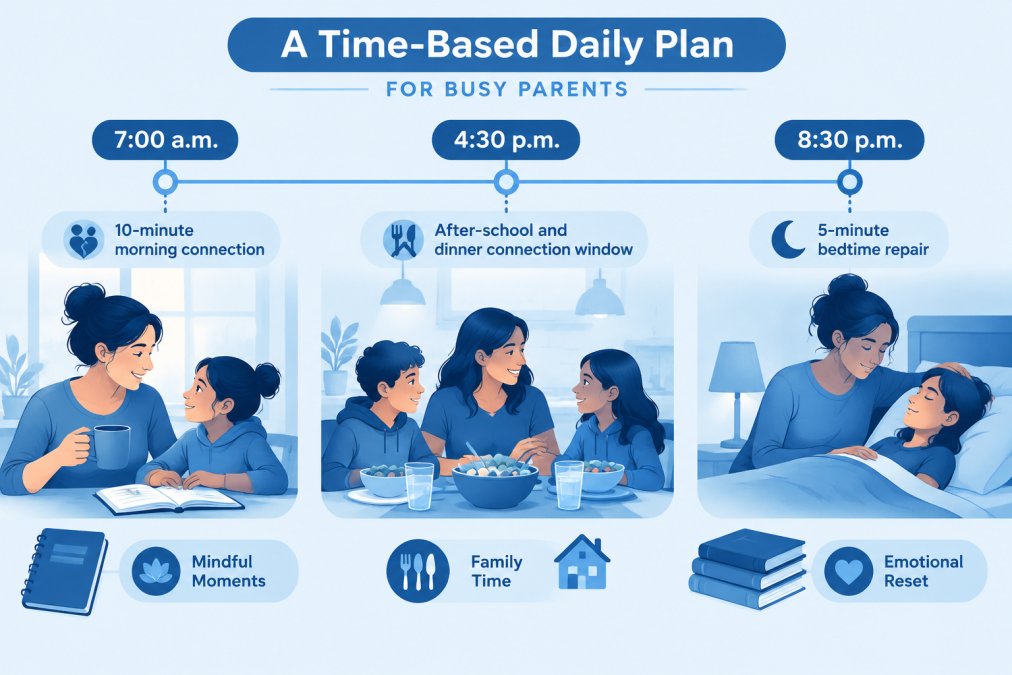
Morning: Ten Minutes That Set the Tone
Ten minutes of undivided attention before the day splinters off does more for the relationship than an hour of distracted time later. Sit with your coffee and your child, no phone, and ask one specific question. If mornings are chaos, ten minutes still resets the tone. A simple morning routine for moms can walk you through a ten-minute version you can start tomorrow.
After School and Dinner: The Connection Window
The after-school window is where most families lose connection to logistics. Try a five-minute "first thing" ritual: before homework, before chores, sit down together and let your child lead the conversation. Following the child's lead signals that their day matters. Cooking, folding laundry, and packing lunches can become shared activities rather than tasks that pull you apart.
Bedtime: Closing the Day With Repair
Bedtime is the natural repair window. Five minutes, lights low, one sentence: "I'm sorry I was short at breakfast." Children learn emotional regulation by watching how adults come back after a mistake.
Intentional Parenting Examples You Can Copy Tonight
Concrete intentional parenting examples beat abstract advice every time. Pick one of these and use it tonight:
- Name the feeling before correcting the behavior: "You're frustrated. Let's figure out the shoes."
- Give one instruction at a time instead of a list of four.
- Ask "What would you do differently next time?" instead of "Why did you do that?"
Each of these takes under a minute and builds the relational home your child returns to.
Daily Parenting Routines That Build Connection Without Extra Hours
Daily parenting routines only work when they attach to something you already do. Attach the habit to an existing transition, and let the transition itself become the cue.
The mechanism is habit stacking: an existing behavior (walking in the door, turning off screens, sitting down to dinner) becomes the trigger for a new, tiny behavior.
Rituals for Everyday Transitions
Transitions are where behavior problems cluster: leaving the house, coming home, screens off, bedtime. A short ritual makes each one predictable. Predictability lowers anxiety for children and reduces the friction that drains parents.
| Transition | Ritual | Time Needed | Why It Works |
|---|---|---|---|
| Morning departure | One specific question at breakfast | 10 minutes | Sets tone before the day splinters |
| School pickup | Same greeting every day | 1 minute | Signals the child is seen first, before logistics |
| Screens off | Two-sentence countdown | 2 minutes | Gives the brain a runway out of a high-stimulation task |
| Dinner | Each person names one thing about their day | 5 minutes | Builds a shared ritual without requiring a long conversation |
| Bedtime | Repair sentence and lights low | 5 minutes | Closes the day with connection rather than correction |
Time Needed
The After-School Window: The Highest-Leverage Ten Minutes
Most families lose connection to logistics in the first ten minutes after school. Backpacks, snacks, homework, and screens compete for attention, and the child's day goes unacknowledged. A five-minute "first thing" ritual, before homework, before chores, reverses that. Sit down together and let the child lead the conversation.
Watch out: if the after-school ritual becomes a homework interrogation, children learn to avoid it. Keep the first five minutes free of questions about assignments, grades, or behavior.
The Dinner Routine: One Question, Not a Debrief
The dinner ritual works best when it is small and predictable. One question per person, "What was one thing that happened today?", is enough. The goal is a reliable daily touchpoint, not a deep conversation every night. Families with limited time can use the same question at the table, in the car, or during cleanup.
The Bedtime Routine: Repair and Close
Bedtime is the natural repair window because the day is over and the child is winding down. Five minutes, lights low, one sentence: "I'm sorry I was short at breakfast." Children learn emotional regulation by watching how adults come back after a mistake. The routine does not require a perfect day, it requires a consistent close.
Making Routines Survive a Bad Week
The realistic test of any routine is whether it survives a bad week. Three adjustments keep routines alive when time and energy are short:
- Shrink the habit rather than skip it. A one-minute version of the morning check-in still counts.
- Keep the anchor, drop the extras. If dinner conversation is impossible, keep the pickup greeting.
- Track consistency, not streaks. Missing a day is data, not failure.
If you want a structured starting point, our 10-minute habit reset guide for busy moms is built for exactly that kind of restart.
Age-Specific Adaptations: Tweens, Teens, and Big Feelings
The habits stay the same; the delivery changes with the child's developmental stage. A ten-minute morning check-in looks different for a three-year-old than for a fifteen-year-old, and the most common reason intentional parenting habits fail is that parents keep using a script their child has outgrown. Use the stage guide below to adjust warmth, choice, and boundaries without abandoning the three anchor points.
Toddlers and Preschoolers (Ages 1-4): Repetition and Naming
At this stage, intentional parenting is mostly about predictability and language. Children this age are building emotional vocabulary faster than they can regulate, so the adult supplies both the routine and the words.
- Morning: narrate the sequence out loud, "Shoes, then coat, then car", rather than issuing a list. Two-step instructions match attention span.
- Connection window: get on the floor for five minutes of child-led play. Following their lead is the whole intervention.
- Bedtime: name one feeling from the day in one sentence: "You were frustrated when the tower fell." Keep repair simple and physical, a hug and a short sentence.
School-Age Children (Ages 5-11): Choice and Contribution
This is the stage where responsibility habits take root, and where children start wanting to be competent rather than merely comforted.
- Morning: offer two acceptable choices ("Blue shirt or green shirt?") instead of an open question. Choice within boundaries reduces friction without handing over control.
- Connection window: use the after-school five minutes before homework, and let the child pick the topic. Ask one specific question ("What was the best part of recess?") rather than "How was school?"
- Bedtime: add a two-prompt reflection, one thing they handled well, one thing they want to try differently tomorrow. This is the age where a short journal entry can work if the child is willing.
Tweens (Ages 12-14): Consultation and Privacy
Tweens need to be consulted and need their privacy respected, often at the same time. The habit that matters most here is asking before advising.
- Morning: replace the check-in question with a statement of availability, "I'm around if you want to talk before school", and then let them come to you.
- Connection window: shared activity beats face-to-face conversation. Cooking, driving, or a project side by side lowers the pressure to make eye contact.
- Bedtime: keep the repair sentence short and non-interrogating. "I was short earlier, that was mine" lands better than a full debrief.
Teens (Ages 15-18): Sideways Connection and Respected Privacy
With teens, undivided attention often means silence you do not rush to fill. Connection is frequently offered sideways, in the car, on a walk, during a shared task, rather than face to face.
- Morning: a brief, low-demand greeting. Teens often need the first hour of the day to be low-conversation.
- Connection window: the car is the most reliable connection window most families have. Keep the radio low, ask one open question, and resist the urge to turn the answer into a lesson.
- Bedtime: repair still matters, but teens may prefer a text or a note to a spoken conversation. Meet them in the medium they use.
For parents navigating that shift, a guide on how to connect with your teenager goes deeper into practical scripts and timing.
Neurodivergent Children and Big Feelings
For children with ADHD, autism, or sensory processing differences, the same three anchor points apply but the load has to drop. Shorter windows, visual schedules, and fewer words are the standard adjustments most practitioners recommend. A five-minute connection window that actually happens beats a twenty-minute one that gets skipped. If a child is in a meltdown, the repair conversation waits until the nervous system is settled, usually twenty to thirty minutes later, not in the moment.
A Quick Stage-Adjustment Table
| Stage | Morning habit | Connection window | Bedtime repair |
|---|---|---|---|
| Toddler (1-4) | Narrate two-step sequence | 5 min child-led play | Name one feeling |
| School-age (5-11) | Offer two choices | 5 min before homework | Two-prompt reflection |
| Tween (12-14) | State availability | Shared activity | Short, non-interrogating |
| Teen (15-18) | Low-demand greeting | Car or walk | Note or text if preferred |
The habits do not change. The delivery does. When a habit stops working, the first question is usually not "What am I doing wrong?" but "Is this still the right version for this age?"
Using an Intentional Parenting Journal to Track What Works
An intentional parenting journal is a short daily record of what you tried and what happened, kept to one or two lines. It is not a diary or a performance review. The point is pattern recognition: after two weeks you can see which habits actually shifted your household's mood.
Keep it to three prompts: what I tried, what worked, what I'll repeat. A minimalist tracker fits busy schedules better than a detailed log, and minimalist habit tracking ideas for busy moms can show how to set one up without it becoming another chore.
Repair After Conflict: What to Do When You Lose Your Cool
Repair matters more than perfection. Every parent loses their cool. What children remember is whether the adult came back, named it, and reconnected. The four-step repair:
- Name it without excuses: "I yelled."
- Take responsibility: "That was mine to manage, not yours."
- State the repair: "I'm going to take a breath next time."
- Reconnect physically or with humor, if your child welcomes it.
If you are running on empty and repair feels impossible, start with recovery. Our guide on simple ways to reduce parenting burnout fast covers small resets that make repair possible.
Finding a Practical Intentional Parenting PDF and Measuring Progress Without Perfectionism
A practical intentional parenting PDF should be short enough to use on a hard day.
Measuring progress without perfectionism means tracking consistency, not streaks. Count how many days you hit one anchor point, not whether you hit all three.
Intentional parenting is not a personality you are born with.
Frequently Asked Questions
What are daily habits for intentional parenting?
Daily habits for intentional parenting are small, repeatable actions that keep you present and deliberate instead of reactive. Examples include a 10-minute morning check-in, one screen-free conversation at dinner, a bedtime repair ritual, and a two-minute journal note about what went well. The habits work because they are short and tied to moments you already have, like school pickup or lights-out, so they survive busy weeks. Aim for two or three habits you can repeat consistently rather than a long list you abandon by Thursday.
What are some examples of intentional parenting in real life?
Practical intentional parenting examples include narrating your own choices out loud ("I'm frustrated, so I'm taking a breath before I answer"), giving undivided attention for ten minutes with your phone in another room, asking your child's opinion before deciding a family rule, and using everyday tasks like folding laundry or packing lunches as conversation time. Another example is following your child's lead in play or conversation instead of steering it. Each one replaces an autopilot reaction with a purposeful choice, and none requires extra hours in the day.
What is the 7-7-7 rule for parenting?
The 7-7-7 rule is a popular social media framework suggesting seven minutes of connection, seven minutes of play, and seven minutes of conversation with your child each day. It is a useful reminder that connection can be brief, but it is not a research-backed standard and the exact structure varies by source. Treat it as one option among many. A single ten-minute block of undivided attention, done consistently, delivers the same core benefit: predictable, focused time with you.
How can I be a more intentional parent when life feels busy?
Anchor habits to transitions you already have rather than adding new blocks to your calendar. The drive to school, the first five minutes after work, dinner, and bedtime are free real estate. Pick one anchor and attach a single habit: a question in the car, phones away at dinner, or a two-sentence bedtime recap. Keep it under ten minutes so it survives a bad week. An intentional parenting journal helps here, because writing down what worked takes two minutes and shows you which habits are actually sticking.
How do I repair with my child after I lose my cool?
Repair works best when it is specific and short. Name what happened without excuses ("I raised my voice at you about the dishes"), name the impact ("that probably felt unfair"), and state what you will do differently ("next time I'll take a minute before I respond"). Skip asking your child to reassure you. Do it within the same day when possible, and keep it to under a minute for younger kids. Repair after conflict is one of the strongest modeling moments you get, because it shows your child that mistakes are fixable.
What should an intentional parenting PDF or journal include?
A useful intentional parenting PDF or journal should include a short daily prompt (what went well, one thing to try tomorrow), a place to note your child's current interests so you can follow their lead, and a simple repair script you can reference after a hard moment. Keep it to one page per day or less. The format matters less than the habit of a two-minute nightly review. Digital journals work well for busy parents because they live on the phone you already check,
How do I measure progress without aiming for perfection?
Track consistency, not perfection. At the end of each week, count how many days you hit your chosen habit out of seven, and note one moment of connection you remember. Three or four days out of seven is a real win in a busy household. Look for direction of change over a month rather than daily scores, and drop any habit that has not survived two weeks, because a habit that does not fit your schedule is not a character failure.