 how-to
Simple Morning Routine for Moms: 10-Minute Guide
Table of Contents
- Why a Simple Morning Routine for Moms Changes Everything
- How to Wake Up Before Your Kids (Without Exhausting Yourself)
- Your 10 Minute Morning Routine, Step by Step
- Morning Self-Care for Moms That Fits Real Life
- Prep the Night Before So Mornings Run Themselves
- Routines for Working Moms, Stay-at-Home Moms, and Neurodivergent Moms
- Common Mistakes That Break Your Morning Routine
- Frequently Asked Questions
Last Updated: September 20, 2026
Why a Simple Morning Routine for Moms Changes Everything
A simple morning routine for moms is a short, repeatable set of actions you do right after waking, designed to protect your energy before the day's demands begin. It works because it gives you one calm pocket of control. This guide from SSBGMARKETINGINC. breaks the whole thing down into ten usable minutes.
How to Wake Up Before Your Kids (Without Exhausting Yourself)
Waking up before your kids works only if you protect your sleep first. Shift your bedtime earlier in small steps, and set one alarm you intend to keep. A wake-up time you can't sustain is worse than no plan at all.
Pick a Wake-Up Time You Can Actually Keep
Choose a time you can hit five days out of seven, not your ideal time. Most moms try to jump straight to 5:00 a.m. and quit by Thursday.
Try this instead:
- Move your alarm back by 15 minutes every few days
- Keep the same wake time on weekends, within an hour
- Pair the alarm with a reason you care about, like quiet coffee
Make Getting Out of Bed Easier
The gap between hearing the alarm and standing up is where most routines die. Close that gap with preparation, not willpower.
- Put your alarm across the room
- Set out your water glass the night before
- Keep a robe or slippers within reach
- Skip the phone for the first few minutes
Your 10 Minute Morning Routine, Step by Step
The 10 minute morning routine below has three blocks: hydrate and breathe, journal or set one intention, then stretch and handle one prep task. Ten minutes total. No app required.
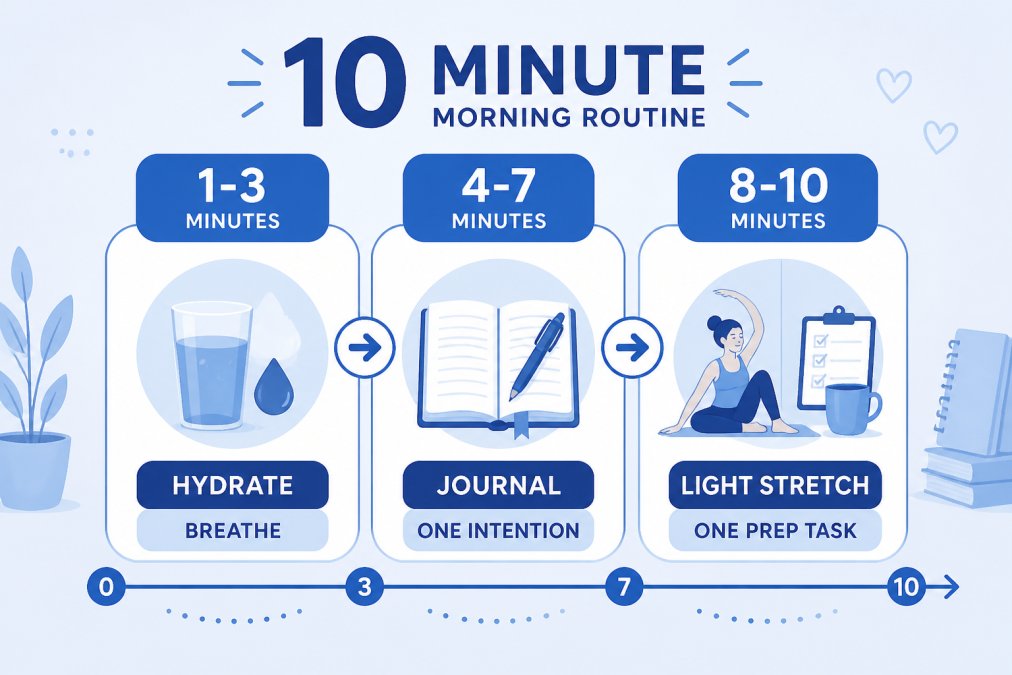
Here's the full sequence:
| Minutes | Action | Why It Works |
|---|---|---|
| 1-3 | Drink water, slow breathing | Wakes up your body and calms your mind |
| 4-7 | Journal or set one intention | Gives the day a single clear focus |
| 8-10 | Light stretch, one prep task | Loosens your body, removes one future stress |
Minutes 1-3: Hydrate and Breathe
Drink a full glass of water before you do anything else. Dehydration mimics tiredness, so you'll feel sluggish until you drink.
Minutes 4-7: Journal or Set One Intention
Write down one thing you're grateful for and one thing you want from the day. One line each is enough.
Minutes 8-10: Light Stretch and One Prep Task
Stretch whatever feels tight, then knock out one small task. Fill water bottles. Set out backpacks. Start the coffee.
Morning Self-Care for Moms That Fits Real Life
Morning self-care for moms means habits short enough to survive a bad night's sleep. Meditation, journaling, and stretching all count. So does sitting quietly with your coffee. The difference between self-care that sticks and self-care that becomes another chore is whether it costs you money, decisions, or willpower. The version below costs none of the three.
The Zero-Cost Self-Care Stack
Every item here uses something you already own. No app subscription, no new journal, no gym membership.
- Hydration: water before coffee, every time. Keep a glass by the sink the night before so you don't have to think about it.
- Mindfulness: two minutes of slow breathing. In through the nose for a count of four, out through the mouth for a count of six. That longer exhale is what signals your nervous system to settle.
- Journaling: one gratitude line, one intention. A spiral notebook from the grocery store works as well as a bound journal.
- Movement: a short stretch, not a full workout. Reach for the ceiling, roll your shoulders, touch your toes. Sixty seconds is enough to shake off sleep stiffness.
- Quiet: a few phone-free minutes. This is the one most moms skip, and it's the one that protects the rest.
Why 'Phone-Free' Is the Real Self-Care
The first thing most moms touch in the morning is a phone, not a water glass. That single habit undoes the calm the rest of the routine is trying to build. A common pattern is: you open one app to check the weather, and twenty minutes later you've read three news stories and two group chats, and the kids are awake.
Get the 3-step manifestation ebook now →
The 'Attach, Don't Add' Rule
If you want a structured way to journal without overthinking it, SSBGMARKETINGINC. built its 10-Minute Manifestation Journal for Busy Moms around exactly this kind of short daily practice: gratitude, visualization, done.
Prep the Night Before So Mornings Run Themselves
Night-before prep removes decisions from your morning. Set out clothes, pack bags, and write tomorrow's one intention before bed. Ten minutes at night buys you a calmer morning.
Evening prep checklist:
- Set out clothes for you and the kids
- Pack bags, lunches, and paperwork
- Fill water bottles and set out the coffee
- Write tomorrow's one intention
- Put your alarm across the room
- Charge your phone outside the bedroom
Routines for Working Moms, Stay-at-Home Moms, and Neurodivergent Moms
One routine can't fit every mom, so adjust the shape of it. Working moms usually need the earliest, tightest version. Stay-at-home moms often have more flexibility but less separation between roles. Neurodivergent moms need routines built for how their brains actually work. Most guides stop there and hand everyone the same ten-minute list. Here's what actually changes for each group.
Working Moms: Protect the First Ten Minutes Like a Meeting
If you leave the house, your morning has a hard deadline. Front-load prep the night before so your ten minutes are quiet and non-negotiable before anyone else wakes.
- Set two alarms: one to wake you, one five minutes before you need to be out the door. The second one is your buffer, not your snooze.
- Lay out your own clothes, not just the kids'. Moms routinely prep everyone but themselves.
- Keep a 'launch pad' by the door: keys, badge, bag, water bottle. One spot, every night.
- If you commute, use the first five minutes of the drive as your quiet block instead of the kitchen. Same habit, different room.
Stay-at-Home Moms: Build a Boundary, Not a Schedule
Without a commute, the day blurs. The problem isn't time, it's the absence of a transition. Anchor your ten minutes to a fixed cue, like right after you pour your first coffee, and treat that cue as a wall.
- Pick one physical signal that the routine has started: the coffee mug, the kitchen chair, the back step.
- Don't fold the routine into chores. If your 'self-care' is unloading the dishwasher, it isn't self-care.
- Use nap time for the harder tasks, not for the routine. The routine belongs at the start of the day, not in the middle.
Neurodivergent Moms: Design for Your Brain, Not Against It
Most morning-routine advice assumes a neurotypical brain that responds to alarms, timers, and streaks. If you have ADHD or you're raising a sensory-sensitive household, that advice often backfires. Rigid timers create pressure, and pressure creates avoidance. Here's what tends to work instead.
- Replace timers with sequences. Instead of 'three minutes of journaling,' use 'water, then journal, then stretch.' Order does the work that a clock can't.
- Use a visible checklist. A sticky note on the bathroom mirror beats an app you'll forget to open. Checking a box gives a small dopamine hit that helps you move to the next step.
- Allow sameness. Repeating the same three steps every day isn't boring, it's the point. Novelty is what makes a routine expensive for an ADHD brain.
- Plan for sensory needs. If the sound of the blender sets off your morning, prep smoothie ingredients the night before and blend after the kids are up, or skip the blender entirely.
- Build in a reset, not a streak. Missing a day isn't failure. The goal is to return the next morning, not to preserve a perfect record.
- Lower the activation cost. If getting out of bed is the hardest step, put your water glass and slippers within arm's reach. The fewer decisions between 'awake' and 'up,' the better.
Single Parents and Tight Budgets
If you're doing the morning alone, the ten-minute routine still works, but the night-before prep matters twice as much. There's no second adult to absorb a missed step. Keep the prep to three items maximum, clothes, bags, water, and skip anything that requires a purchase. A routine that costs money is a routine that quits when money is tight.
Common Mistakes That Break Your Morning Routine
Most broken routines fail for the same handful of reasons. Fix these and the routine holds.
- Making it too long. Ten minutes is the ceiling, not the floor.
- Skipping the night-before prep. Mornings inherit last night's chaos.
- Chasing a perfect streak. One missed day is fine. Two becomes a pattern.
- Copying someone else's routine. Their schedule isn't yours.
- Adding instead of replacing. New habits need a slot, not a squeeze.
- Quitting after a bad week. Bad weeks happen. Restart the next morning.
Frequently Asked Questions
How can a busy mom create a simple morning routine?
Start smaller than feels impressive. Pick two or three actions you can finish in 10 minutes, such as drinking water, writing one sentence in a journal, and stretching. Anchor them to something you already do, like making coffee. Keep the same order every day for two weeks before adding anything. A morning routine for moms works when it survives a bad night's sleep, not when it looks perfect on paper.
How do you stay consistent with a morning routine when kids are unpredictable?
Build in a fallback version. On hard mornings, do only the first step, which might be drinking a glass of water and taking three slow breaths. Decide in advance that the short version still counts, so a disrupted morning does not become a skipped week. Keep your journal or water bottle somewhere visible the night before to remove the decision from your morning brain.
How can I practice mindfulness in under 10 minutes each morning?
Try a three-part sequence: two minutes of slow breathing, three minutes of journaling one thing you are grateful for and one thing you want from the day, and two minutes of quiet stretching. That is seven minutes total and requires no app or subscription. The point is repetition, not duration. A short practice you repeat daily builds more mental clarity than a long one you do twice a month.
What are the benefits of a morning routine for mental health?
A predictable start gives you a sense of control before the day's demands arrive, which matters when you are managing a household and a job. Many moms report lower stress and better focus when they front-load quiet time instead of scrolling. The routine also models self-care for your kids, including teenagers, who learn habits by watching yours rather than hearing about them.