 how-to
Does Daily Manifestation Actually Work?
Last Updated: November 2, 2026
Quick Summary
Daily manifestation works only to the extent that it changes your attention, expectations, and follow-through; no credible evidence shows thoughts alone alter external events. A realistic routine takes about 10 minutes: set one intention, visualize it briefly, write it down, then name a single action.
- A working practice pairs a specific written intention with one concrete action taken the same day.
- The recommended routine follows four fixed steps and takes about 10 minutes daily.
- Shrink affirmations until they are believable, or switch to a question instead of a declaration.
- Expect the first real shifts after three to four weeks of steady practice, not days.
- Manifestation turns harmful when it replaces action, treatment, or honest planning.
Table of Contents
- What Daily Manifestation Actually Means
- Does Manifestation Work Scientifically? Separating Psychology From Magic
- What a Realistic Daily Manifestation Routine Looks Like
- Manifestation Affirmations for Beginners: What to Say and What to Skip
- Manifestation Journal Prompts That Move You Toward Action
- How to Measure Progress and Set Realistic Timelines
- Risks and Limitations: When Manifestation Can Hurt
- Start Your First 3-Step Manifestation Practice
- Frequently Asked Questions
What Daily Manifestation Actually Means
Daily manifestation is the practice of setting a clear intention each day, then pairing focused thought with small, consistent actions to steer your attention and behavior toward a goal.
That distinction matters. Most skeptics assume manifestation means sitting still and waiting for the universe to deliver.
Two things separate a working daily manifestation habit from daydreaming:
- Intention: a specific, written goal rather than a vague mood.
- Action: one concrete step you take the same day.
Take away either one, and the practice collapses into hoping. Keep both, and you have something closer to a goal-setting routine with a visual component.
Does Manifestation Work Scientifically? Separating Psychology From Magic
No credible scientific evidence shows that thoughts alone change external events.
Psychologists have long studied how expectations shape perception and effort. The American Psychological Association's overview of mindset research documents how beliefs about your own ability influence persistence and performance. That is not magic.
To separate the two cleanly, look at the mechanisms that are well documented in psychology and behavior research:
- Selective attention: What you rehearse mentally becomes easier to notice. If you write down "find one networking opportunity this week," you are more likely to spot a relevant event or introduction that you would otherwise scroll past. The opportunity was always there; your attention changed.
- Expectation and effort: Believing a goal is attainable tends to increase persistence and the quality of effort you put in. This is the well-studied link between self-efficacy and performance, not evidence that thoughts bend reality.
- Implementation intentions: Research on goal-setting consistently finds that specifying when, where, and how you will act ("If it is Tuesday morning, I will send one follow-up email") improves follow-through more than a vague intention does.
What is not supported:
- The idea that a thought can override physical reality or replace effort.
- Claims that a specific number of repetitions, a particular time of day, or a certain phrasing guarantees an external result.
- Any promise that manifestation substitutes for medical care, financial planning, or professional advice.
If you have ever wondered whether manifestation is real, that is the fair answer. Readers who want a grounded, non-spiritual take can explore practical mindfulness for non-spiritual people to see how the same attention skills apply without any mystical framing.
What a Realistic Daily Manifestation Routine Looks Like
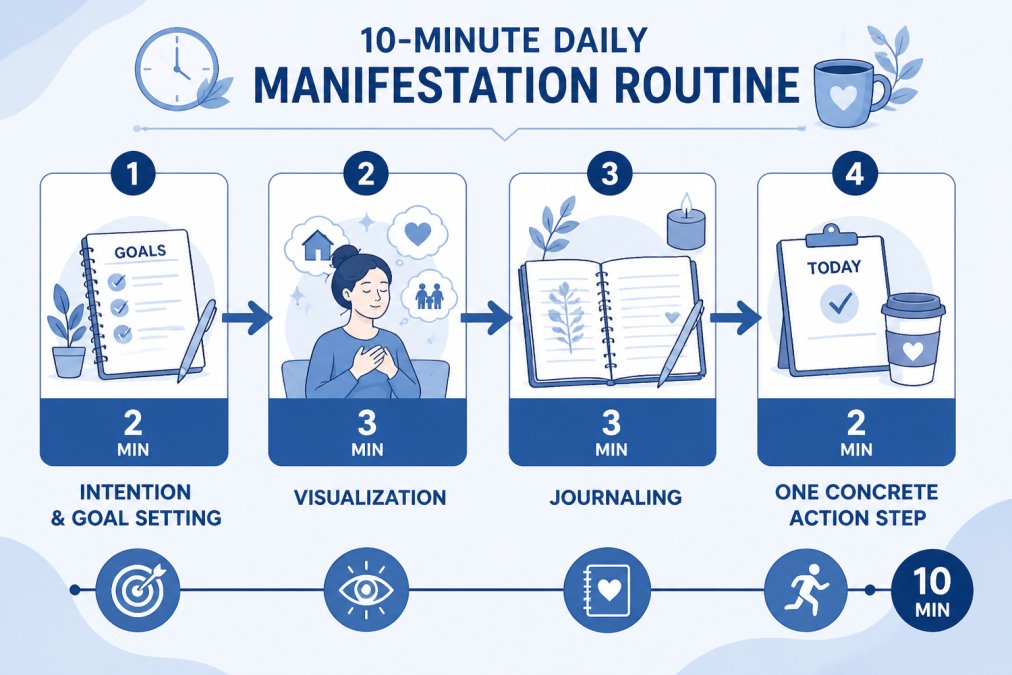
A realistic daily manifestation routine takes about 10 minutes and follows four fixed steps: set one intention, visualize it briefly, write it down, then name a single action. The power comes from repetition, not length. Ten minutes done daily beats an hour done once.
Here is the structure we recommend:
- Minute 1-2: Write one clear intention for the day.
- Minute 3-5: Picture the outcome in plain detail.
- Minute 6-8: Journal a sentence or two about how it felt.
- Minute 9-10: Choose one action you will take today.
A 10-Minute Morning Version for Busy Schedules
Mornings with kids rarely go to plan, so build the habit around a fixed anchor: right after you pour your first drink, before the phone comes out. Keep a pen and one page nearby. If 10 minutes is unrealistic on a given day, do the four steps in four minutes. For a fuller walkthrough, see our 10-minute manifestation routine for busy moms.
Adapting the Routine to Different Goals and Schedules
The four steps stay the same, but the emphasis should shift with your goal and your day. A fair comparison of the common techniques looks like this:
| Technique | Best for | Likely benefit | Limitation |
|---|---|---|---|
| Affirmations | Building self-belief before a hard task | Shifts self-talk and confidence | Feels hollow if the statement is implausible |
| Visualization | Preparing for a specific event or conversation | Supports rehearsal and readiness | Can become daydreaming if no action follows |
| Journaling | Working through obstacles and planning | Clarifies next steps and reduces rumination | Can turn into venting without a decision |
| Goal planning | Long-term or multi-step goals | Turns intention into a schedule | Needs regular review to stay useful |
Match the technique to the goal. For a job interview, spend more time visualizing the conversation and less on journaling. For a recurring habit like saving money, lean on goal planning and a weekly review.
Adapt to your schedule too. If your mornings are chaotic, move the routine to lunch or right after the kids go to bed. If you have five minutes, do intention and one action only.
What to Do When Affirmations Feel Implausible
If an affirmation feels false, your brain tends to reject it, and the practice can feel discouraging. Shrink the statement until it is believable. Instead of "I am confident in meetings," try "I am learning to speak up once per meeting." Instead of "I am wealthy," try "I am taking one step to reduce debt this week." A believable stretch beats a fantasy every time.
How to Tell If the Routine Is Working
Judge the routine by observable behavior, not by signs or coincidences. A simple weekly check works:
- Did you complete the routine most days?
- Did you take at least one action step per day?
- Did your goal stay clear, or did it drift into five competing wishes?
- Did your mood and stress shift gradually rather than overnight?
Set timelines in weeks, not days. Most habit changes show up slowly. Expect the first real shifts in three to four weeks of steady practice, and treat missed days as normal rather than failure. If you want a lighter way to track, these minimalist habit tracking ideas fit a packed schedule.
Manifestation Affirmations for Beginners: What to Say and What to Skip
Good manifestation affirmations for beginners are believable, present tense, and tied to action. Skip anything your brain will reject on contact. An affirmation you do not believe triggers resistance, not belief.
Get the 3-step manifestation ebook now →
Use this filter:
- Keep: "I am learning to handle stressful mornings calmly."
- Keep: "I follow through on one small step today."
- Skip: "I am a millionaire" when your bank balance argues otherwise.
- Skip: any phrase that promises results without effort.
Say two or three affirmations out loud, once in the morning. Repetition builds self-belief over time, which is the part psychology actually supports. The goal is a believable stretch, not a fantasy.
Manifestation Journal Prompts That Move You Toward Action
Strong manifestation journal prompts push you past wishing and into planning. Each prompt should end with a decision or a next step. Vague reflection feels productive but changes nothing.
Try these:
- What is one outcome I want this week, stated in one sentence?
- What would I do today if I believed this was possible?
- What is one small action I can take in the next hour?
- What got in my way yesterday, and what will I change?
Write for five minutes, no editing. If you are new to journaling, our guide to starting manifestation journals for skeptical moms covers the basics without the fluff. The 10-Minute Manifestation Journal for Busy Moms is a bite-sized daily tool for gratitude and visualization.
How to Measure Progress and Set Realistic Timelines
Measure progress by behavior and evidence, not by waiting for a sign. Track how often you complete the routine, how many action steps you take, and what actually changes in your week.
Use a simple weekly check:
| What to track | How often | What good looks like |
|---|---|---|
| Routine completed | Daily | Most days, not every day |
| Action steps taken | Daily | At least one per day |
| Goal clarity | Weekly | One clear goal, not five |
| Mood and stress | Weekly | Gradual, not overnight |
Set timelines in weeks, not days. Most habit changes show up slowly. If you want a lighter way to track, these minimalist habit tracking ideas fit a packed schedule.
Risks and Limitations: When Manifestation Can Hurt
Manifestation turns harmful when it replaces action, treatment, or honest planning. The risks are real and worth naming plainly.
Watch out: using manifestation to avoid a problem, like debt or a health concern, can delay the help you actually need.
Other limits to keep in mind:
- It can fuel guilt if you blame yourself when results do not come.
- It can encourage unrealistic expectations about speed.
- It is not a treatment for anxiety, depression, or grief.
If manifestation starts to feel like pressure rather than relief, scale it back. The practice should support your mental health, not add another item to an already heavy load.
Start Your First 3-Step Manifestation Practice
Here is the simplest version to start today:
- Write one intention for the next 24 hours.
- Spend three minutes visualizing the outcome in plain detail.
- Take one action before the day ends.
That is the whole method. It respects your time and your skepticism, and it gives you something measurable to review each week. The Teen Girl Glow Up Journal is a toolkit designed to help adolescent girls build self-esteem and healthy habits.
Frequently Asked Questions
Does daily manifestation actually work, or is it just wishful thinking?
Daily manifestation works in a narrower way than most claims suggest. The parts with real backing are the psychological ones: clarifying goals, rehearsing outcomes through visualization, and repeating affirmations that shift self-belief and attention. Those habits can change motivation, behavior, and effort, which in turn change outcomes. What does not hold up is the idea that thoughts alone rearrange reality. Treat daily manifestation as a mindset and action practice, not a substitute for effort, and it can genuinely help.
How long should a daily manifestation routine take?
Ten minutes a day is enough to build the habit. A workable split is two minutes writing your intention, three minutes visualizing the outcome, three minutes journaling, and two minutes naming one action you will take. Consistency matters more than length: five focused minutes every morning beats a 45-minute session you abandon after a week. If you are juggling work and kids, anchor the routine to something you already do, like your first cup of coffee.
Can manifestation affirmations for beginners work if you do not believe them yet?
They can still help, but the wording matters. Repeating a claim your brain rejects outright tends to trigger pushback rather than belief. Start with affirmations that are believable and action-oriented, such as I am learning to handle stressful mornings with more calm, instead of a sweeping statement that feels false. Over time, small repeated shifts in self-belief and attention can make the stronger versions feel credible. Pair each affirmation with one small action to keep it grounded.
What is the difference between manifestation and positive thinking?
Positive thinking is a general outlook: noticing the good and expecting reasonable outcomes. Manifestation is a structured practice built on intention, visualization, affirmations, and journaling, often aimed at a specific goal. The overlap is real, since both shape attention and mindset. The practical difference is that a solid manifestation practice ends in action, while positive thinking can stay passive. If your routine never produces a concrete next step, it has drifted into wishing rather than manifesting.
If your mornings feel like survival mode, a short, repeatable ritual can be the reset you have been looking for. SSBGMARKETINGINC. builds minimalist 3-step digital journals designed to fit real, chaotic schedules, including a daily gratitude and visualization tool and a teen-focused companion journal. Each one is short, structured, and built for consistency over intensity. Get started with SSBGMARKETINGINC. and turn ten quiet minutes into a daily habit that actually sticks.