 how-to
Practical Mindfulness for Non-Spiritual People
Table of Contents
- What Practical Mindfulness Means When You're Not Spiritual
- Mindfulness Without Meditation: Everyday Ways to Train Attention
- Mindfulness Exercises for Beginners: Start With One Minute
- Short Mindfulness Exercises You Can Do in the Middle of Chaos
- Mindful Breathing Exercises: The Simplest Way to Reset
- A 4-Week Starter Plan for Practical Mindfulness
- Troubleshooting Common Struggles and Adapting to Your Life
- Frequently Asked Questions
Last Updated: October 17, 2026
What Practical Mindfulness Means When You're Not Spiritual
Practical mindfulness is the practice of paying attention to the present moment on purpose, without tying it to any religion, belief system, or spiritual goal.
You don't need candles, chanting, or a philosophy. You need a few minutes and a willingness to notice what's happening.
Here's the part most guides get wrong: they wrap a simple skill in spiritual language, then wonder why busy people tune out. The skill itself is plain. You notice your breath. You notice your thoughts. You come back when you drift.
Secular meditation and nonreligious meditation describe the same thing: attention practice stripped of doctrine. You can do it while folding laundry or waiting in a school pickup line.
Mindfulness Without Meditation: Everyday Ways to Train Attention
Mindfulness without meditation means using ordinary moments as your practice instead of setting aside a formal session. The car, the kitchen, and the shower all work as training grounds.
A common mistake is assuming you need a cushion and twenty quiet minutes. You don't. Attention training happens in tiny reps, the same way a muscle gets stronger.
Try these everyday mindfulness habits:
- Mindful walking: feel each foot land on the floor as you cross a parking lot.
- Mindful dishwashing: notice the water temperature and the weight of each plate.
- Mindful listening: hear three distinct sounds before you unlock your phone.
- Mindful driving: name what you see at each red light instead of reaching for a screen.
- Mindful snacking: take one bite with your full attention before the next.
Each of these is a mindfulness exercise that takes seconds. Stack one onto a habit you already have and it stops feeling like a chore.
For a broader look at how attention practice is described in plain terms, the National Center for Complementary and Integrative Health overview of meditation separates meditation from relaxation techniques and religious practice.
Mindfulness Exercises for Beginners: Start With One Minute
Mindfulness exercises for beginners should start at one minute, not twenty. A minute is short enough that your brain can't argue with it, and long enough to notice something real.
Here is the exact first-week plan we would hand a total beginner. Do one session a day, at roughly the same time, and keep each session at the listed length.
| Day | Practice | Time | What you actually do |
|---|---|---|---|
| 1 | One-breath anchor | 1 minute | Sit as you are, feel one full breath in and out, then stop. |
| 2 | Three-breath anchor | 1 minute | Feel three breaths; count each return to the breath. |
| 3 | Breath plus sound | 2 minutes | First minute on breath, second minute on the farthest sound you can hear. |
| 4 | Short body check | 2 minutes | Move attention from feet to head, pausing at each area. |
| 5 | Breath and body | 3 minutes | Alternate 30 seconds of breath and 30 seconds of body sensation. |
| 6 | Walking practice | 3 minutes | Walk at normal pace and feel each foot land. |
| 7 | Combined session | 5 minutes | Two minutes breath, two minutes body, one minute sound. |
The mechanics of each session are simple:
- Sit however you're already sitting. No special comfortable posture required.
- Set a timer for the listed length so you are not clock-watching.
- Put your attention on one breath in and one breath out.
- When your mind wanders, note it and return. No judgment.
- Stop when the timer sounds. That counts as a full session.
Notice step four. Noticing thoughts and coming back is the whole skill. Beginners think wandering means failure. It means the practice is working.
A few practical notes that make the first week easier to finish. Keep the timer visible but face-down so you are not checking it. Pick a trigger you already have, such as the first cup of coffee or brushing your teeth, and stack the session onto it. If silence feels uncomfortable, a guided meditation recording can carry you through the first week; treat it as training wheels and drop it once the steps feel familiar. And if a session feels pointless, that is a thought to notice and return from, not a verdict on the practice.
Short Mindfulness Exercises You Can Do in the Middle of Chaos
Short mindfulness exercises work best when they're anchored to a trigger you can't miss: a red light, a ringing phone, a kettle boiling. Chaos is not the enemy of practice. It's the gym.
Try the 3-3-3 reset when you feel scattered:
- Name three things you can see.
- Name three things you can hear.
- Move three body parts on purpose.
That's body awareness in under a minute, and it pulls you out of the mental spin cycle. Another option is the one-sentence journal: write a single line about what you notice right now. Journaling this briefly beats a blank page you'll never fill.
Get the 3-step manifestation ebook now →
If you want a structured tool, our 10-Minute Manifestation Journal for Busy Moms builds this into a daily gratitude and visualization habit sized for a hectic schedule. It's a journal, not a spiritual commitment, and that's the point.
Mindful Breathing Exercises: The Simplest Way to Reset
Mindful breathing exercises are the fastest reset available because your breath is always with you and costs nothing. The goal is not to breathe perfectly. It's to feel the breath.
Start with these breathing methods:
- Box breathing: in for four counts, hold for four, out for four, hold for four.
- Extended exhale: in for four counts, out for six. The longer exhale tends to feel calming.
- Hand on chest: feel one hand rise and fall for five breaths.
- Deep breathing pause: three slow breaths before you open your email.
Breath awareness is the entry point for most people because it's concrete. You're not chasing a feeling. You're tracking a physical sensation.
The American Institute of Stress resources on breathing and stress notes that slow, deliberate breathing is one of the most accessible ways to calm the body's stress response. That's a physical mechanism, not a belief system.
A 4-Week Starter Plan for Practical Mindfulness
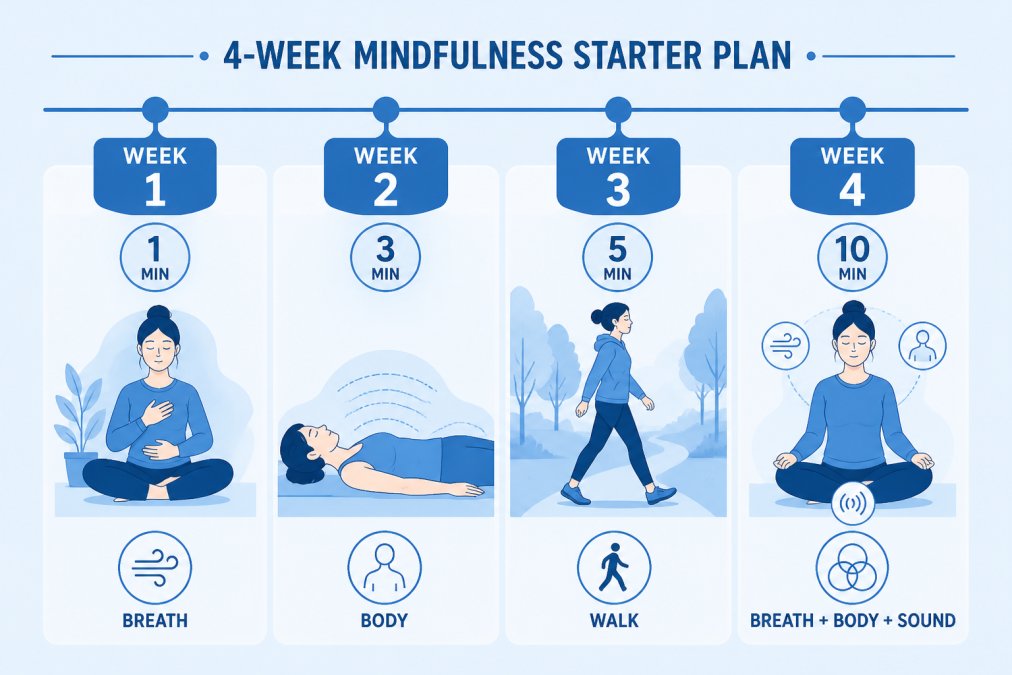
This practical mindfulness plan builds from one minute to ten over four weeks. Skip a day and pick up where you left off. There's no streak to protect.
Here's the full progression:
| Week | Daily Practice | Time | Focus |
|---|---|---|---|
| 1 | Breathing anchor | 1 minute | Breath awareness |
| 2 | Body scan | 3 minutes | Body awareness |
| 3 | Mindful walking | 5 minutes | Movement and sensation |
| 4 | Combined practice | 10 minutes | Breath, body, sound |
A guided meditation recording can carry you through any week if silence feels hard. Use it as training wheels, not a permanent crutch.
Troubleshooting Common Struggles and Adapting to Your Life
The biggest struggle is expecting stillness. Most people's minds are loud, and that's normal. Nonjudgmental awareness means you notice the noise without grading yourself for it.
Here is how to handle the common snags, with the mechanism and the fix for each:
- "I can't focus." Focus is the rep you're building, not the entry fee. Restlessness is usually a sign that your session is longer than your current attention span. Shorten it by half and count returns instead of chasing stillness.
- Intrusive or repetitive thoughts. A wandering mind is the default setting, not a malfunction. When a thought hooks you, label it plainly ("planning," "worrying") and return to one breath. Labeling gives the thinking mind a small job so it stops fighting the practice.
- Boredom. Boredom is often under-stimulation, not failure. Switch the anchor from breath to sound or to the sensation of your feet, which gives attention something fresh to track.
- Physical discomfort. Adjust before you endure. Change posture, open your eyes, or switch to standing meditation or a slow walk. Discomfort is information, not a test of willpower.
- Sleepiness. Sit up, open your eyes, or practice standing or walking. A session done slumped in a warm chair is more likely to become a nap than attention training.
- "I feel nothing." Sensations are subtle at first. Track temperature, weight, and contact points instead of waiting for calm. Calm is a side effect, not the target.
- "I missed a week." Start again today. There's no penalty box and no lost progress; the skill does not expire.
- "It feels silly." That's a thought, not a fact. Note it and return to the breath.
Adapt the practice to your life rather than the reverse. The same attention skill works across settings and bodies:
- Seated: a chair with feet flat on the floor is enough; no cushion required.
- Standing: useful in a kitchen or at a counter when sitting still feels hard.
- Walking: a slow walk indoors or outdoors doubles as physical activity and attention practice.
- Eyes-open: keep a soft gaze on one point if closing your eyes makes you drowsy or anxious.
- Workplace: a 60-second breath pause before opening email or joining a call fits between tasks.
- Mobility and sensory needs: practice lying down, seated, or with support; use audio guidance if reading is hard; choose a quiet corner or use earplugs if sound is distracting. The technique adapts; the goal does not change.
- Creative activities: drawing, cooking, or washing dishes can become attention anchors when you focus on texture, color, and temperature.
For teens, the same principles apply with different packaging. Our Teen Girl Glow Up Journal uses mindset prompts and habit tracking to make mindfulness feel relatable rather than preachy, which is exactly what skeptical teenagers need.
How do you know it's working without chasing spiritual or performance claims? Look for small, plain signs: you notice tension sooner, you pause before snapping, you return to a task faster, or you catch yourself before reaching for your phone. Those are the real markers.
The Centers for Disease Control and Prevention resources on mental health and Substance Abuse and Mental Health Services Administration national helpline are good starting points if you need support beyond self-guided practice.
Frequently Asked Questions
What is secular mindfulness, and how is it different from spiritual meditation?
Secular mindfulness is the practice of paying attention to the present moment without judgment, stripped of religious or spiritual beliefs. It focuses on training attention and awareness through exercises like breath awareness and body scans. Unlike spiritual meditation, which may involve chanting, prayer, or seeking transcendence, secular mindfulness is evidence-informed and aims at stress reduction, calm, and self-observation. You don't need to adopt any belief system to practice it.
How can I practice mindfulness without meditating?
You can practice mindfulness without meditation by bringing full attention to everyday activities. Try mindful walking: notice each step and the sensation of your feet on the ground. Or practice mindful eating: take one bite of food and focus on taste, texture, and smell. You can also do a quick body scan while standing in line or wash dishes with full awareness of the water and soap. These mindfulness exercises for beginners fit into your day without a formal sitting practice.
I'm skeptical about meditation. Can practical mindfulness still help me?
Yes. Practical mindfulness is designed for skeptics. It doesn't ask you to believe in anything supernatural or adopt spiritual beliefs. Instead, it uses attention training and simple exercises like mindful breathing exercises to help you notice thoughts and sensations without judgment. Research suggests that even short mindfulness exercises can reduce stress and improve focus. You can evaluate your own experience by tracking how you feel before and after each practice.
How long should I practice mindfulness each day?
Start with just one minute of mindful breathing or a short body scan. Consistency matters more than duration. Aim for 1-3 minutes daily in the first week, then gradually increase to 5-10 minutes as it becomes a habit. Short mindfulness exercises can be done multiple times a day. A practical goal is to integrate mindfulness into existing routines, like your morning coffee or evening wind-down, so it feels natural and sustainable.