 how-to
How to Practice Mindfulness With Teenagers: 7 Steps
Table of Contents
- Step 1: Start With Your Own Mindfulness Practice
- Step 2: Introduce Mindfulness Activities for Teens Without Pressure
- Step 3: How to Teach Mindfulness to an Anxious Teen
- Step 4: Use Mindfulness Scripts for Parents to Guide the Conversation
- Step 5: Practice Mindfulness With Teenagers During Daily Routines
- Step 7: Track Progress and Adjust Your Approach
- Conclusion: Making Mindfulness a Shared Habit
- Frequently Asked Questions
Last Updated: October 4, 2026
Step 1: Start With Your Own Mindfulness Practice
You cannot teach a calm you do not have, the first rule of how to practice mindfulness with teenagers, and the step most parents skip.
Teens learn by watching, not by being told. If you bark orders from the kitchen while claiming to be "present," the lesson lands as hypocrisy.
Start with ten minutes a day. That is it.
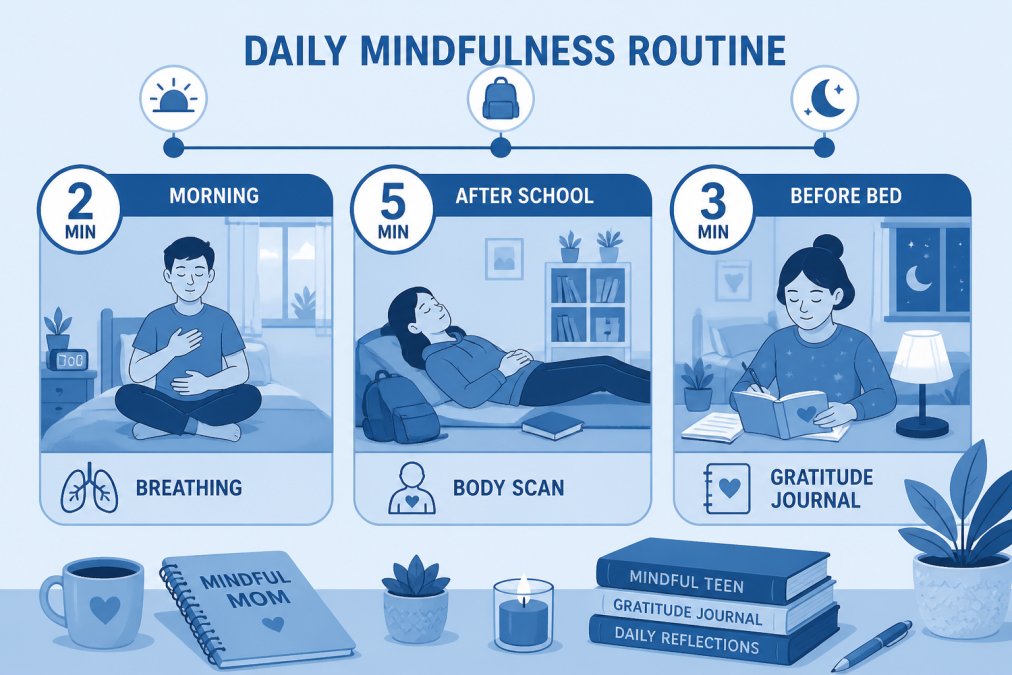
- Morning: two minutes of deep breathing before you check your phone
- Midday: one minute of sensory awareness while your coffee brews
- Evening: five minutes of a gratitude journal before bed
That small routine builds your own emotional regulation. The American Psychological Association's guidance on stress management backs this up: modeling calm behavior teaches coping strategies faster than lecturing ever will.
One honest caveat: your first week will feel pointless. Push through it anyway.
Step 2: Introduce Mindfulness Activities for Teens Without Pressure
The fastest way to kill a teen's interest in mindfulness is to announce it as a project. Skip the family meeting. Skip the lecture. Just fold it in.
Here is how to introduce mindfulness activities for teens without triggering an eye roll:
- Offer, don't assign. "Want to try something with me?" beats "You need to do this."
- Keep it under five minutes at first
- Tie it to something they already care about, like sports, music, or gaming
Five-Minute Breathing Exercises
Box breathing is the easiest starting point: inhale for four counts, hold for four, exhale for four, hold for four.
4-7-8 breathing works well before bed: inhale four counts, hold seven, exhale eight. It triggers the relaxation response and helps with sleep.
Alternate nostril breathing sounds odd but teens often like it, it feels like a challenge, not a chore.
Sensory Grounding Techniques
Grounding techniques pull attention back to the present using the five senses. Have your teen name three things they can hear, two they can touch, and one they can smell, ninety seconds, works almost anywhere.
Step 3: How to Teach Mindfulness to an Anxious Teen
When anxiety is in the room, standard mindfulness advice falls flat. Telling an anxious teen to "just breathe" can make things worse by drawing attention to the racing heart and spiraling thoughts. Flip the order: notice the anxiety first, then work with it.
Recognizing Anxiety Triggers
Common triggers for teens include:
- Social media comparison spirals
- Test scores and grade pressure
- Friendship drama or exclusion
Help your teen name the trigger out loud. "I'm anxious because I have a test tomorrow" is easier to work with than free-floating dread.
Using the 5-4-3-2-1 Technique
The 5-4-3-2-1 technique is a grounding method that walks through all five senses in sequence. Name five things you see, four you hear, three you can touch, two you can smell, and one you can taste.
It works because it gives the anxious brain a job: racing thoughts lose their grip when attention redirects to sensory input.
Step 4: Use Mindfulness Scripts for Parents to Guide the Conversation
Mindfulness scripts for parents are short, pre-planned phrases for when your teen is stressed, they keep you from freezing up or lecturing.
Try these:
- "I notice you seem tense. Want to sit with me for a minute, no talking required?"
- "Let's take three slow breaths together before we talk about it."
- "What's one thing you can see right now that's not moving?"
Notice what these scripts do not do: they do not diagnose or tell the teen what to feel.
Get the 3-step manifestation ebook now →
If your teen shuts you down, wait a day and try again. Consistency beats intensity every time.
Step 5: Practice Mindfulness With Teenagers During Daily Routines
The trick to making mindfulness stick is attaching it to things you already do. No extra calendar blocks. No new habits to remember.
Step 7: Track Progress and Adjust Your Approach
Almost every guide tells you to practice but never tells the teen how to see it working. Without visible evidence, mindfulness feels like a chore with no payoff, and teens quit. Hand the tracking to the teen, not the parent, a teen who owns the data owns the habit. Keep it light; heavy tracking turns mindfulness into homework, and homework gets abandoned.
A Teen-Owned Weekly Check-In
Instead of a parent-run spreadsheet, give your teen a simple one-page log they fill in themselves. One line per day. That is the whole system.
| What to Track | How Often | What to Look For |
|---|---|---|
| Mood after practice | Daily, one word | Patterns over a week |
| Sleep quality | Nightly, 1-5 scale | Better rest on practice days |
| Anxiety moments | As they happen | Fewer or shorter episodes |
| Joint practice sessions | Weekly count | Consistency, not perfection |
| One thing that felt easier | Weekly, one sentence | Proof the practice is working |
The last row is the one most trackers miss. Teens need to name a benefit in their own words, "I fell asleep faster," "I didn't snap at my mom," "I got through the test without spiraling." That sentence turns a practice into something they want to keep.
Make the Data Visible
Numbers on a page do not motivate teens. Patterns do. Try one of these:
- A simple mood line on a wall calendar, one colored dot per day
- A phone note with a running list of "wins" the teen adds to themselves
- A shared note between parent and teen where each adds one observation per week
The goal is not a perfect record. It is a visible trail the teen can look back on and say, "I actually did this."
Adjust on a Two-Week Cycle
Review the log together every two weeks. Three questions, no lecture:
- What is working?
- What feels like a chore?
- What should we change?
Then change one thing. If the evening practice keeps getting skipped, move it to the morning. If breathing exercises feel flat, swap in mindful movement, a slow walk, stretching, or a few minutes of yoga.
Our National Institutes of Health's overview of mind and body practices explains that different mindfulness methods work better for different people.
Modifications for Neurodivergent Teens
If your teen is neurodivergent, expect to modify more, and expect standard advice to fail first. Adjustments that consistently help:
- Shorter sessions. Two minutes beats ten. Build up only if the teen asks.
- More movement. Walking, stretching, or a fidget in hand while breathing.
- Clear visual cues. A printed card with the steps, not a verbal instruction.
The tracking log matters even more here, because progress for neurodivergent teens rarely looks standard. It looks like one fewer meltdown, one smoother transition, one night of better sleep. Those count.
Conclusion: Making Mindfulness a Shared Habit
The hardest part of building mindfulness with teenagers is not the technique. It is consistency when life gets loud.
That is exactly why we built our journals the way we did. The 10-Minute Manifestation Journal for Busy Moms gives you a bite-sized daily gratitude and visualization routine that fits into a hectic morning.
You do not need a perfect practice. You need a small one you will actually keep. Get the 3-step manifestation ebook now
Frequently Asked Questions
What are some simple mindfulness activities for teens?
Teens can try five-minute breathing exercises, sensory grounding like the 5-4-3-2-1 technique, mindful walking, or a quick body scan. These activities fit into a busy schedule and don't require any special equipment. For example, a teen can practice deep breathing before a test or use grounding techniques when feeling overwhelmed.
How do you practice mindfulness with an anxious teenager?
Start by acknowledging their feelings without judgment. Introduce calming techniques like deep breathing or guided imagery when they're already relaxed, so they can use them during anxious moments. Keep sessions short (5-10 minutes) and practice together. The 5-4-3-2-1 technique can help ground them by engaging their senses.
How long should a daily mindfulness practice be for teens?
Research suggests that even 5-10 minutes a day can be beneficial for teens. Consistency matters more than duration. Start with 2-3 minutes and gradually increase as they get comfortable. A short daily practice is more sustainable than longer, infrequent sessions.
What are mindfulness scripts for parents to use with teens?
Mindfulness scripts are simple, guided prompts you can read aloud. For example: 'Let's take three deep breaths together. Notice how your body feels. Now, name three things you can see, two you can hear, and one you can smell.' These scripts help structure the practice and make it easier for teens to follow along without feeling pressured.