 How-to
7 Mindful Parenting Techniques to Stay Calm Today
Last Updated: November 19, 2026
Quick Summary
Practice mindful parenting in 60-second bursts by using the pause before you react: freeze for three seconds, feel your feet on the floor, and ask what your child needs. You can also name your emotion out loud and use the 4-6 breath, inhaling for four counts and exhaling for six.
- The pause before you react means physically freezing for three seconds and feeling your feet on the floor.
- The 4-6 breath means inhaling for four counts and exhaling for six, and three rounds takes under a minute.
- A one-minute body scan at the kitchen sink means noticing water temperature, shoulders, jaw, and breath.
- Start with one anchor and one practice for two weeks, aiming for four days out of seven.
- Add a second practice only after the first has survived at least ten of fourteen days.
Table of Contents
- Why Mindful Parenting Feels Impossible (and Why It Isn't)
- Core Mindful Parenting Techniques You Can Use in 60 Seconds
- Mindfulness Exercises for Parents That Fit a Chaotic Schedule
- Mindfulness Exercises for Kids to Do Alongside You
- Building a Mindful Parenting Routine That Actually Sticks
- When Mindfulness Feels Like It Isn't Working
- Start Your 3-Step Reset With the 10-Minute Manifestation Journal
- Frequently Asked Questions
Why Mindful Parenting Feels Impossible (and Why It Isn't)
Mindful parenting is the practice of staying aware of your own emotions and your child's needs in the present moment, without judgment.
Here's the truth. Mindfulness while parenting was never meant to look like a silent meditation retreat.
Below, we'll show you exactly how to practice mindfulness while parenting in short bursts that fit real life, not a spa schedule.
Core Mindful Parenting Techniques You Can Use in 60 Seconds
Sixty seconds is enough time to shift your nervous system and your response. These two techniques form the backbone of every other practice in this guide.
The Pause Before You React
The pause is the single most powerful tool in mindful parenting. When your child spills juice on the carpet five minutes before school, your body floods with stress hormones before your brain catches up.
Try this:
- Stop moving. Physically freeze for three seconds.
- Feel your feet on the floor.
- Ask yourself: "What does my child need right now?"
A common mistake is treating the pause as a delay. It isn't. It's the difference between a response you'll regret and one your child will remember as calm.
Name the Emotion, Then Choose the Response
Naming an emotion reduces its grip on your behavior.
Say it out loud: "I'm feeling overwhelmed right now." Then add: "I'm going to take a breath and figure out the next step."
Kids learn emotional regulation by watching you do it. When you name the emotion, you model self-regulation instead of just talking about it.
Mindfulness Exercises for Parents That Fit a Chaotic Schedule
Chaos doesn't disqualify you from mindfulness practice. It just means your practice has to be smaller and more portable than a 30-minute guided meditation.
The 4-6 Breath and the Slow Exhale Reset
The 4-6 breath means inhaling for four counts and exhaling for six. The longer exhale activates your parasympathetic nervous system, which is the branch of your nervous system responsible for calm.
Use it when:
- You're stuck in school pickup traffic
- You're about to open a stressful email
- You're standing in the pantry at 9 p.m. wondering where the day went
Three rounds takes under a minute. Deep breathing won't erase your to-do list, but it lowers the reactivity that makes the list feel impossible.
The One-Minute Body Scan at the Kitchen Sink
A body scan is a quick check-in with physical sensation from head to toe. You don't need a cushion or an app. You need a sink full of dishes.
While you wash, notice:
- The temperature of the water on your hands
- Your shoulders (are they up near your ears?)
- Your jaw (is it clenched?)
This is sensory awareness, and it pulls your attention out of the mental spiral and into your body. One minute of it counts.
Mindfulness Exercises for Kids to Do Alongside You
Kids learn mindfulness by doing it with you, not by being told to calm down. These shared exercises take the pressure off both of you.
Five Senses Grounding for Anxious Kids
Five senses grounding is a simple way to pull a child out of worry and into the present moment. Ask your child to name:
- 5 things they can see
- 4 things they can touch
- 3 things they can hear
It works at bedtime, in the car, or before a test. Younger kids love the counting structure. Older kids tolerate it because it gives them something to do with their hands and attention.
Age-Specific Adjustments for Tweens and Teens
Teens need a different entry point. A 15-year-old will not sit cross-legged and breathe with you, and pushing it will backfire.
What works better:
- Practice side by side, not face to face (car rides are ideal)
- Keep sessions short and skip the lecture
- Let them lead the conversation
For a deeper step-by-step approach, our guide on how to practice mindfulness with teenagers walks through seven concrete steps. And if you want more quick practices for packed days, see mindfulness habits for busy moms.
Building a Mindful Parenting Routine That Actually Sticks
Most parents fail at mindfulness not because the practices are hard but because they try to install five of them at once. A routine that sticks is built in layers, with a clear rule for when to add the next one and a way to tell whether it is working.
Start With One Anchor, Not a Schedule
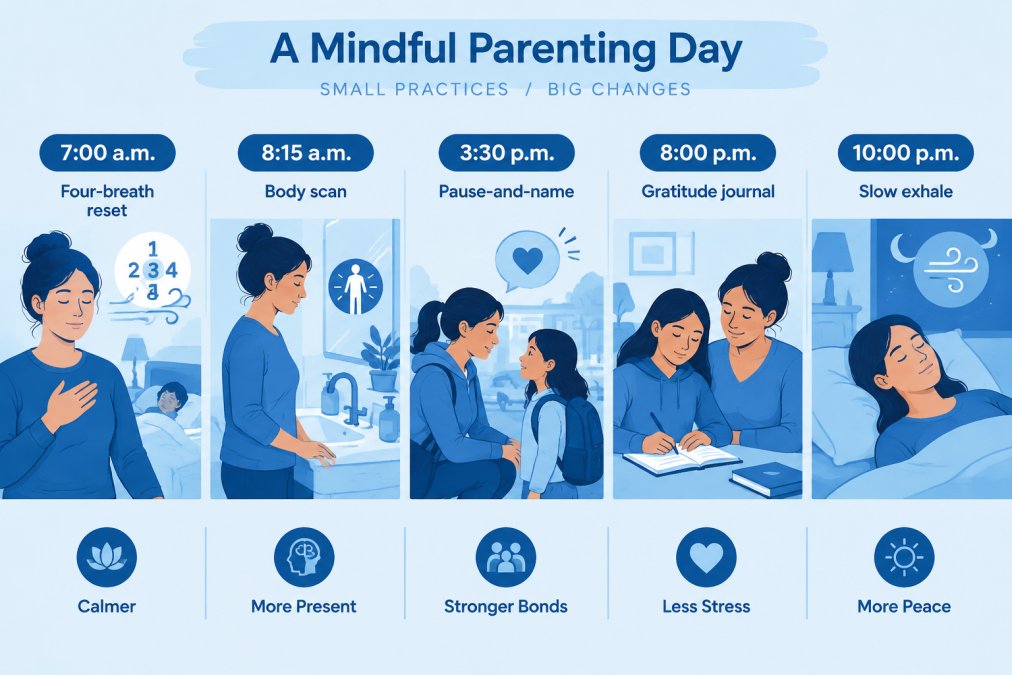
An anchor is an existing transition you already pass through every day: waking the kids, the school drop-off line, the after-school pickup, the dinner-to-bath handoff, the moment you sit down after bedtime. Pick exactly one.
Attach a single practice to that anchor and nothing else for the first two weeks. If your anchor is the pickup line, the practice is three rounds of the 4-6 breath before you put the car in park. If your anchor is the kitchen sink, it is the one-minute body scan.
A Four-Week Progression
This is the part most guides skip. Add a second practice only after the first one has survived at least ten of fourteen days.
- Week 1: One anchor, one practice. Goal: do it four days out of seven.
- Week 2: Same anchor, same practice. Goal: six days out of seven.
- Week 3: Add a second anchor and a second practice only if week 2 hit six days. Otherwise repeat week 2.
A common pattern is that week 3 is where parents overload and quit. The rule is simple: consistency beats variety. Two practices done daily will change your household more than six practices done sporadically.
Track Consistency Without Turning It Into a Chore
Do not build a color-coded habit tracker. Use a physical marker you already see, a small dot on the corner of the kitchen calendar, a tally on a notepad by the coffee maker, a single check in your phone's notes app.
What to Do When the Week Falls Apart
Illness, travel, a work deadline, a child's rough patch, these will erase a week.
Watch out: the most common failure mode is treating a missed day as proof the routine does not work. A missed day is data, not a verdict.
If you want a fuller framework for building daily habits around parenting, our practical guide to daily habits for intentional parenting walks through the underlying structure. And if you are worried about whether any of this survives a genuinely chaotic season, our article on whether mindfulness habits can survive a chaotic daily schedule addresses that directly.
Here is the four-week progression the article lays out, with the goal for each week.
| Week | What to add | Goal |
|---|---|---|
| Week 1 | One anchor, one practice | Do it four days out of seven |
| Week 2 | Same anchor, same practice | Six days out of seven |
| Week 3 | Second anchor and practice only if week 2 hit six days | Otherwise repeat week 2 |
| Week 4 | Pause-before-you-react as a floating tool | Deploy on demand, not at a fixed time |
When Mindfulness Feels Like It Isn't Working
Mindfulness is not failing when it feels hard. It is failing when it is measured wrong. The most common mistake parents make is judging the practice by whether they stayed calm. You will not stay calm every time, and no credible practitioner claims you will. Judge the practice instead by whether you recover faster than you used to, whether the gap between feeling triggered and choosing your response has shortened.
Diagnose Before You Quit
Most "it isn't working" complaints fall into one of five patterns. Match yours before you change anything.
- Too distracted to breathe. The anchor is wrong. Stop trying to meditate in an empty room you do not have. Anchor to a task you already do, the sink, the shower, the walk to the mailbox, and let the task carry the attention.
- No time. The practice is too big. The pause before you react requires zero minutes. Three rounds of 4-6 breath takes under a minute. If a practice needs a cushion, it is not a parenting practice yet.
- Skeptical or self-conscious. Drop the word "mindfulness" entirely. You are not meditating; you are taking one slow breath before you answer. The label is optional; the pause is not.
The Expectation Trap
A common pattern is that parents expect mindfulness to make them calm immediately. It does not work that way.
Watch out: if you find yourself using mindfulness as a way to suppress anger rather than notice it, the practice will backfire. Naming the emotion out loud, "I am furious right now", is not the opposite of mindfulness.
What Research Supports and What It Doesn't
Mindfulness-based approaches have a reasonable evidence base for reducing parental stress and improving emotional regulation, and organizations such as the American Psychological Association's resources on stress and parenting note that caregiver stress affects both physical health and how parents respond to their children. What the evidence does not support is the idea that mindfulness is a cure-all.
When to Seek Additional Support
Mindfulness is a complement to professional care, not a replacement for it. Consider reaching out to a pediatrician, therapist, or family counselor if any of the following is true:
- Your stress or irritability is affecting your sleep, appetite, or work on most days.
- You find yourself avoiding your child or dreading time with them.
- A child's behavior is escalating despite consistent, calm responses.
None of these mean mindfulness has failed. They mean the situation calls for more than a breathing exercise, and getting that support is part of good parenting, not a departure from it.
Self-compassion matters here. You are building a parenting skill, not auditioning for sainthood. If you forgot for three days, start again today. Guilt is not a mindfulness tool.
Start Your 3-Step Reset With the 10-Minute Manifestation Journal
You don't need more information. You need a structure small enough to survive a Tuesday. The 10-Minute Manifestation Journal for Busy Moms offers a short daily gratitude and visualization practice that fits before the coffee finishes brewing.
The challenge isn't learning one more technique. It's finding a practice small enough that you'll actually return to it tomorrow.
Frequently Asked Questions
What is mindful parenting, exactly?
Mindful parenting means paying attention to the present moment with your child, without judging yourself or them. In practice it looks like noticing your own stress before you speak, naming what you feel, and choosing a response instead of reacting on autopilot. It is not about staying calm every second. It is about returning to awareness faster after you lose it, which is why short daily practices matter more than perfect composure.
How do I stay calm when my child is having a meltdown?
Start with your own body before your words. Take one slow exhale that lasts longer than your inhale, then name the emotion out loud for both of you: "You're frustrated and so am I." Naming an emotion reduces its intensity and gives your child language for what they feel. Keep your voice lower and slower than theirs. If you can, crouch to their eye level. You do not need to solve anything in that moment; staying present is the mindful parenting technique that matters.
What are simple mindfulness exercises parents can do with children?
Try five senses grounding: name one thing you can see, hear, touch, smell, and taste. It takes about 60 seconds and works for kids as young as four. For older kids, try a shared three-line journal at bedtime: one thing that went well, one thing that felt hard, and one thing you are looking forward to. Teens often prefer doing this side by side rather than face to face, which lowers the pressure and keeps the habit going.
How long does it take to see results from a mindful parenting routine?
Some parents find they recover from stressful moments more quickly with regular daily practice, even when each session is short. The change is often small at first: you catch yourself mid-reaction instead of after it. Track it simply by noting one moment each evening when you paused before responding. Consistency matters far more than session length, so a 60-second habit you keep beats a 20-minute meditation you skip.