 how-to
Get Printable Teen Growth Toolkit: A Review of What's Inside
Last Updated: November 15, 2026
Quick Summary
A printable teen growth toolkit is a digital collection of worksheets, prompts, and trackers that helps teenagers build self-awareness, resilience, and healthy habits. It arrives as a one-time PDF download with no subscription, app, or account, and you can print it at home or use it digitally. Pages work on their own, so you can start with just three to five pages.
- The toolkit includes growth mindset prompts, self-esteem worksheets, parent-teen communication cards, a progress tracker, and calm coloring pages.
- A sensible first print run is three to five pages: the welcome page, one prompt sheet, one worksheet, and the tracker.
- Select Letter paper and Actual size scaling, and turn off ink-saving mode for the tracker page.
- The weekly tracker holds three teen-named habits, one mood rating, one win, one keep, and one drop.
- Four checkpoints run across a twelve-week cycle: baseline at week 1, review at week 4, habit audit at week 8, and reflection at week 12.
Table of Contents
- What the Printable Teen Growth Toolkit Includes
- How to Download and Print Your Toolkit
- Free Growth Mindset Activities for Teens Included
- The Growth Mindset Workbook for Teens Section
- Building Self-Esteem in Teenage Girls: What the Pages Do
- Parent-Teen Communication Prompts for Shared Growth
- Tracking Progress With the Teen Growth Toolkit
- Get the 3-Step Manifestation Ebook and Start Today
- Frequently Asked Questions
What the Printable Teen Growth Toolkit Includes
A printable teen growth toolkit is a digital collection of worksheets, prompts, and trackers that can help teenagers build self-awareness, resilience, and healthy habits.
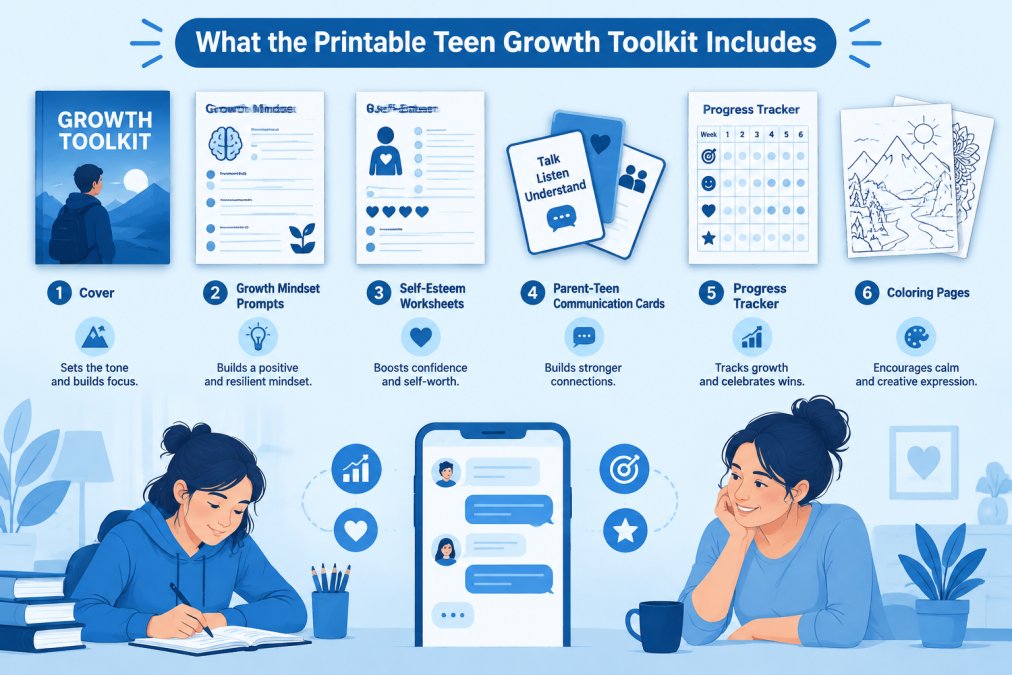
A Page-by-Page Preview
- Cover and welcome page: sets the tone and explains how to use the toolkit in short sessions.
- Growth mindset prompts: reflective writing questions that help teens reframe setbacks as information.
- Self-esteem worksheets: strength-spotting exercises and confidence check-ins.
Every page works on its own. You do not have to complete the toolkit in order, and nothing expires.
How to Download and Print Your Toolkit
Most roundups of teen growth resources stop at a link. This section walks through the full path from search to printed page, states exactly what access requires, and gives the printer and screen settings that matter.
Step 1: Confirm what you are getting before you commit
Watch out: some toolkits advertise a free sample and then lock the tracker or the communication cards behind a subscription. Check the page count against the preview before you enter an email address.
Step 2: Complete the one-time download
Go to the shop page, choose the toolkit, and complete checkout. The PDF arrives by email within a few minutes; save it before you print. There is no account and no recurring charge. If the email does not arrive, check spam or promotions first, PDF attachments are frequently filtered there.
Step 3: Choose your pages deliberately
The toolkit is modular, so you do not need to print all of it. A sensible first print run is three to five pages: the welcome page, one growth mindset prompt sheet, one self-esteem worksheet, and the progress tracker.
Step 4: Set your printer correctly
The default settings on most home printers will work, but a few adjustments prevent the common problems:
- Paper size: select Letter, not A4. The margins are built for Letter, and A4 will clip the footer on the tracker page.
- Scaling: choose "Actual size" or 100%, not "Fit to page," which shrinks the writing lines and cramps the prompt boxes.
- Color: black and white is fine. The pages survive grayscale, so you save ink without losing legibility.
Step 5: Use it digitally if printing is not an option
The PDF is not a fillable form, but it opens cleanly in most note-taking apps that support PDF annotation, including built-in markup tools on phones and tablets. A teen who prefers typing can add a text box over each prompt line and save a copy. The tracker grid works the same way: type habit names in the left column and fill the boxes each week.
Step 6: Adapt it to your setting
The same file works across contexts with small changes:
- At home: print the communication cards on cardstock, cut them apart, and keep them in a jar on the kitchen counter.
- In a classroom or group: print one prompt sheet per student and run a ten-minute silent writing block, then a five-minute share-out.
- For a teen who is overwhelmed: start with the coloring and calm pages only, and introduce one writing prompt the following week.
Access requirements, stated plainly
No subscription, no app, no account, and no shipping. One purchase, one PDF, unlimited printing for personal or single-classroom use.
Free Growth Mindset Activities for Teens Included
Growth mindset activities for teens are a helpful focus for this kind of resource. The prompts are built around one idea: ability grows with practice, not luck. Teens who hear that message repeatedly tend to try harder after a setback instead of shutting down.
The Growth Mindset Workbook for Teens Section
If you want to compare this with a standalone journal, our review of a teen girl journal for anxiety covers a related option and what it does well.
Building Self-Esteem in Teenage Girls: What the Pages Do
Building self-esteem in teenage girls is not about compliments. It is about giving her evidence that she can handle things.
For a deeper look at the ideas behind these pages, read our guide on building self esteem in teenage girls. Parents who want practical steps beyond the toolkit can start with how to build teen self-esteem.
Parent-Teen Communication Prompts for Shared Growth
Parent-teen communication prompts turn the toolkit into something you do together.
Examples include:
- "What is something you are proud of this week that nobody noticed?"
- "What is one thing you wish I understood better?"
- "What is a small risk you want to take this month?"
Use one card at a time. Slip it into the car ride home or leave it on the kitchen counter.
If you want more ways to keep the lines open, our guide to connecting with your teenager expands on these prompts with everyday conversation habits.
Tracking Progress With the Teen Growth Toolkit
Most journals fail at the tracking stage, not the writing stage. A teen starts strong, misses a week, feels behind, and stops. The tracker in this toolkit assumes missed weeks are normal and resets cleanly rather than punishing.
The weekly grid, defined
Each tracker page covers one week and holds five fields:
- Three habits the teen names herself, for example, "lights out by 10:30," "one page of the prompt sheet," "walk after school."
- One mood rating on a simple 1-to-5 scale, filled in once at the end of the week.
- One win, a single sentence about something that went well, however small.
- One keep, the habit she wants to carry into next week.
- One drop, the habit or expectation she is releasing.
That is the entire system. It takes about five minutes on a Sunday evening and produces a written record she can look back on when she feels stuck.
Milestones that make progress visible
The grid is weekly; the milestones are what turn it into a plan. Set four checkpoints across a twelve-week cycle:
- Week 1, Baseline. Fill in the first grid without changing anything. The goal is an honest starting point, not a perfect week.
- Week 4, First review. Compare mood ratings across four weeks. Look for a pattern: are low weeks clustered around a particular day or event?
- Week 8, Habit audit. Count how many weeks each habit actually happened. Keep the two that survived; retire the one that did not. This step prevents the tracker from becoming a guilt log.
The reflection check-in, scripted
A milestone review works better with a short script than with an open question. Use these four prompts at weeks 4, 8, and 12:
- "Which habit was easiest to keep, and why?"
- "Which week was hardest, and what was different about it?"
- "What is one thing you did this month that the you of three months ago would not have done?"
- "What is one thing you want to try next month?"
Keep the answers to one or two sentences each. The point is a record, not an essay.
Adapting the tracker to different needs
The same page works across ages and settings with small adjustments:
- Younger teens (13-14): reduce to two habits and drop the mood rating to a simple face scale.
- Older teens (17-18): add a fourth habit and a monthly rather than weekly review, since their schedules are less predictable.
- Teens with attention or executive-function challenges: print the tracker at 100% and place it somewhere visible, like a bedroom door or the inside of a planner. The physical cue matters more than the review itself.
- Classroom or group use: run the grid as a shared five-minute Friday close, with students filling in their own copy and optionally sharing one "win" with a partner.
What to do when a week is missed
Skip the guilt. Turn to a fresh page, write the current date, and start again. The tracker has no streak counter and no cumulative score, by design, a reset is the intended response. The teens who finish are the ones who treat the restart as routine.
Measuring whether it is working
At the week-12 check-in, look at three signals rather than one:
- Consistency: how many of the twelve weeks have at least one habit filled in?
- Direction: did the mood ratings move at all, even by one point, across the cycle?
- Language: do the "one win" lines get more specific over time? A shift from "good week" to "I asked a question in class" is the clearest sign the reflection is doing its job.
None of these require an app, a subscription, or a spreadsheet. A printed page, a pen, and five minutes a week are enough to turn a stack of worksheets into a plan a teen can see working.
The tracker runs on a simple weekly grid and four checkpoints across a twelve-week cycle.
| Item | Value | Note |
|---|---|---|
| Habits per week | Three | Named by the teen herself |
| Mood rating | 1-to-5 scale | Filled in once at week's end |
| Weekly time | About five minutes | Sunday evening |
| Week 1 | Baseline | Honest starting point, not a perfect week |
| Week 4 | First review | Compare mood ratings across four weeks |
| Week 8 | Habit audit | Keep two habits, retire one |
| Week 12 | Reflection check-in | Re-read all twelve "one win" lines |
| Cycle length | Twelve weeks | Four checkpoints |
Get the 3-Step Manifestation Ebook and Start Today
If you are unsure whether daily manifestation is worth your time, our article on whether daily manifestation actually works looks at the practice honestly, including where it helps and where it does not.
Here is the challenge most moms face: you want to support your daughter's growth, but you are already stretched thin.
Frequently Asked Questions
Where can I get a printable teen growth toolkit?
You can download the Teen Girl Glow Up Journal directly from the Clarity in 3 Steps online store. Check the product page for current pricing and details.
Are there free growth mindset activities for teens in the toolkit?
The toolkit includes free growth mindset activities for teens as part of the broader package, such as reframing prompts, challenge trackers, and short reflection exercises. These are the same style of activities you would find in a standalone growth mindset workbook for teens, but they sit alongside self-esteem and communication pages so you are not buying three separate resources. The free activities are a good way to test whether your daughter engages with the format before committing to a longer routine.
What should a growth mindset workbook for teens include?
A useful growth mindset workbook for teens should include prompts that reframe setbacks, space to track small challenges, and language that does not feel preachy. Look for pages a teenager can complete in 10 minutes or less, because long worksheets tend to get abandoned.
How can I help a teenage girl build self-esteem without being judgmental?
Start with shared prompts rather than direct advice. Building self-esteem in teenage girls works better when the teen leads and the parent listens. Open conversations about strengths, stress, and goals without correcting her answers. Let her keep her journal private if she prefers. Small, consistent practice beats one big talk.
How do you use a growth mindset workbook with a teenager?
Set a fixed 10-minute slot, ideally in the morning or right after school, and let your teen choose which page to start with. Work through one prompt at a time rather than assigning multiple pages. After a week, check in together and ask what felt useful.