 how-to
Teen Girl Journal for Anxiety: A 2026 Review
Table of Contents
- Teen Girl Journal for Anxiety: A Review of the Teen Girl Glow Up Journal
- What to Look for in a Teen Girl Journal for Anxiety
- Journal Prompts for Teen Girls: Sample Prompts from the Glow Up Journal
- The 3-3-3 Method for Anxiety: A Simple Grounding Technique
- Self-Esteem Journal Prompts for Teenage Girls: Building Confidence One Page at a Time
- Real Teen Experiences: What Users Say About the Glow Up Journal
- Conclusion: Is the Teen Girl Glow Up Journal Right for Your Daughter?
- Frequently Asked Questions
Last Updated: October 12, 2026
Teen Girl Journal for Anxiety: A Review of the Teen Girl Glow Up Journal
A teen girl journal for anxiety is a guided notebook that helps teenage girls name what they feel, calm their worries, and build confidence through short daily writing.
Anxiety in teen girls often shows up as racing thoughts at night, stomachaches before school, or avoiding friends. A journal gives her somewhere to put those feelings.
Below: what the Glow Up Journal includes, how to use it, and whether it fits your daughter.
National Institute of Mental Health on anxiety in children and teens
What to Look for in a Teen Girl Journal for Anxiety
The best journal for an anxious teen is short, private, and judgment-free. Long writing sessions feel like homework; ten focused minutes works better. But format matters as much as prompts, so here is how to choose and personalize one.
Paper or digital?
Both work. Match the trade-off to how she already lives.
- Paper notebooks slow racing thoughts because handwriting is slower than typing, and they cannot ping her with notifications. They are easy to hide, but a lost or found notebook is a privacy risk.
- Notes and journaling apps are searchable, backed up, and always on her phone, which matters if she writes at night. But a shared family plan, synced cloud account, or borrowed phone can expose entries she thought were private.
- Guided paper journals split the difference: the structure is printed, so she does not have to invent a format when she is already anxious.
A common pattern is paper for feelings, a phone for reminders. There is no wrong answer as long as she will use it.
Privacy preferences
Ask her what private means before you buy anything. Some teens want a lock or password, others are fine with a shelf, and a few want to share entries with a parent or counselor on purpose. All are valid. What matters is that she chooses, because a journal she does not trust is one she will not use honestly.
Prompt-led versus free writing
- Prompt-led journals give her a starting sentence. This is the better fit when anxiety makes her mind go blank or when she is new to journaling.
- Free writing is a blank page. It suits teens who already know what they want to say and find prompts confining.
- A hybrid is often best: a short prompt to start, then open space to keep going if the words come.
How to adapt prompts to her comfort level
Prompts are suggestions, not assignments. If one feels too heavy, she can:
- Answer it in one word.
- Swap it for an easier one from the same section.
- Write about something else entirely and come back later.
- Skip it and note why she skipped it, which is itself useful information.
A pretty cover means nothing if the inside feels like a school worksheet, and teens spot fake instantly. The Glow Up Journal keeps every page simple: no long essays, no pressure to be positive.
Quick fit check before you buy
- Does it fit in a backpack or bedside drawer?
- Can she finish a page in ten minutes or less?
- Is there a calming step before the writing?
If most answers are yes, the format is probably right. The journal she uses beats the one that looks best on a shelf.
Journal Prompts for Teen Girls: Sample Prompts from the Glow Up Journal
Journal prompts for teen girls work best when they name real situations: friend drama, grades, body image, family tension. Vague prompts get blank pages.
Here are samples from the Glow Up Journal, grouped by goal.
1. Prompts for Identifying and Naming Emotions
Naming a feeling lowers its grip. These prompts help her label what is there.
- What emotion showed up most today?
- Where did you feel it in your body?
- If that feeling had a color, what would it be?
- What happened right before it started?
- What would you tell a friend feeling this way?
2. Prompts for Managing Worries and Anxious Thoughts
Worry management starts with getting the thought out of her head and onto paper.
- What is the worry, in one sentence?
- What is the worst case, and how likely is it?
- What is one thing you can control here?
- What would you say to this worry if it were a person?
- What is one small step you can take today?
3. Prompts for Building Self-Love and Gratitude
Self-love grows from small, repeated proof, not one big pep talk.
- Name three things you did well today.
- What is one thing you like about your personality?
- Who made you feel good this week, and why?
- What is one thing your body helped you do today?
- Write a short note to your future self.
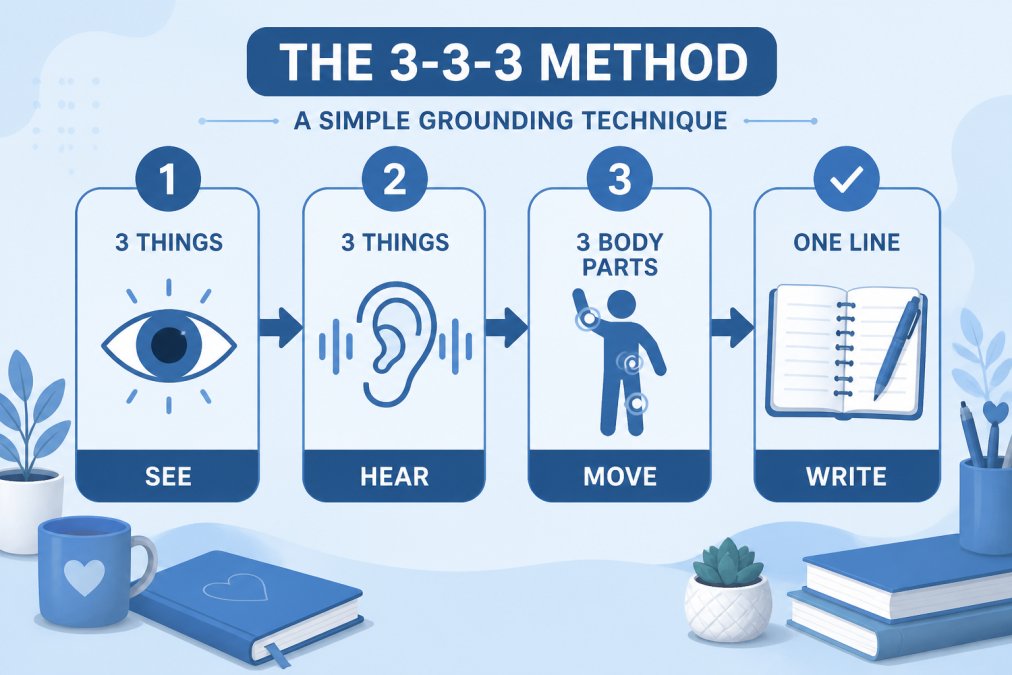
The 3-3-3 Method for Anxiety: A Simple Grounding Technique
Attach journaling to something she already does, like brushing her teeth or lights out.
Expected Result: She does not have to remember a new habit.
Step 2: Run the 3-3-3 Method [Time: 2 minutes]
Three things she sees, three she hears, three body parts she moves.
Expected Result: Her breathing slows and her shoulders drop.
Step 3: Answer One Prompt [Time: 5 minutes]
One prompt is enough. She can write one line or ten.
Expected Result: The feeling is on paper instead of stuck in her head.
Step 4: Close With One Good Thing [Time: 2 minutes]
One small positive moment from the day. A text from a friend. A song.
Expected Result: She ends on steadiness, not dread.
Get the 3-step manifestation ebook now →
| Step | Time | What She Does | Why It Helps |
|---|---|---|---|
| 1. Pick a time | 1 min | Attach to an existing habit | Builds the routine |
| 2. 3-3-3 method | 2 min | See, hear, move | Calms the body |
| 3. One prompt | 5 min | Write freely | Names the feeling |
| 4. One good thing | 2 min | Note a positive | Ends steady |
Self-Esteem Journal Prompts for Teenage Girls: Building Confidence One Page at a Time
Self-esteem journal prompts for teenage girls build confidence slowly, through evidence she can see. Confidence is not a feeling she waits for. It is a record she keeps.
These prompts work well for that:
- What is something you handled well this week?
- What is a mistake you learned from, and what did it teach you?
- What is one thing you are better at than you were a year ago?
One honest line a day beats a perfect page once a month. The girls who stick with it keep it small.
When writing makes things worse
Journaling is a support tool, not therapy, and should never be the only help she gets. For most teens writing brings relief; for some it does the opposite. Watch for these signs a session is going wrong:
- Breathing gets faster, or her chest tightens.
- She starts rereading the same line over and over.
- She feels more hopeless, angry, or numb than when she started.
If any of that happens, stop the session, close the journal, and run the 3-3-3 method or another grounding exercise. Then do something physical: a glass of water, a walk, a shower. Come back to the page another day, or not at all.
When to bring in a trusted adult or a professional
A journal is not a substitute for care. Reach out to a parent, school counselor, doctor, or mental health professional if your daughter:
- Writes about self-harm, suicide, or wanting to disappear.
- Has trouble eating, sleeping, or going to school for more than a few days.
- Says the anxiety is stopping her from doing things she used to enjoy.
If there is an immediate safety concern, contact emergency services or a crisis line right away. The 988 Suicide & Crisis Lifeline is available by call or text in the United States (Contact Us).
Privacy and sharing
Decide together, before she starts, who can read the journal. Ground rules that work for many families:
- The journal stays private unless she chooses to share a page.
- If you are worried about her safety, say so out loud and ask her to show you, rather than reading it behind her back.
- If she wants to share an entry with a counselor or therapist, that is her call.
Trust is the whole point. A teen who thinks her journal will be read without permission will stop writing or start writing for an audience, and neither helps.
A realistic schedule
She does not need to write every day. Three or four short sessions a week is enough to see patterns, and ten minutes is plenty. A blank week is not failure; pick it back up on the next calm evening and keep the bar low.
Real Teen Experiences: What Users Say About the Glow Up Journal
Feedback from real users is the clearest sign of whether a guided journal lands. What teens told us:
Chloe K., a high school sophomore, said the journal helped her clear her head, and she ended up earning an A in math and making the cheer team. Maya L., 16, said the mindset prompts eased her social anxiety and helped her find a strong friend group. Hailey T., 14, said it changed her morning routine and helped her start working toward things instead of just wishing for them.
Those are their words, not promises. Every teen is different; results vary.
What we hear most from moms is simpler: their daughter finally has a place to put the noise. That alone can shift a rough week.
Conclusion: Is the Teen Girl Glow Up Journal Right for Your Daughter?
If your daughter is anxious, withdrawn, or hard on herself, a short daily journal is one of the easiest tools to try. It asks ten minutes, a pen, and a little privacy.
The Teen Girl Glow Up Journal gives her guided prompts, the 3-3-3 grounding method, and space to build self-love and gratitude without pressure.
Start with one page tonight. Small steps add up.
Frequently Asked Questions
What is the 3-3-3 journal method?
The 3-3-3 method is a grounding technique that helps ease anxiety by directing attention to your senses and body. You name three things you can see, three things you can hear, and then move three body parts. In a teen anxiety journal, you can write down these three observations, which reinforces the calming effect and creates a record of what helped. It's a quick, portable tool teens can use anywhere.
What are some good journal prompts for teen girls?
Good prompts for teen girls address their real-life concerns, such as friendships, school stress, and self-image. Examples include: 'What is one thing I handled well today?' 'What worried me, and what can I control about it?' 'List three things I like about myself.' The Teen Girl Glow Up Journal includes prompts like these, organized to build self-awareness and coping skills without feeling like homework.
Can journaling help teens with anxiety?
Yes, journaling can help teens with anxiety by providing a safe outlet for emotions and a way to organize thoughts. Writing about worries can reduce their intensity. The Teen Girl Glow Up Journal uses guided prompts to help teens label feelings and practice calming strategies. However, journaling is not a replacement for professional help if anxiety is severe or persistent.
How often should a teen journal about anxiety?
A teen can journal about anxiety as often as it feels helpful, but a consistent routine like daily or every other day often works best. Even 5-10 minutes can make a difference. The Teen Girl Glow Up Journal suggests a simple daily practice. During an anxiety episode, a teen can turn to a specific prompt for immediate grounding. The key is flexibility, not pressure.
Should parents read their teenager's journal?
Privacy is crucial for a teen's journal to feel like a safe space. Reading it without permission can break trust. Instead, talk with your teen about boundaries. If you're concerned about their safety, address it directly with them or seek professional guidance. The Teen Girl Glow Up Journal encourages teens to share only what they choose, and parents can support by respecting that choice.
A teen girl journal for anxiety only helps if she actually uses it. That is why the Teen Girl Glow Up Journal keeps every entry short, guided, and private, with prompts for naming emotions, managing worry, and building self-esteem, plus the 3-3-3 grounding method built right in. Get the 3-step manifestation ebook now, and give your daughter a calm, simple place to start.