 how-to
Manage Mental Clutter as a Parent: A Simple 2026 Guide
Table of Contents
- How to Manage Mental Clutter as a Parent: Start With a Reset
- Parenting Burnout Signs: Know When You've Crossed the Line
- The Mental Load Checklist for Parents: Name What You're Carrying
- Simple Mindfulness Exercises for Busy Parents (5 Minutes or Less)
- How to Stop Feeling Overwhelmed Daily: A 10-Minute Evening Routine
- Age-Appropriate Chores and Household Systems That Carry Part of the Load
- When Mental Clutter Needs More Than a Checklist
- Conclusion: Small Resets, Repeated Often
- Frequently Asked Questions
Last Updated: October 5, 2026
How to Manage Mental Clutter as a Parent: Start With a Reset
You can learn to manage mental clutter as a parent, and it starts with one honest question: what is your brain still holding at 9 p.m.? This guide from SSBGMARKETINGINC. walks you through a simple reset you can finish tonight, not next month. Mental clutter is the pile of unfinished thoughts, reminders, worries, and half-made decisions that runs in the background all day. For parents, that background noise rarely switches off. Below, we break the whole process into small, repeatable steps.
What Counts as Mental Clutter (And What Doesn't)
Mental clutter is anything your brain keeps tracking that isn't happening right now. It includes school forms, appointment dates, snack duty, and the gift you still haven't bought.
It does not include real planning. A grocery list on paper is not clutter. A grocery list you keep re-memorizing is.
Here's the difference in practice:
- Clutter: "I must remember to sign the permission slip."
- Not clutter: "Permission slip is on the calendar for Thursday."
- Clutter: Replaying a tense conversation from this morning.
- Not clutter: Deciding to talk it through at dinner.
The fix is almost always the same: move it out of your head and into a system. Keep reading, and we'll show you exactly how.
Parenting Burnout Signs: Know When You've Crossed the Line
Parenting burnout signs show up long before you snap. Watch for these:
- You feel drained before the day even starts
- Small requests feel like huge demands
- You're going through the motions without much feeling
- You forget things you never used to forget
- You feel guilty for being tired
Many parents find that the earliest sign is not exhaustion. It's numbness. When you stop looking forward to things you used to enjoy, that's a signal worth taking seriously.
If that sounds familiar, you're not failing. You're overloaded. The American Psychological Association's resources on stress and burnout explain that long-term stress affects both mood and memory, which makes the clutter feel worse.
The Mental Load Checklist for Parents: Name What You're Carrying
A mental load checklist for parents works because naming the load shrinks it. Most of us carry tasks we've never actually written down. Once you see them, you can sort them, and, more importantly, you can hand some of them off for good.
Step 1: Audit the Invisible Work
Set a timer for 15 minutes. Write down everything your brain is holding, not just tasks, but the thinking behind them. A common pattern is that parents list the visible chores (laundry, dishes) and forget the invisible labor that actually drains them: remembering the pediatrician's number, tracking which kid outgrew which shoes, noticing the sunscreen is almost empty, planning the teacher gift, following up on the RSVP that never came.
To surface the invisible layer, ask yourself three questions:
- What do I track that no one else tracks? (Sizes, allergies, teacher names, medication schedules, social dynamics between kids.)
- What do I remind other people to do? (Take the trash out, sign the form, call grandma, pack the cleats.)
- What do I notice before anyone asks? (The fridge is low, the dog is out of food, the field trip form is due Friday.)
Those three lists are your mental load. They are also the exact items that are easiest to redistribute, because they are invisible to everyone but you.
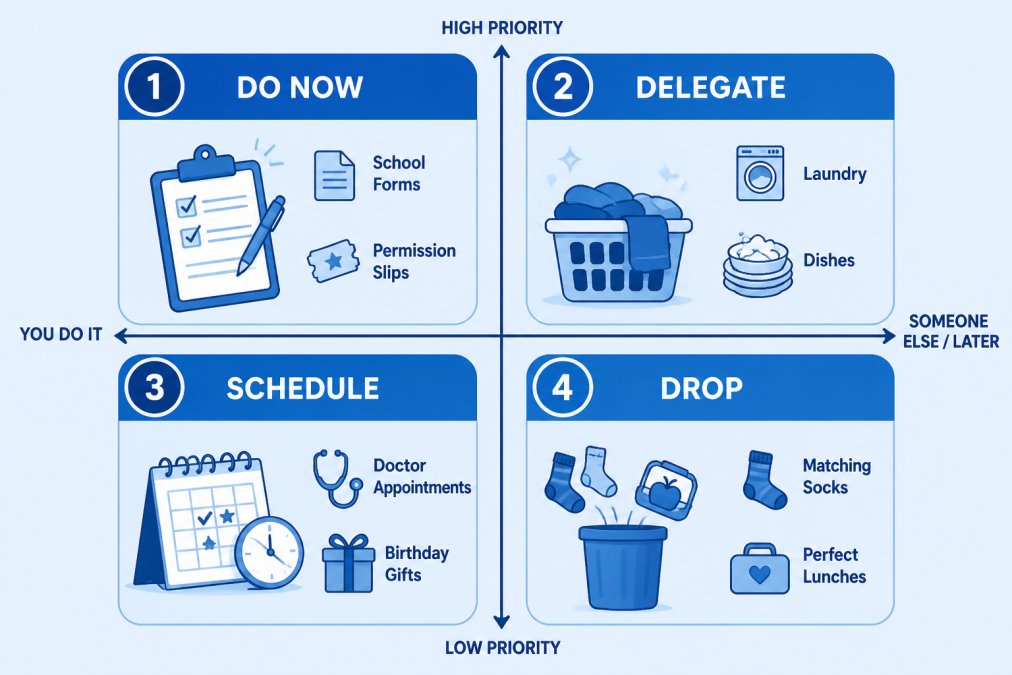
Step 2: Sort Into Four Buckets
Take each item and sort it:
- Do Now, takes under five minutes, do it today
- Delegate, someone else can own this
- Schedule, needs a date and a reminder
- Drop, doesn't actually matter
| Bucket | Example Task | Action |
|---|---|---|
| Do Now | Sign a school form | Handle in 2 minutes |
| Delegate | Fold laundry | Hand to a family member |
| Schedule | Dentist appointment | Add to shared calendar |
| Drop | Perfectly matched socks | Let it go |
Most parents find that a surprising number of items land in "Drop." That's the point.
Step 3: Redistribute the Invisible Work (Not Just the Chores)
This is the step most checklists skip, and it's the one that actually changes your week. Delegating a task ("fold the laundry") is different from delegating ownership ("you are the person who notices when we're out of detergent and buys more"). Task delegation still leaves you as the family's memory.
Use this rule of thumb: if you have to remind someone to do it, you still own it. To truly hand something off, the other person needs three things:
- The trigger, what tells them it's time (the calendar, the empty bin, the Sunday-night check-in)
- The standard, what "done" looks like (not your standard, a workable one)
- The follow-up, who checks if it slipped, and it can't be you
A common pattern among parents who successfully reduce mental load is to assign whole domains rather than individual tasks. One caregiver owns all school communication. Another owns all medical appointments. Another owns all sports logistics. The domain owner is responsible for noticing, planning, and following up, not just executing.
Step 4: Review Weekly (10 Minutes)
Once a week, sit down for ten minutes and ask three questions:
- What did I end up re-remembering this week that I thought I'd handed off?
- What fell through the cracks, and who owns it now?
- What can move from "Delegate" to "Drop"?
This review is what keeps the system from collapsing back into your head. Without it, delegated items quietly return to you within two or three weeks, a pattern most parents recognize the moment they name it.
Simple Mindfulness Exercises for Busy Parents (5 Minutes or Less)
Simple mindfulness exercises for busy parents don't need a cushion or a quiet room. They need about five minutes and a willingness to stop.
Try these:
Get the 3-step manifestation ebook now →
- Box breathing: Breathe in for four counts, hold four, out four, hold four. Repeat five times.
- The 5-4-3-2-1 scan: Name 5 things you see, 4 you feel, 3 you hear, 2 you smell, 1 you taste.
- One-sentence gratitude: Write one true sentence about today before bed.
The National Institutes of Health's overview of mindfulness research notes that even brief mindfulness practice can lower stress responses over time.
How to Stop Feeling Overwhelmed Daily: A 10-Minute Evening Routine
You stop feeling overwhelmed daily by clearing your head before bed, not by doing more during the day. The routine below takes ten minutes and sets up tomorrow.
- Dump (3 minutes): Write every open loop on paper. No editing.
- Sort (3 minutes): Move each item into Do Now, Delegate, Schedule, or Drop.
- Pick three (2 minutes): Choose the only three things that matter tomorrow.
- Close the day (2 minutes): One sentence of gratitude, then lights out.
That's it. This is the same three-step reset we build into our own tools, because simple beats perfect when you're tired.
Age-Appropriate Chores and Household Systems That Carry Part of the Load
Age-appropriate chores and household systems carry part of the load so you don't have to. The goal isn't perfection. It's participation, and participation that actually reduces what you're tracking, not just what you're doing.
Match Tasks to Your Family's Stage, Not Just Your Kid's Age
Age bands are a starting point, but the real variable is your family's current season.
Babies and toddlers (0-3): The "chore" here is participation in routines, not output.
Preschool and early elementary (4-7): Put toys away, set napkins on the table, match socks, water a plant, feed a pet with supervision.
School-age (8-11): Sort laundry, feed pets independently, pack their own backpack, make a simple breakfast, take out recycling, wipe down counters.
Build a System the Whole Family Can See
Chores fail when they live only in your head. Pair them with two visible tools:
- A shared calendar for anything with a date (appointments, practices, deadlines)
- A shared task list for anything recurring (dishes, trash, laundry, pet care)
When the list lives outside your head, you stop being the family's only memory. A common pattern is to review the list together once a week, Sunday evening works for many families, and reassign anything that's consistently slipping.
Measure Whether the Load Actually Shifted
A chore chart that doesn't change your mental load isn't working. Track three simple indicators over a month:
- Fewer reminders from you. If you're still prompting the same task daily after two weeks, the ownership hasn't transferred.
- Fewer forgotten items. Permission slips, water bottles, and appointment dates should stop living in your head.
- More protected downtime for you. If your evenings look identical to before, the system is decorative.
If none of those move, the problem is usually that you delegated tasks instead of domains. Go back to the audit and hand off the noticing, not just the doing.
When Mental Clutter Needs More Than a Checklist
Sometimes a checklist isn't enough. If you've tried the reset and still feel stuck, that's information, not failure.
Reach out to a licensed therapist or your doctor if you notice:
- Sadness or worry that lasts most days for weeks
- Trouble sleeping even when you're exhausted
- Feeling unable to care for yourself or your kids
- Thoughts of harming yourself
These are signs to get professional support, and asking for it is a strength. The Substance Abuse and Mental Health Services Administration's National Helpline offers free, confidential help.
For everyday overwhelm, our 10-Minute Manifestation Journal for Busy Moms gives you a bite-sized daily reset built for hectic schedules. Mothers like Chloe K. have told us it helped them "clear my head" in the middle of a busy season.
Conclusion: Small Resets, Repeated Often
The challenge isn't finding one perfect system. It's repeating a small reset often enough that it becomes your default. At SSBGMARKETINGINC., we built our journals around exactly that idea: three simple steps, ten minutes, done. Our 10-Minute Manifestation Journal for Busy Moms uses daily gratitude and visualization prompts, and our Teen Girl Glow Up Journal helps your daughter build the same habit. Get the 3-step manifestation ebook now and start your first reset tonight.
Frequently Asked Questions
How can parents manage mental clutter?
Start by writing down everything you're tracking, from school forms to snack duty. Seeing it on paper turns a fog of worry into a finite list. Then sort each item into do now, delegate, schedule, or drop. A short evening review of the next day's top three priorities keeps the list from rebuilding. Most parents find the writing itself, not the completing, is what quiets mental clutter.
What are the early parenting burnout signs I should watch for?
Common parenting burnout signs include snapping over small things, dreading mornings before they start, feeling detached from your kids, and losing interest in things you used to enjoy. Physical signs like poor sleep and constant fatigue often show up too. If these last more than a few weeks, treat them as a signal to cut commitments and ask for help rather than push harder.
How do I ask my partner to share the mental load?
Bring a written list, not a feeling. Sit down together and go through the mental load checklist, marking who currently tracks each item. Many tasks are invisible because only one person notices them. Assign whole categories, like school communication or meal planning, rather than individual chores, so one person owns the thinking, not just the doing.
Do simple mindfulness exercises for busy parents actually work in five minutes?
Five minutes of focused breathing or a body scan can lower the feeling of urgency even if it doesn't clear your whole to-do list. The benefit comes from repetition, not length. Pairing a short practice with an existing habit, like sitting in the car before pickup, makes it stick. If racing thoughts continue for weeks and interfere with daily functioning, talk to a licensed mental health professional.