 How-to
How to Overcome Mom Burnout in 2026
Last Updated: November 17, 2026
Quick Summary
You overcome mom burnout by treating it as depletion, not a character flaw: stabilize with two weeks of protected sleep, real meals, water, one declined commitment and one concrete block of help, then rebuild boundaries and support over the following weeks. A staged plan of about 12 weeks works because small moves stack, and persistent symptoms that do not respond to rest and boundary changes warrant a doctor or therapist.
- Score the 7-item mom burnout quiz from 0 to 3; 17-21 means high burnout and warrants talking to a doctor or therapist soon.
- In weeks 1-2, guard bedtime, eat real meals, drink water before coffee, decline one commitment and ask for one specific block of help.
- In weeks 3-6, pick two boundaries and hold them four weeks, then assign an owner to every unowned household task.
- In weeks 7-12, ask weekly what drained you most and remove one drain, and return to Week 1 actions when two of your three early-warning signs appear.
- Free or low-cost support includes community mental health clinics, employee assistance programs, parent support groups and a shared digital calendar.
Table of Contents
- What Mom Burnout Really Is in 2026
- Mom Burnout Symptoms: How to Recognize the Warning Signs
- Take the Mom Burnout Quiz: Where Are You Right Now?
- How to Explain Mom Burnout to Your Husband
- How to Fix Mom Burnout: A Staged Recovery Plan
- Low-Cost, Low-Time Support That Actually Fits Your Day
- When Exhaustion May Signal Something More
- Start Your 3-Step Reset Today
- Frequently Asked Questions
What Mom Burnout Really Is in 2026
Mom burnout is a state of deep physical and emotional exhaustion caused by long-term caregiving stress. It builds slowly.
If you are searching for help with overcoming mom burnout in 2026, you already know something is off.
The first thing to understand: burnout is not a character flaw. It is a depletion problem. Too many demands, too few recovery breaks, for too long.
How It Differs From Ordinary Stress
Ordinary stress comes and goes. A hard week ends. You rest and bounce back.
Burnout does not work that way. The American Psychological Association's resources on stress and burnout draws a clear line between short-term pressure and chronic depletion. With burnout, the tank stays empty no matter how much you sleep.
Watch for these differences:
- Stress responds to a break. Burnout does not.
- Stress feels urgent. Burnout feels flat.
- Stress makes you tense. Burnout makes you numb.
Why the Mental Load Tips You Over
The mental load is the invisible work of running a family. It is the dentist appointment you remembered. The permission slip you signed. The snack you packed at 6 a.m.
This load never clocks out. That is why it wears mothers down faster than any single task.
Most advice tells you to "just delegate." But you cannot hand off what lives in your head. Our guide to managing mental clutter as a parent breaks that process down simply.
Mom Burnout Symptoms: How to Recognize the Warning Signs
Mom burnout symptoms show up in your body and mood before you connect the dots. Catching them early is the whole game.
Here is what to watch for.
Emotional and Physical Signs of Prolonged Exhaustion
The emotional signs often hit first:
- Irritability over small things
- Anxiety that will not settle
- Feeling depleted before the day starts
The physical signs follow:
- Waking up tired after a full night
- Headaches and tight shoulders
- Getting sick more often
If daily overwhelm is your main struggle, our guide on how to stop feeling overwhelmed daily gives you concrete steps to steady your days.
Take the Mom Burnout Quiz: Where Are You Right Now?
A mom burnout quiz is a quick self-check, not a diagnosis. It helps you see how deep the depletion runs so you can match your response to your reality.
Score each item from 0 (never) to 3 (almost always):
- I wake up tired even after a full night.
- I feel numb or detached from my family.
- Small tasks feel physically heavy.
- I snap at people over minor things.
- I cannot remember the last time I felt rested.
- I have dropped things I used to enjoy.
- I feel like I am failing at everything.
Your score:
- 0-5: Low risk. Keep your current habits.
- 6-11: Early warning. Time to protect your rest.
- 12-16: Moderate burnout. Start the recovery plan below.
How to Explain Mom Burnout to Your Husband
Explaining mom burnout to your husband works best when you lead with facts, not accusations. The goal is a teammate, not a fight.
Most partners are not ignoring you. They simply cannot see the invisible work. Your job is to make it visible.
Scripts to Start the Conversation
Pick a calm moment, not mid-argument. Try one of these openers:
"I need to tell you something real. I am running on empty, and I need us to fix it together, not me alone."
"I am not asking you to solve me. I am asking you to carry more of what happens in this house."
"Here is what a normal day feels like for me. I want to walk you through it so you can see what I see."
Keep it short. Expect questions. Ask for one specific change, not a total overhaul.
Dividing the Invisible Labor
Shared responsibility means shared thinking, not just shared tasks. Start with a list.
| Task | Who Owns It Fully | Backup |
|---|---|---|
| School forms and emails | Partner | You |
| Grocery planning | You | Partner |
| Doctor appointments | Partner | You |
| Bedtime routine | Both | Either |
| Bill paying | Partner | You |
The rule: the owner thinks, plans, and does. No reminders from you.
How to Fix Mom Burnout: A Staged Recovery Plan
You cannot fix mom burnout in a weekend. You fix it in stages, with small moves that stack. The plan below is organized into phases over about 12 weeks, but treat the timeline as a guide, not a deadline.
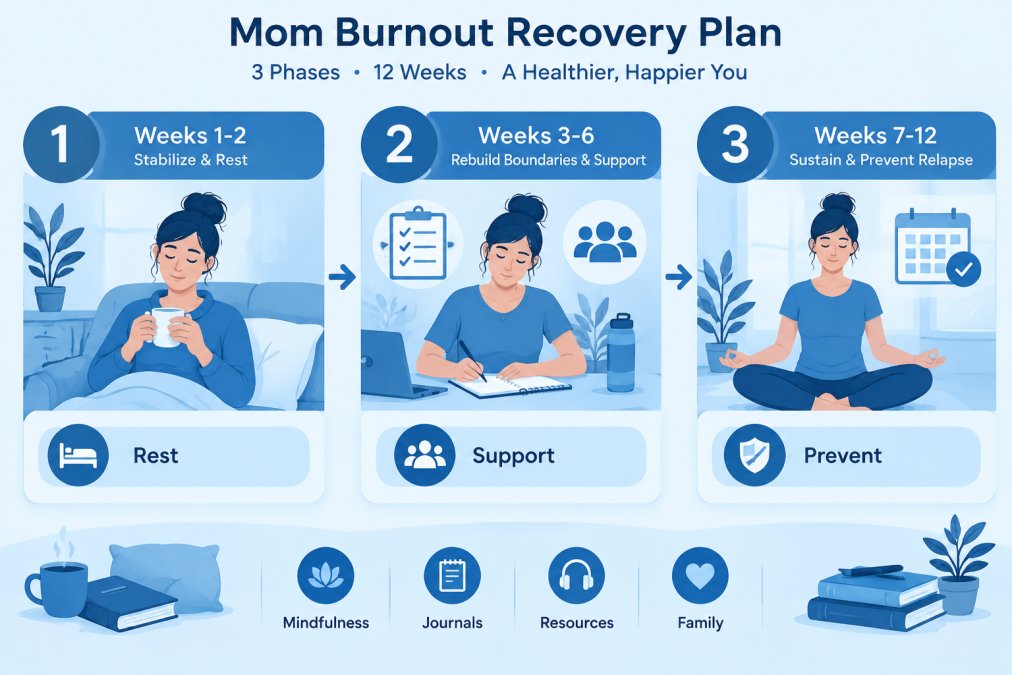
Weeks 1-2: Stabilize and Rest
Your only job here is to stop the bleeding. Do not try to overhaul your life yet. Rest is the work right now.
- Sleep first. Guard bedtime like a non-negotiable appointment. A consistent lights-out time, even on weekends, does more than one long catch-up night.
- Eat real meals. No skipping. Keep one easy protein and one easy carbohydrate on hand so a meal does not require a decision.
- Drink water before coffee. Dehydration mimics fatigue and worsens irritability.
Watch out: If you use these two weeks to reorganize the whole house or start a new routine for everyone, you will spend the recovery you just built. Keep the scope to sleep, food, water, and one declined commitment.
Weeks 3-6: Rebuild Boundaries and Support
Now you add structure. Pick two boundaries and hold them for the full four weeks before adding more.
- "I do not answer school messages after 8 p.m."
- "Sunday afternoons are mine."
- "I do not take on new volunteer roles this season."
Write each boundary down and tell one other adult in the household what it is.
Then build your support system. One person who knows your real week is worth more than a list of acquaintances.
This is also the phase to run a simple task audit.
Weeks 7-12: Sustain and Prevent Relapse
This phase is about keeping what works and building an early-warning system so the next high-stress season does not undo your progress.
Check in weekly with one question: "What drained me most this week?" Then remove one drain. Repeat. Small habits beat big resets.
Build a personal early-warning checklist.
Plan for predictable high-stress periods, the start of a school year, holidays, a work deadline, a family illness.
Watch out: Recovery is rarely a straight line.
When the Plan Is Not Enough
If you have followed the first six weeks and still feel flat, numb, or unable to function, that is information, not failure. Persistent symptoms that do not respond to rest and boundary changes are worth a conversation with a doctor or therapist. The section below on when exhaustion may signal something more explains what to watch for.
Low-Cost, Low-Time Support That Actually Fits Your Day
Support does not have to cost much or take hours. It has to fit the life you actually live. Many burnout tips assume you have money, childcare, and free time. If you have none of those, the options below are built around the constraints many parents face.
When You Have Ten Minutes and No Childcare
- A ten-minute walk alone. No phone. Just quiet. If you cannot leave the house, step outside the front door or sit in a parked car for ten minutes.
- A five-minute journal. Write down one thing that drained you and one thing you will not do tomorrow.
- A five-minute reset after a hard moment. Set a timer, sit down, and do nothing but breathe until it goes off. This is not meditation; it is a pause between demands.
When You Have No Budget
- Free or low-cost counseling. Community mental health clinics, employee assistance programs, and many faith-based organizations offer sliding-scale or no-cost sessions. Employee assistance programs are often available to a spouse or partner even if you do not work outside the home, so check both employers.
- Parent support groups. Many hospitals, libraries, and community centers host free parent groups. A group is not therapy, but it breaks the isolation that makes burnout worse.
- Library and park programs. Story time, drop-in play groups, and library events give you a low-cost block of time where another adult is present and your child is engaged.
When You Have No Free Time
- Stack recovery onto existing tasks. Listen to something you enjoy during the commute or while folding laundry. It is not a break, but it returns a small piece of the day to you.
- Ask for one specific block, not general help. "Can you handle dinner Wednesday so I can go to bed early?" is easier to say yes to than "I need more help."
- Use the smallest unit of rest. A five-minute lie-down with the door closed counts. So does eating lunch sitting down instead of standing.
Watch out: Do not turn low-cost support into another project to manage. Pick one option from this list, try it for a week, and keep it only if it actually gave you something back. A support that adds planning work is not support.
If you need relief fast, our guide on simple ways to reduce parenting burnout lists short options you can start today.
When Exhaustion May Signal Something More
Sometimes exhaustion is not just burnout. It can point to a medical or mental health condition.
Talk to a doctor if you notice:
- Sadness or hopelessness that lasts weeks
- Loss of interest in almost everything
- Sleep problems that do not improve
The National Institute of Mental Health's overview of depression explains the signs clearly. Burnout and depression can look alike. Only a professional can tell them apart.
Getting checked is not weakness. It is data. And data helps you fix the right problem.
Start Your 3-Step Reset Today
You do not need a perfect plan. You need one small step, then another.
Here is the reset we recommend at SSBGMARKETINGINC.:
- Name it. Take the quiz and write down your score.
- Rest first. Protect sleep and meals for two weeks.
- Add one support. Ask one person for one specific thing.
That is it. Small, repeatable, real.
If you want a simple daily tool to hold the habit in place, our 10-minute habit reset guide for busy moms walks you through it step by step.
Overcoming mom burnout in 2026 starts with one honest look at your week. SSBGMARKETINGINC. builds simple 3-step digital tools for exactly this moment, including our 10-Minute Manifestation Journal for Busy Moms, built for hectic schedules, and our Teen Girl Glow Up Journal for the daughters watching how you care for yourself.
Frequently Asked Questions
What are the symptoms of severe parental burnout?
Severe parental burnout shows up as emotional exhaustion that sleep does not fix, physical depletion, irritability, anxiety, and a sense of detachment from your kids. You may feel like you are running on empty, lose interest in things you used to enjoy, and notice your patience is gone. Some moms describe a loss of identity, feeling like they only exist to manage everyone else. If these signs last for weeks rather than days, that is your signal to get support rather than push through.
How can you tell the difference between mom burnout and depression?
Mom burnout is usually tied to caregiving demands and eases when the load lifts, while depression is a broader mood condition that persists across situations. Burnout brings exhaustion and overwhelm; depression often brings persistent sadness, hopelessness, and loss of interest in most things. The two can overlap, and burnout can lead to depression. A licensed therapist or doctor can sort out which is which, so if low mood lasts more than two weeks, get an assessment rather than self-diagnosing.
How long does it take to recover from mom burnout?
There is no single timeline, but a staged approach helps. Many moms feel steadier after two to four weeks of deliberate rest and reduced load, with deeper recovery over two to three months of rebuilding boundaries and support. Recovery is not linear and depends on how long you have been depleted and whether your responsibilities actually change. Track small wins like better sleep or fewer irritable moments rather than waiting for a dramatic shift.
How can a working mom recover from burnout while keeping her job?
Start with small, repeatable changes rather than a big overhaul. Protect one non-negotiable rest block each day, set a hard stop on work email in the evening, and delegate one recurring household task. Use a short daily reset like a 10-minute journal to clear mental clutter before the day starts. Ask your partner to own specific responsibilities outright, not just help out. If your workplace offers an employee assistance program, use it for counseling, which is often free.