 how-to
10 Minute Habit Reset Guide for Busy Moms
Table of Contents
- What Is a 10 Minute Habit Reset?
- The 10-Minute Mental Reset That Calms Your Nervous System
- Build a Simple Morning Routine for Moms in 10 Minutes
- How to Restart a Habit After Falling Off Track
- Why a Habit Tracker for Moms Keeps the Reset Going
- How to Reset a Habit in 10 Minutes: Step-by-Step
- Common Mistakes That Break Your Habit Reset
- Conclusion: Your Next 10 Minutes
- Frequently Asked Questions
Last Updated: October 7, 2026
What Is a 10 Minute Habit Reset?
A 10 minute habit reset is a short, structured pause where you clear your head, reset your space, and restart one small habit. It is not a full routine overhaul.
Most habits do not fail from lack of will. They fail from lack of time and too much mental clutter. A reset gives you a clean starting point without asking for an hour you do not have.
Why Ten Minutes Is Enough
Ten minutes works because it fits inside a real gap in your day. A short window is easier to protect than a long one, and a small, repeatable block beats a big plan you never start. It also lowers the bar for showing up: you are not committing to a lifestyle change, just one pause.
- It fits between tasks, no schedule rewrite needed
- It is short enough to repeat daily
- It targets one habit at a time, not ten
The 10-Minute Mental Reset That Calms Your Nervous System
A 10-minute mental reset is a brief, structured pause that signals safety to your body so your thinking brain can come back online. It combines slow breathing, a quick brain dump, and one grounding technique. The point is not to feel zen. The point is to move out of a stress state fast enough to make one good decision.
What Is Actually Happening in Your Body
Your autonomic nervous system runs two branches that matter here.
Two things happen when you stay in that state too long. Your breathing gets shallow and fast, keeping the alarm loop running.
The reset reverses both. Slow exhales are the lever: when your exhale is longer than your inhale, your heart rate slows and your vagus nerve signals that the emergency is over.
The 10-Minute Sequence
- Minutes 1-2: Sit and drop the phone. Put it face down and out of arm's reach. Looking at it resets the stress loop you are trying to interrupt.
- Minutes 3-4: Breathe in for four, out for six. Inhale through your nose, exhale through your mouth or nose. The longer exhale is the active ingredient. If four and six feels hard, try three and five. The ratio matters more than the count.
- Minutes 5-7: Brain dump. Write down every open loop in your head, unfiltered. Do not organize it, the goal is to move it out of working memory, which holds only a few items at once and gets overloaded fast.
- Minutes 8-9: Ground with one sense. Name five things you can see, or press your feet into the floor and notice the pressure. This pulls attention out of the mental replay and into the present.
- Minute 10: Pick one next action. Circle one item from the brain dump. That is your re-entry point.
Why the Brain Dump Matters More Than the Breathing
Breathing calms the body. The brain dump clears the runway. If you breathe for ten minutes and then walk back into the same mental clutter, the reset fades within an hour.
A common pattern is that the first three items on the brain dump are the same every day.
According to Harvard Health's overview of relaxation techniques, slow, steady breathing can help calm the body's stress response.
Build a Simple Morning Routine for Moms in 10 Minutes
A simple morning routine for moms works best when it happens before the house wakes up or right after the kids leave.
Most morning routines fail because they are built for someone with a quiet house and no commute. Yours has to survive interruptions.
A practical 10-minute morning routine:
- Minutes 1-3: Drink water and take five slow breaths
- Minutes 4-6: Write one intention for the day
- Minutes 7-10: Pick your top three tasks and stop
That is it. No app required, no 45-minute yoga flow.
Habit stacking makes this stick: attach a new habit to one you already do.
How to Restart a Habit After Falling Off Track
To restart a habit, skip the guilt and repeat the smallest version of it today. Falling off track is normal.
Here is what most guides miss: the restart is the habit. People who keep habits long term are not the ones who never miss. They are the ones who return faster. The skill you are building is not consistency.
The Two-Day Rule
One missed day is noise; two in a row is where habits die. Adopt a simple rule: never miss twice. You may skip a day, but not two, this prevents the slow slide where a missed Tuesday becomes a missed month. If you already missed two or more days, you are not disqualified; you are just restarting from a lower rung, and the rung still counts.
Why You Feel Resistant (And What to Do About It)
Resistance is usually one of four things, and each has a different fix:
- The habit is too big. Fix: cut it in half, then in half again. Meditating for ten minutes becomes one minute. Journaling a page becomes one sentence. Walking daily becomes a walk to the mailbox.
- The trigger is gone. Fix: reattach the habit to something you already do without thinking, like starting the coffee or brushing your teeth.
- The reward is missing. Fix: add a small, immediate payoff. A checkmark, a sip of something you like, or one word about how you feel after.
The Restart Script
When you feel the pull to quit, say: "I am not starting over. I am continuing from where I paused." Starting over implies you lost progress, you did not, the neural pathway is still there. Then do the smallest version today, not tomorrow. A one-minute version done today beats a ten-minute version planned for Monday.
What to Do After a Long Gap
If it has been weeks or months, do not rebuild the old routine. Build a new, smaller one, the old version was calibrated for a version of your life that may not exist anymore. Start at the floor: one minute, one sentence, one walk to the mailbox, then grow it again. Behavior change research points to the same pattern: small, repeatable actions beat big, rare ones, and the restart is the clearest proof of it.
If you have tried journals that ended up on your nightstand, the fix is usually size, not motivation. The 10-Minute Manifestation Journal for Busy Moms from SSBGMARKETINGINC. is built around this idea. It asks for a few minutes a day, not a lifestyle overhaul.
Why a Habit Tracker for Moms Keeps the Reset Going
A habit tracker for moms turns a one-time reset into a daily ritual.
What to track:
- Whether you did the reset, yes or no
- How you felt after, in one word
- Which habit you are resetting this week
Keep it to one habit at a time. Tracking five habits at once is a fast way to quit all five.
Get the 3-step manifestation ebook now →
A paper tracker on the fridge works. So does a simple note on your phone. The format matters less than the streak.
How to Reset a Habit in 10 Minutes: Step-by-Step
Total Time: 10 minutes Difficulty: Beginner
This is the core routine. Do it once today and you have already restarted. You will need a timer, one surface you can clear, and something to write on.
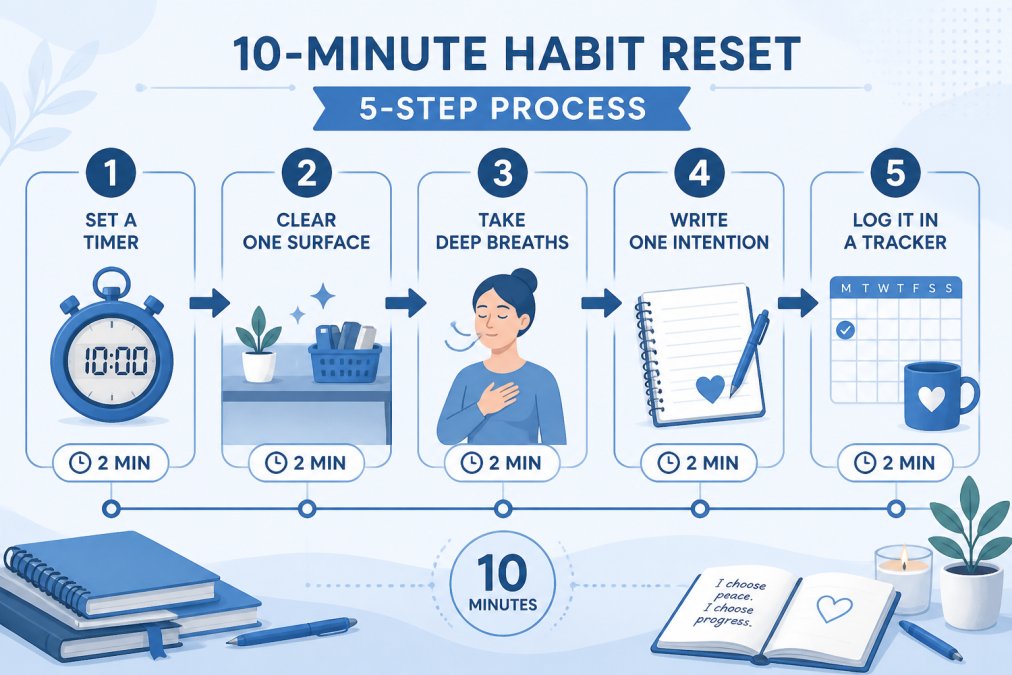
Step 1: Set a Timer for 10 Minutes [Time: 30 seconds]
Set a timer on your phone and put the phone out of reach. The timer protects the ten minutes. Without it, the reset drifts into scrolling.
Expected Result: A defined window you can actually finish.
Step 2: Clear One Surface [Time: 3 minutes]
Pick one surface, such as your kitchen counter or nightstand. Clear only that surface. Do not clean the whole room.
A clear surface gives your brain a visual signal that things are under control. Decluttering one small area is enough to shift the mood of a space.
Expected Result: One visible, organized space.
Step 3: Take Five Deep Breaths [Time: 1 minute]
Breathe in through your nose for four counts, out for six. Repeat five times. This is the nervous system reset, sixty seconds that changes how the next nine minutes feel.
Expected Result: A slower heart rate and a calmer head.
Step 4: Write One Intention [Time: 4 minutes]
Write one sentence about the habit you are restarting. Keep it specific and small.
- Weak: "Be more present"
- Strong: "Walk for five minutes after dinner"
One intention, one action, one day at a time.
Expected Result: A single clear action for today.
Step 5: Log It in a Tracker [Time: 1 minute]
Mark the day done. Write one word for how you feel. That is your first checkmark.
Expected Result: A visible start to your streak.
Common Mistakes That Break Your Habit Reset
The biggest mistake is making the reset too big. A ten-minute reset that slowly becomes forty minutes will get dropped the first busy week. Keep it small on purpose.
Other mistakes we see often:
- Resetting everything at once. Pick one habit. The rest can wait.
- Skipping the timer. Without a limit, the reset expands and dies.
- Waiting for the perfect moment. There is no quiet, perfect moment. There is only the ten minutes you claim.
If your reset keeps failing, the problem is usually the size, not you. Shrink it until it is easy, then let consistency do the work.
Conclusion: Your Next 10 Minutes
The hard part of any habit reset is not knowing what to do. It is starting when your day is already full. You do not need a free hour or a perfect morning.
At SSBGMARKETINGINC., we build tools for exactly this kind of mom: short on time, big on intention. Our Teen Girl Glow Up Journal helps you share that same mindfulness practice with your daughter, so the reset becomes something you do together.
Get the 3-step manifestation ebook now and turn your next ten minutes into a habit that holds.
Frequently Asked Questions
How do you reset a habit in 10 minutes?
Pick one habit you want to restart, set a timer for 10 minutes, and complete the smallest possible version of it. For example, if you want to journal, write one sentence. The goal is to remove the pressure that caused you to stop. Research on habit formation shows that consistency matters more than duration, so a 10-minute habit reset works because it lowers the barrier to starting again.
What can I do for a quick mental reset?
A 10-minute mental reset can include five slow breaths, a two-minute brain dump of everything on your mind, and one small physical action like clearing your desk or making tea. These steps calm your nervous system and create mental clarity without requiring a long break. Busy moms can do this during a school pickup line or while dinner simmers on the stove.
How do I restart a habit after falling off track?
Stop treating the break as failure. Choose a trigger you already do daily, like pouring your morning coffee, and attach the habit to it. This is called habit stacking. Then track it for seven days using a simple habit tracker for moms. If you miss a day, do a two-minute version the next day instead of quitting entirely. Restarting is a skill, not a character flaw.
How can busy moms make time for mindfulness?
You do not need a 30-minute meditation session. A simple morning routine for moms can start with three minutes of breathing before anyone else wakes up. Pair it with an existing task like brushing your teeth or waiting for coffee to brew. The key is attaching mindfulness to something you already do, so it does not feel like one more item on your to-do list.