 ultimate-guide
How to Stop Feeling Overwhelmed Daily: A Practical Guide
Last Updated: November 8, 2026
Quick Summary
To stop feeling overwhelmed daily, run a 3-step reset: pause and breathe slowly for two minutes, write down every open loop, then pick the single task that matters most today and break it into a first step you can start in under two minutes. It doesn't solve your life, but it gets you back to a state where you can solve the next piece.
- Slow breathing with a long exhale, four counts in and six counts out, signals safety to your nervous system.
- Score tasks 1 to 3 on impact and reversibility, then multiply; anything 6 or above gets scheduled today.
- Assign whole categories of responsibility to others instead of asking someone to help with single tasks.
- Keep three daily anchors: a 3-minute morning priority check-in, a 2-minute midday pause, and a 5-minute evening brain dump.
- Seek professional support if overwhelm doesn't lift after a few weeks of consistent changes.
Table of Contents
- Why You Feel Overwhelmed Every Day
- What to Do When You Feel Overwhelmed With Life
- How to Stop Feeling Overwhelmed and Anxious
- How to Stop Feeling Overwhelmed at Home
- How to Prioritize When Everything Feels Urgent
- Digital Overload and Attention Management for Busy Moms
- A Daily Routine That Prevents Overwhelm From Building
- When Overwhelm May Require Professional Support
- Frequently Asked Questions
Why You Feel Overwhelmed Every Day
Feeling overwhelmed is what happens when the demands on your attention outrun your capacity to process them, and for most busy mothers it has become a daily default rather than an occasional bad day.
A simple 3-step reset can have one job: lower the noise long enough for you to think again. Overwhelm isn't a relaxation problem. It's a load-management problem.
The Real Root Causes of Daily Overwhelm
Daily overwhelm rarely comes from one big crisis. It builds from small, unclosed loops: the school form you keep forgetting, the group chat you're behind on, the mental tab you never close.
A common mistake is treating the symptom, the frazzled feeling, while leaving the source untouched. If your day has no structure for deciding what matters, everything can feel urgent by default.
The Physical Symptoms of Feeling Overwhelmed
Feeling overwhelmed shows up in the body before you name it. Watch for tight shoulders, a clenched jaw, shallow breathing, headaches, a racing heart, or the strange fatigue that comes from doing nothing but worrying.
These are stress response signals, not proof you're failing. Catching them early can help, since noticing tension sooner may make the recovery feel shorter.
What to Do When You Feel Overwhelmed With Life
When life feels like too much, the answer is not to push harder. For fast, simple ways to reduce parenting burnout, see simple ways to reduce parenting burnout. If the overwhelm is tangled with burnout rather than a single busy week, our guide to overcoming parental burnout goes deeper into strategies built specifically for parents.
The 3-Step Reset You Can Do in 10 Minutes
- Pause and breathe slowly for two minutes. Four counts in, six counts out. Slow breathing signals safety to your nervous system, and the long exhale is the part that does the work.
- Write it down. Empty every open loop onto paper or your phone, unfiltered. A brain dump moves the noise out of your head and onto a surface you can actually sort.
- Pick one thing. Circle the single task that matters most today. Not five. One. Then break it into a first step small enough to start in under two minutes.
That's the whole reset. It doesn't solve your life. It gets you back to a state where you can solve the next piece.
How to Stop Feeling Overwhelmed and Anxious
Anxiety and overwhelm can feed each other: the more you spiral about what might go wrong, the less capacity you may have for what's actually in front of you. If anxiety is your main companion in this, our step-by-step guide on how to stop being stressed walks through seven approaches that work alongside this reset.
Try this when the spiraling starts. Name three things you can see, two you can hear, and one you can touch. It sounds almost too simple, but it pulls your attention out of the future and back into the room.
Acceptance matters too. Some days will be messy. Accepting that without judgment lowers the emotional charge and frees up mental energy you were spending on resistance.
How to Stop Feeling Overwhelmed at Home
Home is where the mental load concentrates, because home is where everyone else's needs live. Feeling overwhelmed at home usually traces back to invisible labor: the noticing, planning, and reminding that nobody sees but you carry constantly.
Start by handing off ownership, not tasks. Instead of asking someone to "help with laundry," assign the whole category. Rotate one recurring responsibility off your plate each week.
How to Prioritize When Everything Feels Urgent
Everything feels urgent because urgency is a feeling, not a fact. The practical fix is a concrete triage method you can run in under five minutes. A simple scoring system beats intuition when your nervous system is already flooded.
The 5-Minute Triage Method
Grab a piece of paper or open a note on your phone.
Then score each item on two dimensions, 1 to 3:
- Impact: How much does this matter in one week? (1 = barely, 3 = significantly)
- Reversibility: How hard is it to undo if I delay it? (1 = easy to fix later, 3 = permanent consequence)
Multiply the two scores. Anything scoring 6 or above gets scheduled today. Anything scoring 3 to 5 gets a calendar slot this week.
Watch out: the trap is scoring everything a 3 on impact because it feels important in the moment.
A Worked Example
Suppose your list includes: (a) reply to a client email, (b) sign a school permission slip due tomorrow, (c) reorganize the pantry, (d) schedule a dentist appointment you've postponed twice.
- Client email: impact 2, reversibility 2 = 4 → schedule this week.
- Permission slip: impact 3, reversibility 3 = 9 → do today.
- Pantry: impact 1, reversibility 1 = 1 → park or delete.
The math forces honesty. The pantry feels productive, but it fails both tests.
Returning Borrowed Urgency
The thing nobody tells you is that most "urgent" items are other people's urgency borrowed as your own. Before you score an item, ask: Whose deadline is this? If a colleague, friend, or family member could reasonably handle it themselves, returning that urgency to its owner, politely and without apology, is one of the most effective ways to stop feeling overwhelmed daily.
When Everything Genuinely Is Urgent
Some seasons, a sick child, a work crunch, a move, really do stack multiple high-impact, low-reversibility items at once. The triage method still works, but the output changes: you're not trying to clear the list, you're trying to sequence it. Pick the one item with the highest score, do only that, and re-score the rest tomorrow.
Digital Overload and Attention Management for Busy Moms
Your phone is a direct line to everyone else's priorities, and it never stops ringing. Digital overload fragments attention into pieces too small to finish anything, which is why you can be busy all day and still feel behind.
Practical moves many people find helpful: turn off non-human notifications, batch messages into two or three check-ins a day, and keep one screen-free zone, such as the bedroom. If mental clutter is your specific struggle, our guide to managing mental clutter as a parent gives you a simple system for clearing it.
A Daily Routine That Prevents Overwhelm From Building
Prevention beats rescue every time. A daily routine for overwhelm doesn't need an hour of silence and a candle; it needs three small anchors that keep the load from stacking up.
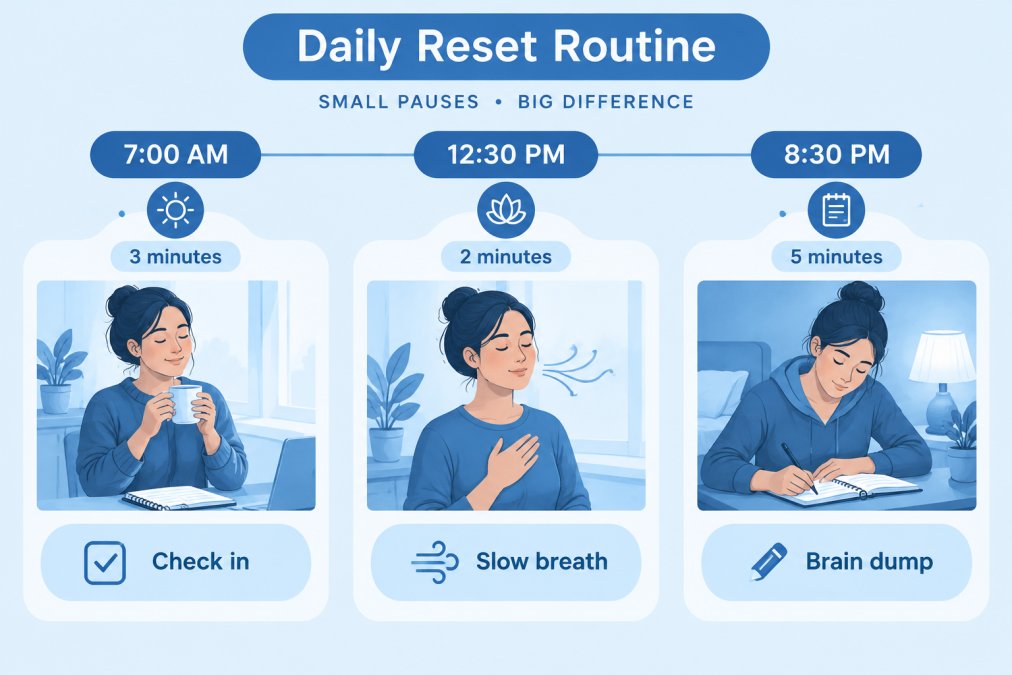
Morning: The 3-Minute Priority Check-In
Before the day picks your priority for you, pick it yourself. Spend three minutes, while the coffee brews, before you open email, writing down the one thing that would make today feel successful.
Why morning? Decision fatigue builds through the day, and the quality of your choices degrades with it. Front-loading the one decision that matters most protects you from spending your best cognitive energy on triage later.
Midday: The 2-Minute Slow-Breathing Pause
Around midday, stress hormones have often accumulated without you noticing. A two-minute pause, four counts in, six counts out, signals safety to your nervous system and lowers the physiological charge before it compounds into the afternoon crash.
Set a phone alarm for the same time each day. The goal is not to feel calm in the moment; it's to prevent the stress response from staying switched on for eight straight hours.
Evening: The 5-Minute Brain Dump
Open loops follow you to bed. A five-minute brain dump before dinner, every unfinished task, worry, and reminder onto paper, closes the tabs in your head so they don't replay at 2 a.m.
Watch out: the brain dump can become a worry session if you let it. Keep a hard five-minute limit and stop when the timer goes. The point is to externalize, not to solve.
Personalizing the Routine to Your Overwhelm Type
The three anchors above are the baseline, but the daily pattern in the query, daily overwhelm, usually has a specific cause. Adjust the routine to match:
- Workload overwhelm: Add a 10-minute Sunday planning session to map the week's top three priorities before Monday arrives.
- Caregiving overwhelm: Add a daily handoff, one recurring responsibility transferred to another adult each week, not just a one-off task.
- Uncertainty overwhelm: Add a two-minute "what's actually in my control today" note to the morning check-in.
Protecting the Basics
Sleep, movement, and regular meals are foundational habits that support your stress response. These daily habits are simple and often effective. Aim for a consistent wake time, ten minutes of walking, and one meal eaten away from a screen. None of these are dramatic; together they raise the threshold at which overwhelm tips over.
The Weekly Review That Keeps It Running
Once a week, Friday afternoon or Sunday evening, five minutes, review what actually happened. Which anchor did you skip? Which one helped most? Adjust one thing for next week. A routine that never gets reviewed becomes another item on the list; a routine that gets tuned becomes a system you can keep.
Three small anchors keep the load from stacking up through the day.
| Time of day | What to do | How long |
|---|---|---|
| Morning | Write the one thing that would make today feel successful | 3 minutes |
| Midday | Slow-breathing pause, four counts in, six counts out | 2 minutes |
| Evening | Brain dump every unfinished task, worry and reminder | 5 minutes |
| Weekly | Review which anchor you skipped and which helped most | 5 minutes |
How long
When Overwhelm May Require Professional Support
Sometimes overwhelm is a signal, not a scheduling problem.
Seeking help is not a failure of your coping strategies. For many people, professional support alongside practical daily habits can be a helpful part of managing persistent overwhelm.
Feeling overwhelmed daily isn't something you fix once and forget. It's something you manage with small, repeatable tools, and the smallest tools are often the ones that stick.
Frequently Asked Questions
What could be causing my constant feeling of overwhelm?
Constant overwhelm usually comes from a mix of too many open tasks, decision fatigue, and no recovery time. For busy moms, the biggest drivers are household management, career demands, and the mental load of tracking everyone's needs. Digital overload plays a role too: constant notifications keep your stress response switched on. One approach is to narrow your focus to one or two priorities per day and build short pauses into your routine, which may give your nervous system a chance to reset.
What are the physical symptoms of feeling overwhelmed?
The physical symptoms of feeling overwhelmed often include tight shoulders or jaw, headaches, shallow breathing, a racing heart, trouble sleeping, and fatigue that does not improve after rest. Some people feel it as stomach upset or a lump in the throat. These are signs your stress response is stuck in the on position. When you notice them, treat them as a signal to pause rather than push through. Two minutes of slow breathing can lower the physical intensity enough to think clearly again.
How can I stop feeling overwhelmed and anxious in the moment?
Start with your body before your thoughts. Take five slow breaths with a longer exhale than inhale, then name what you are feeling out loud or in writing. Next, pick one small action you can complete in under ten minutes, like clearing one counter or sending one email. When you are feeling overwhelmed and anxious, completing a single small task may help you feel that things are more manageable. Consider saving bigger decisions for after your body has settled.
How do I stop feeling overwhelmed at home when the mess and to-do list keep growing?
Lower the bar on purpose. Choose one room or one surface and reset only that, for ten minutes maximum. Write down everything on your mind in a brain dump, then circle the three items that actually matter today and ignore the rest until tomorrow. Involve your family with simple, age-appropriate tasks instead of doing it all yourself. A short daily reset habit may keep the pile from becoming a source of dread.
How do I know when overwhelm means I need professional help?
Consider reaching out to a doctor or therapist if overwhelm lasts most days for more than two weeks, if you cannot sleep or eat normally, if you feel hopeless or numb, or if it is affecting your work and relationships. Panic attacks, chest pain, or thoughts of harming yourself need prompt attention. A licensed mental health professional can assess whether anxiety or depression is involved. Daily habits and journaling help, but they are not a substitute for care when symptoms are persistent or severe.