 ultimate-guide
Non-Judgmental Parenting Support Resources for Moms
Last Updated: October 23, 2026
Quick Summary
Non-judgmental parenting support is care and community offered without criticism, comparison, or unsolicited advice, and it removes the fear that keeps overwhelmed mothers silent. Parenting support groups work best when the format matches your actual life, and asking for help gets easier when you request a specific, small thing from a specific person.
- Non-judgmental listening means reflecting back what you heard and asking what kind of response the person wants.
- Before joining a group, ask whether the facilitator sets ground rules about advice-giving.
- Send your first ask for help as a text so you can finish the sentence without your voice cracking.
- Sort burnout resources by time cost first, from a 10-minute journal to weekly support groups.
- Build a network with three people and one recurring touchpoint rather than a wide web of contacts.
Table of Contents
- Why Non-Judgmental Parenting Support Changes Everything
- What Non-Judgmental Listening Actually Looks Like
- Parenting Support Groups: Finding a Room That Fits
- How to Ask for Parenting Help Without the Shame Spiral
- Parenting Burnout Resources That Fit a Real Schedule
- Building a Support Network You Can Actually Maintain
- Conclusion
- Frequently Asked Questions
Why Non-Judgmental Parenting Support Changes Everything
Non-judgmental parenting support is care and community offered without criticism, comparison, or unsolicited advice, and it changes everything because it removes the fear that keeps overwhelmed mothers silent. That fear is the real barrier, not a lack of resources.
The distinction matters. Judgment-free support means the person across from you listens to what you actually said instead of measuring you against a standard. Many mothers find that once the fear of being graded disappears, they finally tell the truth about how they're doing. And the truth is usually the first step toward relief.
What Non-Judgmental Listening Actually Looks Like
Non-judgmental listening is the practice of receiving what a parent says without correcting, advising, or ranking their experience, and it looks quieter than most people expect. It means reflecting back what you heard, asking what kind of response the person wants, and resisting the urge to solve.
In practice, that sounds like: "That sounds exhausting. Do you want ideas, or do you just need to say it out loud?" That single question does more for a struggling mother than an hour of well-meant tips. A common mistake is confusing listening with agreement. You can hold your own view and still let someone finish a sentence without interruption.
The American Psychological Association's guidance on supportive listening describes this as active listening, and it is a learnable skill rather than a personality trait. You can practice it with a friend this week. Ask one question, then stay quiet for a full minute.
Parenting Support Groups: Finding a Room That Fits
Parenting support groups work best when the format matches your actual life, not the ideal version of it. A group you can reach on a Tuesday night after bedtime beats a perfect one you never attend.
In-Person Groups vs. Online Communities
In-person groups give you eye contact, shared silence, and the sense that other mothers are real. Online communities give you flexibility, anonymity, and access at 11 p.m. when the house is finally quiet. Many parents use both: a weekly online check-in for consistency and a monthly in-person meetup for connection.
When you evaluate a group, ask three questions before joining:
- Does the facilitator set ground rules about advice-giving?
- Can I observe a session before committing?
- Is the group moderated, or does it run unmoderated?
That third question matters more than most people realize. Unmoderated spaces drift toward comparison and criticism fast.
How to Ask for Parenting Help Without the Shame Spiral
Asking for parenting help gets easier when you lower the stakes of the ask. You are not requesting a verdict on your mothering. You are requesting a specific, small thing from a specific person.
The shame spiral starts with a story you tell yourself: that needing help means you're failing. Most people on the receiving end of a request hear something entirely different. They hear that you trust them.
Scripts for the First Ask
Use these word for word until they feel natural:
"I'm having a hard week with [specific situation]. I'm not looking for advice right now. Could you just listen for ten minutes?"
"I need to tap out for an hour on Thursday. Can you take over bedtime so I can reset?"
"I'm looking for a support group and feeling nervous about it. Would you help me find one?"
Notice what these scripts do. Each one names the situation, states what you need, and removes the other person's guesswork. A common mistake is asking vaguely ("let me know if you ever hear of anything") and then feeling hurt when nothing comes back.
Parenting Burnout Resources That Fit a Real Schedule
Parenting burnout resources only help if they survive contact with a Tuesday. The best resource is the one you'll actually use at 9:40 p.m. with dishes in the sink, not the one that requires a quiet hour you don't have.
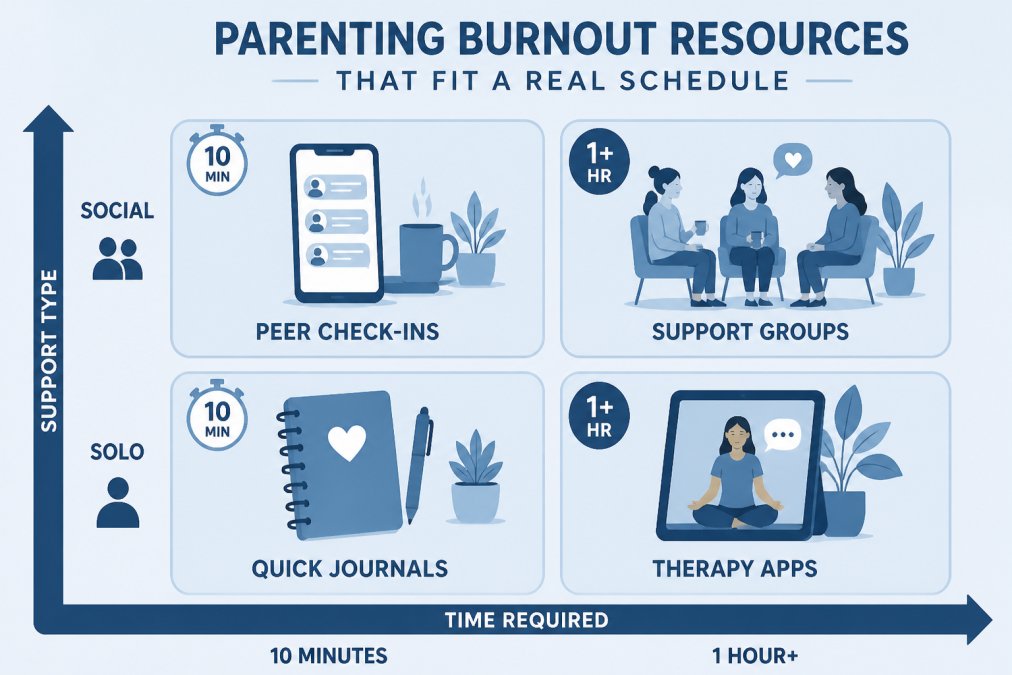
Sort your options by time cost before you sort them by anything else:
| Resource type | Time cost | Best for | Watch out for |
|---|---|---|---|
| Short daily journaling | 10 minutes | Racing thoughts at night | Turning it into another chore |
| Peer check-in call | 15-20 minutes | Feeling isolated | Drifting into complaint loops |
| Support group | 60 minutes weekly | Sustained connection | Unmoderated groups |
| Therapy or counseling | 45-60 minutes | Persistent low mood | Long waitlists |
Our 10-Minute Manifestation Journal for Busy Moms was built for the top row of that table: a short daily gratitude and visualization practice that fits a hectic schedule instead of competing with it. The Substance Abuse and Mental Health Services Administration's national helpline is a free, confidential option if burnout has tipped into something heavier, and it is worth knowing about before you need it.
Building a Support Network You Can Actually Maintain
A support network you can maintain is small, reciprocal, and scheduled. Most mothers try to build a wide web of contacts and then abandon it within a month because it asks too much.
Start with three people and one recurring touchpoint. A weekly text to one friend, a monthly group session, and one family member who knows your hard days. That's it. The Centers for Disease Control and Prevention's guidance on parental stress and connection points to social connection as a protective factor for parents, which matches what we hear from the moms we work with.
For mothers raising daughters, shared practice builds the network from inside the house. Our Teen Girl Glow Up Journal gives you and your daughter a common language for mindset and self-esteem work, which turns a household into a support system rather than a second job.
Conclusion
The hardest part of seeking non-judgmental parenting support resources is not finding them. It's believing you deserve them before you've earned some imaginary right to rest. You don't have to wait for the breaking point to ask for help.
Start with one small step today: send one honest text, bookmark one group, or open one journal. SSBGMARKETINGINC. built the 10-Minute Manifestation Journal for Busy Moms and the Teen Girl Glow Up Journal around exactly this idea, with short daily prompts, a three-step structure, and a format that fits a real schedule. Get the 3-step manifestation ebook now
Frequently Asked Questions
Where can I find non-judgmental parenting support?
Start with three places: local parent support groups (search community center and library listings), online peer communities moderated with clear no-shame rules, and licensed counselors who specialize in parenting stress. The key filter is tone. Call or email ahead and ask directly, 'How do you handle a parent who feels judged?' A group or therapist that answers that question calmly and specifically is usually the right fit for non-judgmental parenting support.
How can I ask for parenting help without feeling judged?
Name the specific task instead of the general feeling. 'Can you take the kids Tuesday from 4 to 6?' lands better than 'I'm drowning.' Specific requests are easier to say yes to and carry less implied failure. Practice one sentence out loud before you send it. If someone responds with advice you didn't ask for, you can say, 'I'm not looking for solutions right now, just a hand.' That is how to ask for parenting help while keeping your dignity intact.
Are there support groups for parents who feel stressed or burned out?
Yes. Options include hospital-sponsored parent groups, faith community groups, school parent networks, and online parenting support groups built around burnout recovery. Many are free; some counselors run sliding-scale group sessions. Before joining, ask two questions: who moderates the group, and what the rules are about giving advice. Groups that center non-judgmental listening rather than quick fixes tend to help burned-out parents more than groups that turn into advice swaps.
What does non-judgmental parenting support look like in practice?
It looks like someone hearing 'I yelled at my daughter again' and responding with curiosity instead of a lecture. Non-judgmental listening means reflecting back what you heard, asking what you need, and not attaching a verdict to your parenting. Practical markers: no unsolicited advice, no comparisons to other families, and space to say the messy truth out loud. You should leave the conversation feeling lighter, not graded.
How do I know if I need parenting burnout resources versus just a break?
A break restores you in a day or two. Burnout keeps returning: irritability most days, dread about the morning routine, feeling detached from your kids, and sleep that does not fix the fatigue. If that pattern has lasted weeks, parenting burnout resources such as a support group, a counselor, or a structured daily reset practice are worth adding. Start with the smallest tool, like a 10-minute journal or one weekly check-in, and build from there.
How can parents support each other without giving unwanted advice?
Ask before offering. 'Do you want ideas or just company?' takes two seconds and prevents most friction. When a friend vents, reflect instead of fixing: 'That sounds exhausting.' Save advice for when it is requested, and when you do share, frame it as what worked for you, not what they should do. This is the core of non-judgmental listening, and it is the fastest way to become the friend other parents actually call.