 ultimate-guide
How to Build Teen Self-Esteem: A Parent's Guide
Table of Contents
- Start with the Signs: Recognizing Low Self-Esteem in Teens
- How to Help a Teenager with Low Self-Esteem: A Step-by-Step Plan
- Teen Self-Confidence Activities That Build Real Skills
- How to Talk to Teens About Body Image Without Causing Shame
- Praise That Builds Teen Self-Esteem Without Pressure
- When Low Self-Esteem Needs Professional Support
- Conclusion
- Frequently Asked Questions
Last Updated: October 20, 2026
Start with the Signs: Recognizing Low Self-Esteem in Teens
Teen self-esteem is a teenager's overall sense of worth and capability, and it shapes how they handle school, friendships, and setbacks. The signs are usually quieter than parents expect.
Watch for these patterns:
- Apologizing for taking up space, or dismissing compliments outright
- Quitting activities before trying, to avoid being seen failing
- Constant comparison to friends or strangers online
- Withdrawing from family meals and previously loved hobbies
- Overreacting to small mistakes as proof of personal failure
One honest note: a bad week is not a diagnosis. Look for duration and breadth. If withdrawal touches school, friends, and home for several weeks, that pattern deserves attention. The American Academy of Pediatrics mental health guidance is a solid starting point for understanding what warrants a closer look.
How to Help a Teenager with Low Self-Esteem: A Step-by-Step Plan
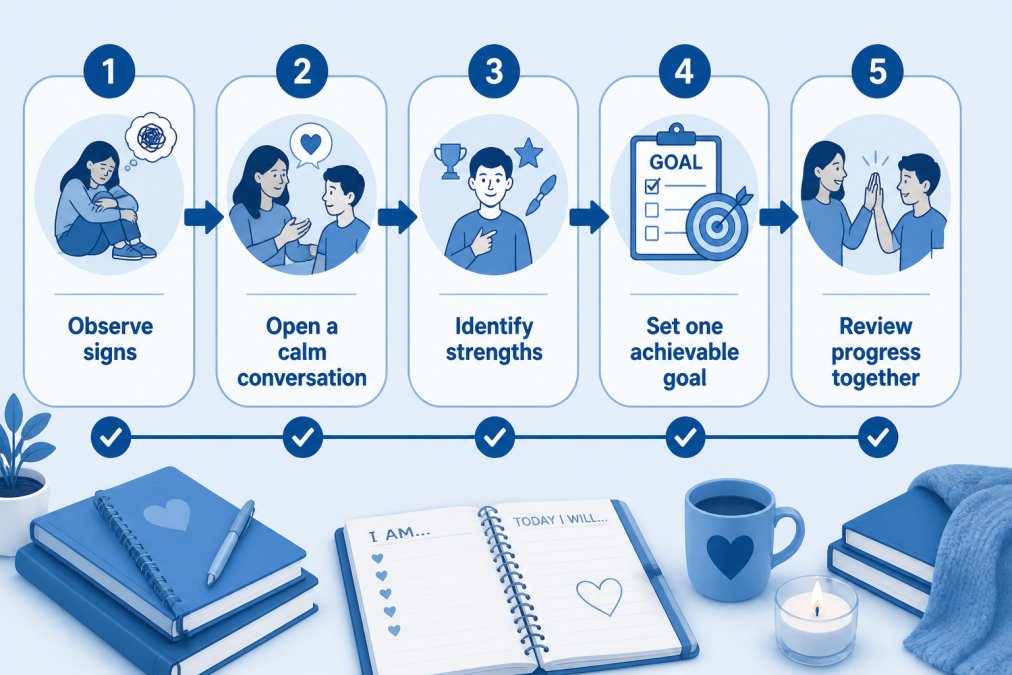
Helping a teenager with low self-esteem starts with observation, not correction. Our five-step plan is designed for busy mothers who need something that fits between dinner and bedtime.
- Observe for one week. Write down what you actually see, not what you fear.
- Open a calm conversation. Ask, don't announce. "I noticed you skipped tryouts. What happened?" beats "You need more confidence."
- Identify two or three real strengths. Name them with evidence.
- Set one achievable goal. Small enough to finish this week.
- Review together. Ask what felt hard, and praise the attempt.
Ten minutes of focused attention beats an hour of distracted hovering. That is the principle behind our 10-Minute Manifestation Journal for Busy Moms.
Teen Self-Confidence Activities That Build Real Skills
Teen self-confidence activities work when they produce visible progress, not just good feelings. Skill-building beats pep talks every time, and the ranking results mostly stop at "encourage hobbies." This section goes further: it gives teens self-directed exercises they can run without a parent in the room, plus the social media tactics most guides skip.
A teen-directed confidence plan (the gap most articles miss)
Most advice online is written for parents. This part is written for the teen. The plan is built on a simple mechanism: confidence follows evidence, and evidence comes from small, repeated actions you can point to.
- Pick one skill you want to be visibly better at in 30 days. Not "be more confident", something observable: a 5K run, a song learned start to finish, 10 volunteer hours logged, a driver's-ed practice log filled in.
- Break it into three weekly actions of 20-30 minutes. Small enough that a bad week doesn't erase the streak.
- Track it where you'll actually see it. A notes-app checklist, a paper calendar on the wall, or a shared doc. The point is a record you can review when motivation dips.
- Write one line after each session: what you did, what felt hard, what you'd change. This is the reflection prompt that turns activity into self-knowledge.
- Review on Sunday. Ask: What moved? What stalled? What's the next smallest step?
A common pattern practitioners describe: teens who keep a visible log for four to six weeks start describing themselves in terms of what they've done ("I'm someone who shows up") rather than what they feel ("I'm not confident").
Skill-building activities with a finish line
- Hobbies with a deliverable: a finished song, a rebuilt bike, a completed volunteer shift, a portfolio of five photos.
- Volunteering: responsibility and independence grow fast when someone else depends on them. Animal shelters, food banks, and library teen councils are common entry points.
- Part-time work or a family role with genuine ownership, not a chore assigned and checked, but a job whose outcome is theirs.
- Practice with achievable goals, reviewed weekly, so progress is visible rather than assumed.
Decision-making is a muscle. Let your teen make low-stakes choices, planning a meal, managing a small budget, choosing their own schedule, and let the imperfect result stand. Resilience grows from recovering, not from being rescued.
Social media strategies most guides leave out
Social media is where teen self-esteem takes the most daily hits, yet most ranking articles mention it only in passing. These are concrete, teen-controlled moves:
- Curate the feed deliberately. Unfollow or mute accounts that reliably leave you feeling worse, fitness, beauty, or "glow-up" accounts included. Follow three accounts that teach something you're actually practicing.
- Take comparison breaks. A 24-hour pause from one platform, once a week, is a low-stakes experiment. Notice what changes in mood and what you reach for instead.
- Separate the edit from the image. When a post stings, ask: what was filtered, staged, or selected? The comparison is usually against a highlight reel, not a life.
- Respond to cyberbullying in writing, not in the moment. Screenshot, block, report, and tell one trusted adult. Do not reply while activated, replies become content.
- Set a bedtime cutoff. Late-night scrolling is where comparison loops run longest; a phone-charging spot outside the bedroom is the simplest fix.
How to Talk to Teens About Body Image Without Causing Shame
Conversations about body image go wrong when they start with a verdict. Start with curiosity instead, and understand the mechanism: teens hear body comments as evaluations of their worth, not their appearance, so even well-meant praise ("You look great!") can register as "so I didn't before." The goal is to remove appearance from the scoreboard, not to add nicer scores.
What to say instead (concrete swaps)
- Instead of "You look so healthy!" try "You seem really energized lately."
- Instead of "I need to lose a few pounds" try saying nothing about your own body at all, model neutral language by leaving it out.
- Instead of "That outfit is flattering" try "That's a great color on you" or, better, ask what they like about it.
- Instead of commenting on food choices try "What sounded good to you?" and let the answer stand.
A common pattern: parents who stop narrating their own diets out loud see the biggest shift, because teens mirror the household's body talk more than its body rules.
When the conversation stalls
Teens often reject body-image conversations with a shrug or a door. That is not failure, it is a signal to change the format. Try:
- Talk side-by-side, not face-to-face. In the car, on a walk, doing dishes. Direct eye contact reads as an evaluation.
- Ask about the media, not the body. "What do you think that post is edited to hide?" is easier to answer than "How do you feel about your body?"
- Name the filter, not the photo. Talk about the editing, lighting, and selection behind images rather than the images themselves.
- Let silence sit. A question left unanswered at dinner is often answered three days later in the car.
Social comparison and peer pressure online
Body image and social media are now the same conversation. Comparison intensifies when feeds are curated by an algorithm rather than chosen. Practical moves: mute or unfollow accounts that reliably leave your teen feeling worse, take a 24-hour break from one platform once a week, and separate the edit from the image, the comparison is usually against a highlight reel, not a life.
Get the 3-step manifestation ebook now →
Inclusive guidance: one approach does not fit every teen
Body image pressure lands differently depending on identity, disability, neurodivergence, culture, and family circumstances. Teens in larger bodies, teens with visible disabilities, and teens from families that comment openly on weight all face different baselines.
If your teen seems consumed by appearance worries, checking, restriction, avoidance of meals or mirrors, the National Eating Disorders Association screening tool offers a private way to check whether professional support makes sense. Treat it as a starting point, not a diagnosis.
Praise That Builds Teen Self-Esteem Without Pressure
Specific praise builds teen self-esteem; vague praise creates pressure. "You're so smart" sets a bar your teen now has to defend. "You studied for three nights and it showed" describes what they did.
Swap these phrases:
- Instead of "You're the best," try "That was a thoughtful thing to say to your friend."
- Instead of "You always do great," try "You handled that setback better than last time."
- Instead of praising outcomes only, praise effort, choices, and recovery from mistakes.
The thing nobody tells you about praise is that teens hear the unspoken part. If every compliment is followed by a suggestion, they learn that praise is a setup for criticism. Let the compliment land and stop talking.
When Low Self-Esteem Needs Professional Support
Low self-esteem sometimes signals something bigger. Seek professional support when you see persistent hopelessness, withdrawal from all friends, refusal to attend school, self-harm, or talk of not wanting to be here.
Start with your pediatrician, who can screen and refer. School counselors are a free, fast first step. Licensed therapists who work with adolescents can teach coping skills and problem-solving directly.
You are not overreacting by asking. Early support is easier than crisis support, and asking for help models self-advocacy for your teen.
Conclusion
Building teen self-esteem is slow, unglamorous work, and it rarely looks like a breakthrough moment. It looks like one calm conversation, one finished project, and one honest compliment repeated over months. Our Teen Girl Glow Up Journal gives your daughter a private, low-pressure place to build those habits, with prompts on mindset, mindfulness, and confidence that she can work through in minutes. Get the 3-step manifestation ebook now.
Frequently Asked Questions
What are the most common signs of low self-esteem in teens?
Watch for frequent self-criticism, avoiding new activities, withdrawing from friends, difficulty accepting compliments, and saying 'I can't' before trying. Teens with low self-esteem may also fixate on appearance, compare themselves constantly on social media, or give up quickly after mistakes. These signs are not a diagnosis, but they are signals to start a calm conversation and offer support rather than criticism.
How can I help my teenager improve their self-concept?
Start by listening without fixing. Ask what they think they are good at and reflect back specific strengths you notice. Encourage one small, achievable goal at a time, such as joining a club or practicing a skill for 10 minutes daily. Celebrate effort, not just outcomes. A structured tool like the Teen Girl Glow Up Journal can give teens a private space to track wins and practice positive self-talk.
What teen self-confidence activities actually work?
Activities that combine skill-building with small challenges work best: volunteering, team sports, creative projects, part-time jobs, or leading a family task. Practice matters more than perfection. Try a weekly 'strength spotter' exercise where your teen names three things they did well, or a 10-minute journaling habit that turns wishes into concrete next steps. Keep the focus on progress, not comparison.
How do I talk to my teen about body image without making it worse?
Avoid commenting on their body directly, even as a compliment. Instead, talk about what bodies can do and how media images are edited. Ask open questions like 'How do you feel after scrolling?' and share your own struggles briefly. Set a no-body-talk rule at meals. If your teen shows signs of an eating disorder, contact a licensed professional or the National Alliance for Eating Disorders helpline.
When should a teenager get professional help for low self-esteem?
Seek professional help if low self-esteem lasts for weeks, interferes with school or friendships, or comes with symptoms like persistent sadness, withdrawal, self-harm, or talk of worthlessness. A pediatrician or licensed therapist can assess for depression or anxiety. Early support works better than waiting. If there is any risk of self-harm, call or text 988 for the Suicide & Crisis Lifeline.
Can parents build teen self-esteem in just 10 minutes a day?
Yes, small consistent actions add up. Ten minutes of undivided attention, a short journaling prompt, or a daily check-in about one win can shift how a teen sees themselves over time. The key is consistency and sincerity, not length. The 10-Minute Manifestation Journal for Busy Moms offers a simple format you can model alongside your teen.