 how-to
What Is the Best 10-Minute Morning Routine for Moms?
Last Updated: November 9, 2026
Quick Summary
The best ten minute morning routine for moms is one minute of box breathing and a glass of water, three minutes of bodyweight movement, four minutes of journaling, and two minutes naming your top task. Keep your phone face-down until it ends, and fold each step into tasks you already do on kid-awake mornings.
- Set out your water bottle, journal, timer, comfortable clothes and floor space the night before.
- Run the bodyweight circuit once: arm circles, side bends, squats, shoulder rolls, calf raises and neck rolls.
- On kid-awake mornings, do box breathing while pouring cereal and journal one line while your child eats.
- Pick a fixed departure anchor such as 7:20 and work backward so the routine ends at 7:10.
- On hard days, cut the routine to two steps: breathe and write.
Table of Contents
- Why a 10-Minute Morning Routine Beats a 60-Minute One
- What You'll Need Before You Start
- Step 1: Take 60 Seconds of Box Breathing and Hydration
- Step 2: Move Your Body for Three Minutes
- Step 3: Write for Four Minutes With These 10-Minute Morning Journal Prompts for Moms
- Building a Mindful Morning Routine for Moms Who Wake Up to Kids Already Awake
- The 10-Minute Morning Routine for Working Moms Who Leave the House
- Your Morning Routine Checklist for Moms (Print or Screenshot This)
- Frequently Asked Questions
Why a 10-Minute Morning Routine Beats a 60-Minute One
The best ten minute morning routine for moms is short on purpose, not short by accident. Ten minutes works because it fits inside the small gap between waking up and the first demand of the day, so it actually happens. A 60-minute plan sounds noble. It also collapses the first time a child wakes up early or a meeting gets moved.
Here at SSBGMARKETINGINC., we build everything around that same idea: small, repeatable steps beat ambitious plans that never survive contact with a real morning.
What Ten Minutes Actually Does for Stress and Focus
Ten minutes is long enough to lower stress and short enough that you cannot talk yourself out of it. Box breathing and hydration calm your body fast. A few minutes of movement wakes up your muscles. A short journal entry clears the mental clutter before it piles up.
The American Psychological Association's resources on stress management notes that brief, consistent calming practices help regulate the body's stress response. Consistency matters more than duration. Ten minutes every day beats an hour once a month, every time.
That's the core argument of this whole guide: frequency wins over length.
What You'll Need Before You Start
Nothing fancy. Set these five things out the night before and the routine runs itself:
- A water bottle or glass by the bed, filled
- A journal and pen on the nightstand
- A timer or phone alarm set to 10 minutes
A common mistake is treating gear as the barrier. It isn't. The barrier is decision fatigue at 6 a.m., and a pre-set station removes it. For a fuller walkthrough of the routine itself, our simple morning routine for moms lays out the full step-by-step version.
Step 1: Take 60 Seconds of Box Breathing and Hydration
Start with one minute of box breathing, then drink water. That's the whole step.
Box breathing is simple: breathe in for four counts, hold for four, breathe out for four, hold for four (Box Breathing Benefits and Techniques). Repeat four times. Then drink a full glass of filtered water.
Why this order? Water rehydrates you after hours without it.
Watch out: don't skip the water because you're rushing to the coffee. One minute is all this step costs you.
Step 2: Move Your Body for Three Minutes
Three minutes of physical movement comes next, and it does not require a gym, equipment, or a change of clothes.
Movement raises energy levels and shakes off stiffness from sleep. It also counts as self-care you can do before anyone needs you. If quick body-based practices work well for you, our guide to quick mindfulness practices for busy moms has more options to slot in.
A No-Equipment Bodyweight Sequence You Can Do in Pajamas
Run this circuit once through, no equipment needed:
- Arm circles - 20 seconds forward, 20 seconds back
- Standing side bends - 30 seconds, gentle stretching
- Bodyweight squats - 10 slow reps
- Shoulder rolls - 20 seconds
- Calf raises - 15 reps
- Neck rolls - 20 seconds, slow and easy
The goal isn't fitness. It's waking your body up so your mind follows.
Step 3: Write for Four Minutes With These 10-Minute Morning Journal Prompts for Moms
The final four minutes go to journaling, and this is where the routine earns its keep. Use these 10-minute morning journal prompts for moms as a rotating set, not a rigid script:
- What is one thing I want to feel today?
- What is one thing I can let go of?
- Name three small things I'm grateful for.
Pick one or two prompts. Write without editing. The point is intentionality, not perfect prose.
Gratitude journaling pairs naturally with this step. If you want a short daily gratitude practice to run alongside it, our 5-minute gratitude practice for busy moms gives you a simple format.
Prompts for Mornings When You Have Nothing Left
Some mornings you open the journal and feel blank. That's normal. Use these stripped-down versions:
- "Today I need ______."
- "One small good thing: ______."
- "I'm doing my best with ______."
Even one line counts. A half-finished entry still beats a skipped one. This is where habit stacking helps: attach the journal to the water bottle, and the two steps become one motion.
Building a Mindful Morning Routine for Moms Who Wake Up to Kids Already Awake
A mindful morning routine for moms rarely happens in silence. Often a child is already awake, asking for breakfast, or climbing into your lap before your feet hit the floor. The fix is not to wake up earlier. The fix is to fold the routine into the caregiving you are already doing, then bridge deliberately into the departure window.
Fold Each Step Into a Task You Already Do
The routine survives a kid-awake morning when each step attaches to something on your existing path. You are not adding ten minutes; you are layering intention onto minutes that already exist.
- Breathing during the pour. Do your four rounds of box breathing while you pour cereal or fill a sippy cup. The physical task occupies your hands; the breath occupies the pause. Nobody needs to know you are doing it.
- Movement during the wait. Run the bodyweight circuit while the toast browns or the kettle heats. Squats, calf raises, and shoulder rolls all work in a kitchen and require no floor space. If a toddler is awake, count the reps out loud and let them count with you.
- Journaling during the meal. Write one line while your child eats. Keep the journal on the counter, not the nightstand, on mornings when kids are up first. One prompt, one sentence, done.
Watch out: do not try to protect a silent ten-minute block on a kid-awake morning. The standard is completion across the morning, not silence.
Bridge the Gap Between the Routine and the Drop-Off
The ten minutes of me-time and the chaos of school drop-off are two different modes, and most routines end without a bridge. That missing transition is why the calm evaporates by the car. Build a two-minute bridge into the end of the routine:
- Name the handoff out loud. Say to yourself, or to your child, "Routine is done, now we move." A spoken marker helps both you and a young child shift gears.
- Set the departure anchor. Pick one fixed time, such as 7:20, and work backward. The routine ends at 7:10, shoes and bags happen 7:10 to 7:20, the door closes at 7:20. A fixed anchor is easier to hold than a flexible window.
- Keep the phone face-down until the car. The scroll is the fastest way to lose the calm you just built, and it is also the fastest way to lose track of the departure time.
- Use the commute as the second calm block. If the drive is quiet, that is your transition. If it is loud, put on one song you both like and treat it as the reset rather than fighting the noise.
If your mornings keep derailing, our 10-minute habit reset guide walks through how to restart a routine that keeps breaking. And when the schedule truly falls apart, our take on whether mindfulness habits can survive a chaotic schedule is worth reading before you quit.
The 10-Minute Morning Routine for Working Moms Who Leave the House
The 10-minute morning routine for working moms who leave the house adds one tool: time-blocking. Do the routine first, before you check your phone or email. Then block your departure window so nothing crowds it.
Here's the sequence that works when you're out the door by 7:30:
- Minute 0-1: Box breathing plus water
- Minute 1-4: Bodyweight movement
- Minute 4-8: Journal one or two prompts
Notice what's missing: the phone. Avoiding screen time in the first ten minutes protects the calm you just built. The scroll can wait.
Your Morning Routine Checklist for Moms (Print or Screenshot This)
This morning routine checklist for moms is the whole routine on one screen. Screenshot it or print it and keep it where you'll see it.
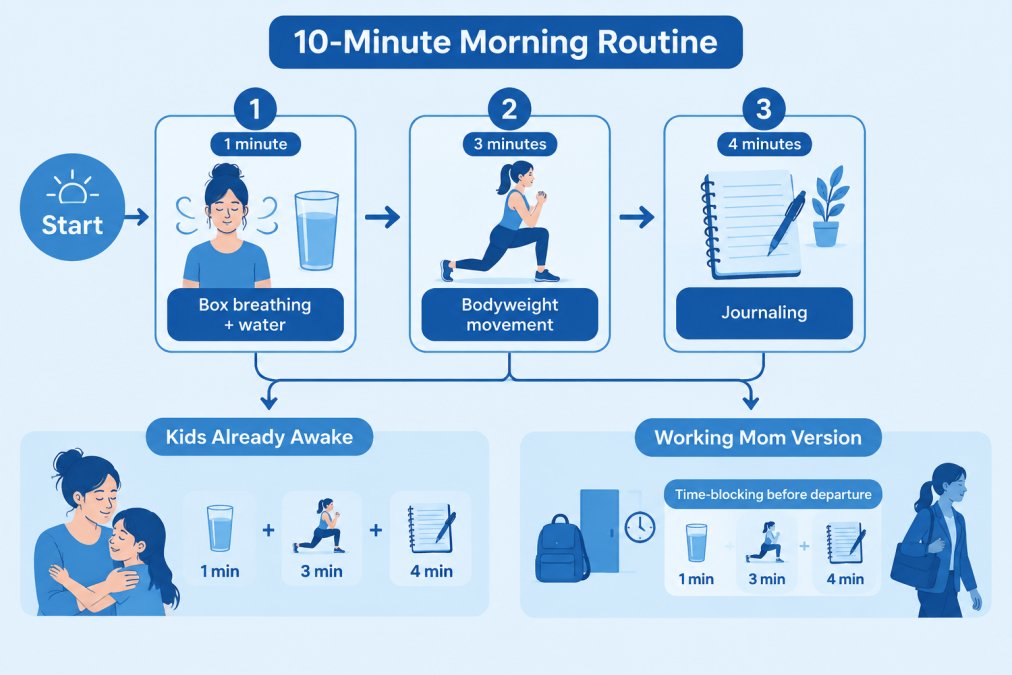
- Water bottle filled and by the bed the night before
- Journal and pen within reach
- Timer set for 10 minutes
| Step | Time | What You Do | Why It Works |
|---|---|---|---|
| Breathe and hydrate | 1 min | Box breathing, then water | Calms the body, rehydrates |
| Move | 3 min | Bodyweight circuit | Raises energy, releases stiffness |
| Write | 4 min | One or two prompts | Clears mental clutter |
| Plan | 2 min | Name your top task | Sets intentionality for the day |
Time
Adjusting the Routine for Neurodivergent Brains, Teens, and Different Ages
One routine does not fit every brain or every age. Small adjustments make it stick.
Cut it to two steps on hard days: breathe and write. Keep the checklist visible so you don't have to hold it in your head.
For teens, the same three steps work with a twist. Invite your daughter to do her own four-minute journal beside you. Shared practice builds connection without a lecture. Our Teen Girl Glow Up Journal was built for exactly this.
For younger kids, shorten each step. A 30-second breathing round and one gratitude line is plenty.
Age and stage change the details, not the structure. Breathing, movement, and a written thought work at any age.
Most moms don't need a longer morning. They need a smaller one they'll actually repeat.
Frequently Asked Questions
Can a 10-minute morning routine really make a difference?
Ten minutes is enough to change how the rest of the day goes because the point is consistency, not duration. A short sequence of deep breathing, physical movement, and journaling gives you a reset before the demands start. The routine works by stacking small habits you will actually repeat, which matters more than a 60-minute plan you abandon by Wednesday. Start with one step, add the next after a week, and keep the whole thing under ten minutes so it survives a bad night's sleep.
How do I keep a mindful morning routine for moms when my kids wake up early?
Stop treating their wake-up as a failure of the routine. If your kids are up before you, run the same three steps with them in the room: box breathing becomes a game, stretching becomes a family stretch, and journaling becomes two minutes at the kitchen counter while they eat. A mindful morning routine for moms is about attention, not silence. Some mothers also shift the journaling to the car line or the coffee break and keep only the breathing and movement in the early slot.
What should I do first in a morning routine?
Start with 60 seconds of box breathing and a glass of filtered water. Breathing first lowers the rush of stress hormones before you touch a phone, and hydration gives you something physical to anchor the habit to. Movement and journaling come after. If you only ever do the first step, you still get a benefit, which is why it goes first. Keep the phone face down until the full ten minutes are done.
What can I do when I miss my morning routine?
Do a two-minute version instead of skipping entirely. Take four slow breaths, stretch your arms overhead, and write one sentence about what you want from the day. Missing the full routine is not a reset to zero, and treating it as one is how routines die. Habit stacking helps here: attach the short version to something you already do, like waiting for the coffee to brew. The next morning, return to the full ten minutes without making up for lost time.