 how-to
Building Resilience in Teenage Girls After Academic Failure: How?
Last Updated: November 7, 2026
Quick Summary
Building resilience in teenage girls after academic failure starts with listening, separating a bad result from her worth, and agreeing on one small next step. Resilience is a learnable skill built through repeated experiences of handling hard things, so parents can help her recover one step at a time.
- Listen first and avoid rushing to fix things; give her 10 to 20 minutes to vent before advising.
- Tell her one test does not decide how smart she is; it shows what to work on next.
- Review the test together and sort misses into unlearned material, misread questions, and time pressure.
- Set one small goal and hold a ten-minute weekly check-in focused on habits rather than grades.
- Seek help from a school counselor, pediatrician, or mental health professional if sadness or hopelessness lasts several weeks.
Table of Contents
- Why Academic Failure Hits Teenage Girls Differently
- What Resilience Means for Teenagers and Why It Can Be Learned
- What to Say to a Teen After Failing a Test
- Step-by-Step: Responding to a Failed Test, Course, or Exam
- How to Rebuild Confidence After a Bad Grade
- Resilience Strategies for Teenagers: Coping, Self-Compassion, and Healthy Habits
- Where Teens Can Find Help Building Resilience, Plus Your Next Step
- Frequently Asked Questions
Academic failure can hit a teenage girl hard, and building resilience in teenage girls after academic failure starts with recognizing that.
Resilience is the ability to recover from a setback and keep moving forward. It is a skill built through small, repeated experiences of handling hard things. For a teen girl facing a failed test, that might look like talking through the result, making a plan, and trying again.
Why Academic Failure Hits Teenage Girls Differently
Resilience advice is often written for teenagers in general, but the difference for girls matters.
Three pressures tend to stack on top of each other.
Gendered expectations. Many girls receive years of quiet messages that they should be organized, pleasant, agreeable, and high-achieving at the same time.
These pressures show up in recognizable ways. Watch for:
- Absolute statements: "I'm just not smart," "I ruin everything," "I'll never get into a good college."
- Avoidance: skipping homework, changing the subject when school comes up, or hiding graded papers.
- Overcorrection: studying past the point of usefulness, skipping meals, or refusing to sleep until every assignment is perfect.
- Withdrawal from friends, activities, or family routines she usually enjoys.
Watch out: reassurance alone can backfire with a perfectionist teen.
It also helps to name the comparison trap directly.
What Resilience Means for Teenagers and Why It Can Be Learned
Resilience does not mean never feeling upset. It means bouncing back after feeling upset, which is the heart of building resilience in teenage girls after academic failure. A resilient teen still cries after a bad grade.
Resilience is built from a few core skills:
- Coping: Handling stress without shutting down or lashing out
- Self-compassion: Speaking to herself the way she would speak to a friend
- Problem-solving: Breaking a big problem into small, doable steps
- Help-seeking: Knowing when and how to ask for support
Each of these skills can be practiced. Teens who get regular chances to solve small problems on their own tend to feel more capable when bigger problems arrive.
What to Say to a Teen After Failing a Test
The first conversation matters more than most parents expect. Your goal is to listen first and solve second.
Avoid these common reactions:
- "You should have studied harder." (This adds guilt to disappointment.)
- "It's not a big deal." (This can feel dismissive, even if you mean well.)
- "Your sister never struggled like this." (Comparisons deepen shame.)
Separate the result from her worth. Try: "One test does not decide how smart you are. It tells us what to work on next."
End with a question about next steps. "What do you think would help most right now?" gives her ownership of the plan.
Step-by-Step: Responding to a Failed Test, Course, or Exam
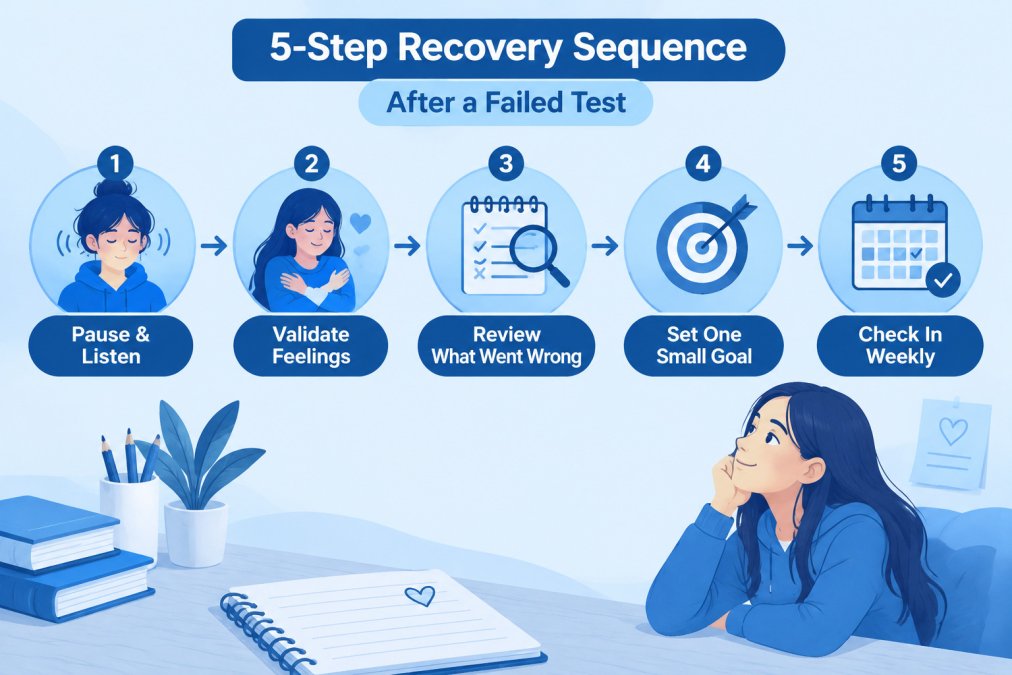
Most resilience articles stop at "validate the feeling and make a plan." That is the right instinct, but it leaves parents without a concrete sequence. The plan below separates the emotional response from the academic one, then connects them. Work through it at her pace, not yours.
The first 24 hours: stabilize, don't solve
- Pause and listen. Give her 10 to 20 minutes to vent before offering any advice. Your only job in this window is to hear her.
- Validate the feeling. Acknowledge that the result hurts. Avoid rushing to fix it. "That sounds really disappointing" is enough.
- Separate the result from her worth. Try: "One test does not decide how smart you are. It tells us what to work on next."
- Agree on one next action, not five. A single small step, opening the test, emailing the teacher, or blocking 20 minutes to review, is enough for day one.
Watch out: trying to complete the whole recovery plan in one sitting usually backfires. A teen who is still upset cannot absorb a study schedule, and pushing one often turns the conversation into a second failure.
The first week: gather facts and build one habit
- Review what went wrong, with the test in hand. Look at the questions together and ask, "Which ones were the hardest, and why?" Sort the misses into three buckets: material she never learned, material she knew but misread, and material she ran out of time on. Each bucket points to a different fix.
- Set one small goal. Choose one change, such as reviewing one topic each day for a week or doing two practice problems before checking the answer key.
- Schedule a short weekly check-in. Ten minutes, same day each week. Keep it about the habit, not the grade.
The grading period: build a collaborative recovery plan
- Contact the teacher or counselor. A brief email works: "I'm [name], [student]'s parent. She's working on recovering from the recent exam. Could we set up 10 minutes to understand what she should prioritize?" Teachers usually respond well to a specific, respectful ask.
- Ask about the path back. Find out whether retakes, test corrections, extra credit, or office hours are available, and what the deadlines are. Policies vary by school and district, so ask rather than assume.
- Use support strategically. A tutor or academic coach is most useful for a specific, named gap, a unit she missed, a skill she has not practiced, rather than as a general "get better at school" measure.
- Review the plan at the end of the grading period. Keep what worked, drop what did not, and say so out loud so she sees that plans are adjustable.
Measuring progress without watching only the grade
Grades move slowly, and a teen who is doing everything right may not see a number change for weeks. Track observable signs instead:
- Help-seeking: Does she ask a question in class or email a teacher without being prompted?
- Study consistency: Is she showing up for short, regular study blocks rather than cramming the night before?
- Emotional recovery: Does she bounce back from a bad quiz in hours rather than days?
- Willingness to try again: Does she attempt the next test without preemptively declaring defeat?
Separating a temporary setback from a learning or mental-health concern
Most academic failures are temporary setbacks. A teen who struggled with one unit, one teacher, or one hard exam usually recovers with support and a fresh plan.
Some patterns call for more than a study plan. Consider talking with a school counselor, pediatrician, or licensed mental health professional if you notice:
- Persistent sadness or hopelessness lasting several weeks
- Big changes in sleep, eating, or daily functioning
- Talk of self-harm or feeling worthless
- A sudden drop across all subjects, not just one
In the United States, the 988 Suicide and Crisis Lifeline is available by call or text at 988 for anyone in crisis. The National Institute of Mental Health's guidance on teen mental health offers reliable information on warning signs.
The pattern is simple: calm first, then facts, then a small plan, then a check-in.
The article lays out a sequence that moves from stabilizing the teen to rebuilding a plan, so this table summarises the timing of each stage.
| Stage | What to do | Timing |
|---|---|---|
| Stabilize | Pause, listen, validate the feeling | First 24 hours |
| Agree on action | Choose one small next step | First 24 hours |
| Gather facts | Review the test and sort the misses | First week |
| Build a habit | Set one small goal | First week |
| Check in | Ten-minute weekly conversation | Weekly |
| Contact school | Email teacher or counselor about options | Grading period |
| Review plan | Keep what worked, drop what did not | End of grading period |
How to Rebuild Confidence After a Bad Grade
Confidence comes from evidence. A teen rebuilds it by finishing small tasks, noticing progress, and hearing honest encouragement.
Try these practical steps:
- Focus on effort and strategy. Praise specific actions, like "You reviewed your mistakes, and that was smart."
- Set achievable targets. Aim for improvement, not perfection.
- Track progress in a simple way. A quick weekly note of what went well can show growth over time.
- Build competence outside school. Sports, art, music, or a part-time job can remind her she is capable.
Progress will not always be steady. Expect a few slow weeks, and keep celebrating small wins.
Resilience Strategies for Teenagers: Coping, Self-Compassion, and Healthy Habits
Long-term resilience grows from daily habits as much as from hard conversations. These strategies work well alongside academic recovery.
Coping skills. Teach simple tools for stress, such as taking a short walk, breathing slowly for one minute, or writing feelings down in a notebook. Our guide on mindfulness with teenagers walks through seven practical steps.
Self-compassion. Encourage her to talk to herself the way she would talk to a best friend.
Healthy routines. Consistent sleep, regular meals, and time outdoors all support emotional steadiness.
Positive relationships. Friendships and trusted adults act as a buffer against stress.
Some families find journaling helpful for working through emotions. Our review of a teen girl journal for anxiety explains how a journal can support coping in practical ways.
Where Teens Can Find Help Building Resilience, Plus Your Next Step
Support is available in many places. Good starting points include:
- School counselors who can coordinate academic plans with teachers
- Tutors or academic coaches for subject-specific gaps
- Pediatricians who can screen for mood or attention concerns
- Trusted adults like coaches, mentors, or relatives
Parents also benefit from support. If you want to strengthen your bond while helping her recover, our practical guide to connecting with your teenager offers simple conversation tools. For a deeper look at building self-esteem at home, see our parent's guide to teen self-esteem and our 2026 guide to self-esteem in teenage girls.
Rebuilding resilience takes patience, and you do not have to do it alone. Start with one calm conversation this week, then choose one small step from this guide. The Teen Girl Glow Up Journal from SSBGMARKETINGINC. is designed to help teen girls build self-esteem, healthy habits, and mindfulness through short, guided prompts.
Frequently Asked Questions
How can I help my teenage daughter cope with failing a test or class?
Start by listening before offering solutions. Let her describe what happened and how she feels, and avoid immediately pointing out what she should have done. Once she feels heard, work together on one small, specific next step, such as scheduling a meeting with her teacher or setting up a short study session for the next unit. Keep the focus on recovery rather than blame, and remind her that one result does not define her ability or her future.
What should I say to my teen after an academic failure?
Try phrases like "That was a hard result, and I can see it's bothering you" or "This doesn't change how much I believe in you." Avoid comparisons to siblings or friends and avoid lectures about effort. Ask open questions such as "What do you think got in the way?" so she can reflect on her own experience. Your calm, steady tone matters more than the perfect words, because it shows her that failure is survivable.
How can teenagers rebuild confidence after a poor grade?
Confidence usually returns through evidence of progress rather than reassurance alone. Help her identify one subject or skill where she is already competent, then set a realistic goal for the next assessment, such as completing practice problems three times a week. Tracking small wins in a journal can make progress visible. Celebrate effort and improvement, not just final grades, so her sense of competence grows from actions she controls.
When should a teen seek extra support after an academic setback?
Consider reaching out to a school counselor, teacher, or pediatrician if the setback lasts several weeks, if she withdraws from friends or activities she used to enjoy, if her sleep or appetite changes significantly, or if she talks about feeling hopeless or worthless. These signs can point to a mental-health concern rather than a temporary setback. In the United States, the 988 Suicide and Crisis Lifeline is available by call or text at 988 if you are worried about her safety.