 how-to
Can Mindfulness Habits Survive a Chaotic Daily Schedule?
Last Updated: October 24, 2026
Quick Summary
Mindfulness habits survive a chaotic daily schedule when you shrink them to 60 seconds to 5 minutes and attach them to cues you already hit, like washing hands or starting the car. Stack one practice on a reliable body cue plus a backup on a transition cue, and never miss twice.
- Five-minute exercises work in a parked car, grocery line, or bathroom stall because they remove time and location barriers.
- The physiological sigh is two quick inhales through the nose then one long exhale, repeated three times.
- Habit stacking attaches a new practice to an existing cue so you don't have to remember it.
- Body cues like waking up, eating, and washing hands are the most reliable anchors because they tie to biology.
- Never miss twice: one skipped day is life, two is a new pattern.
Table of Contents
- Why Mindfulness Habits Fail When Your Schedule Is Unpredictable
- 5-Minute Mindfulness Exercises You Can Do Anywhere
- Mindfulness Exercises for Busy Moms: Breathing, Grounding, and Brief Meditation
- How to Start a Daily Mindfulness Practice With Only a Few Minutes
- Habit Stacking: Attach Mindfulness to Cues You Already Have
- Mindfulness Activities for Kids and Parents to Share
- When You Miss a Day: Recovery Strategies That Keep the Habit Alive
- Pick Your First 3-Step Mindfulness Reset
- Frequently Asked Questions
Why Mindfulness Habits Fail When Your Schedule Is Unpredictable
Most mindfulness habits for chaotic daily schedules fail for one reason: they were designed for calm days.
Rigid routines break the moment life gets messy. And for busy moms, life is messy most days.
At SSBGMARKETINGINC., we build our whole approach around that reality.
Here's what most guides get wrong. They treat consistency as all-or-nothing.
The fix is a flexible system:
- Short practices that fit real gaps in your day
- Cues tied to things you already do
- A recovery plan for the days everything falls apart
Below, we'll show you exactly how to build that system, starting with practices short enough to survive almost anything.
5-Minute Mindfulness Exercises You Can Do Anywhere
Five-minute mindfulness exercises are short, portable practices you can complete in a parked car, a grocery line, or a bathroom stall. The American Psychological Association's guidance on stress management notes that brief, regular practices can help manage everyday stress.
Most guides stop at "try a breathing exercise." That's not enough when your day has no reliable shape. What follows is a time-based menu, so you can pick a practice that fits the gap you actually have, not the gap a planner assumes you have.
The 60-Second Reset
For the moments when you have one minute and nothing else.
- Physiological sigh. Two quick inhales through the nose, then one long exhale through the mouth. Repeat three times. The double inhale helps offload carbon dioxide and the long exhale nudges your nervous system toward calm. This is the fastest reset on the list.
- Feet-and-floor check. Press both feet into the floor, notice the pressure, and name one thing you can hear. That's it. Works at a desk, in a car, or standing in a doorway.
- One-breath pause. Before you open a new tab, send a text, or walk into a room, take one slow breath and let it out longer than you breathed in.
The 2- to 3-Minute Reset
For a coffee refill, a red light, or the two minutes before a call starts.
- 5-4-3-2-1 scan. Name five things you see, four you feel, three you hear, two you smell, one you taste. This is a grounding practice, not a relaxation exercise, so it works even when you're agitated.
- Hand-washing anchor. Wash your hands slowly and notice temperature, texture, and sound. You already wash your hands dozens of times a day; this turns one of those into a practice.
- Body scan, abbreviated. Start at your jaw, move to your shoulders, then your hands. Release each on the exhale. Skip the full-body version when time is tight.
The 5-Minute Reset
For a lunch break, a parked car before pickup, or the gap between meetings.
- Single-task pause. Pick one routine task, like washing dishes or folding laundry, and do only that for five minutes. No phone, no planning, no podcast. The task becomes the practice.
- Walking breath count. Walk at a normal pace and count steps per breath. Inhale for four steps, exhale for six. If you lose count, start over at one. Losing count is part of the practice, not a failure.
- Four-count box breathing. Inhale for four, hold for four, exhale for four, hold for four. Repeat for five minutes. This pattern is easy to remember and works well when your mind is racing.
Matching the Practice to Your Energy Level
Not every practice fits every state. A quick guide:
- Wired and scattered: physiological sigh, box breathing, walking breath count.
- Flat and depleted: feet-and-floor check, hand-washing anchor, single-task pause.
- Irritable or overwhelmed: 5-4-3-2-1 scan, abbreviated body scan, one-breath pause.
None of these need a cushion, an app, or silence. That's the point. The menu exists so you can stop asking "do I have time for this?" and start asking "which one fits the minute I have?"
Mindfulness Exercises for Busy Moms: Breathing, Grounding, and Brief Meditation
Mindfulness exercises for busy moms work best when they're tied to a specific moment of stress, not a generic "find time to relax" instruction. Match the practice to the pressure point.
Deep Breathing and 4-7-8 Breathing
Deep breathing is the fastest reset you have. It's free, invisible, and works in a meeting or a minivan.
The 4-7-8 pattern is a common starting point:
- Breathe in through your nose for 4 counts
- Hold for 7 counts
- Exhale slowly through your mouth for 8 counts
A common mistake is breathing too fast to "get it done." Slow down. The long exhale is the part that helps you settle.
Grounding Practices for Overwhelmed Mornings
Mornings set the tone for everything after. A grounding practice takes under two minutes and anchors you before the chaos starts.
Try this: before you check your phone, stand still and feel your feet on the floor. Name one thing you're grateful for. If mornings feel like a scramble, our simple morning routine for moms gives you a concrete 10-minute structure to build on.
How to Start a Daily Mindfulness Practice With Only a Few Minutes
Starting a daily mindfulness practice with a few minutes means picking one practice, one cue, and one tiny time slot. That's the whole formula. Most people overcomplicate it and quit by week two.
Here's the sequence we recommend:
- Pick one practice. Choose a single breathing or grounding exercise. Not three.
- Anchor it to a cue. Attach it to something you already do daily, like pouring coffee.
- Set the bar embarrassingly low. One minute counts. Seriously.
- Track it simply. A checkmark on your phone note is enough.
If you want a structured starting point, our 10-minute habit reset guide walks you through turning a few minutes into a repeatable daily habit.
Habit Stacking: Attach Mindfulness to Cues You Already Have
Habit stacking means attaching a new practice to an existing daily cue so you don't have to remember it. Your brain already runs on autopilot for dozens of routines. Borrow that autopilot.
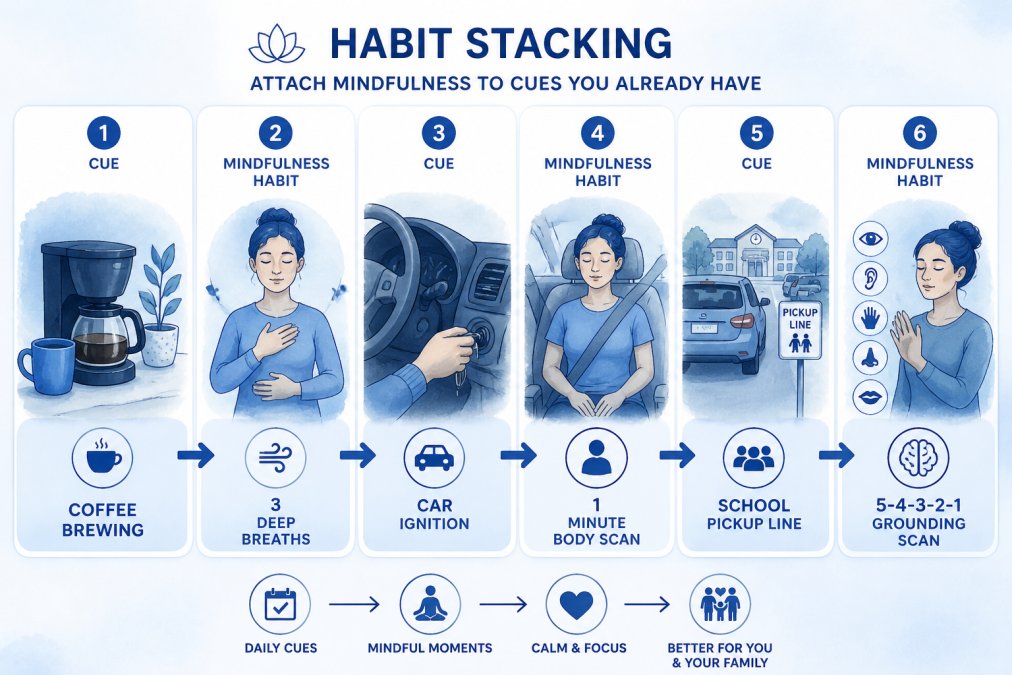
Most habit-stacking advice assumes your day looks the same every day. Chaotic schedules don't.
Get the 3-step manifestation ebook now →
The Three Cue Types That Survive Chaos
Not all cues are equally reliable. Rank yours before you commit.
- Tier 1: Body cues. These happen no matter what. Waking up, using the bathroom, eating, drinking water, washing hands. They are the most reliable anchors because they are tied to biology, not calendar.
- Tier 2: Transition cues. These happen most days but shift in timing. Car ignition, walking through the front door, opening a laptop, starting the dishwasher. Good anchors, but expect them to move.
- Tier 3: Event cues. These happen only on some days. School pickup, a specific meeting, a weekly appointment. Useful when they happen, but never build your only practice on a Tier 3 cue.
A common pattern is to stack one practice on a Tier 1 cue and a backup practice on a Tier 2 cue. That way, a missed transition doesn't wipe out the whole day.
Cue-to-Practice Pairs by Context
Generic pairs like "coffee brewing → three breaths" work, but context-specific pairs stick better because the practice matches the pressure of the moment.
Work and desk context:
- Opening your laptop → one physiological sigh before the first tab loads
- Joining a video call → feet-and-floor check while the meeting connects
- Sending an email → one-breath pause before you hit send
Caregiving and family context:
- Buckling a car seat → three slow breaths while you fasten the buckle
- Starting dinner prep → hand-washing anchor at the sink
- Bedtime tuck-in → gratitude swap (each person names one good thing from the day)
Household and transition context:
- Car ignition → one minute of silence before the radio goes on
- Walking through the front door → shoes-off, three-breaths rule
- Loading the dishwasher → single-task pause for the first five minutes
School pickup line:
- A 5-4-3-2-1 grounding scan while you wait. This is a Tier 3 cue, so pair it with a Tier 1 backup for days when pickup doesn't happen.
For a cue that pairs naturally with gratitude, our 5-minute gratitude practice slots neatly onto a morning or bedtime routine.
Building a Backup Stack for Interrupted Days
The real test of a stacking system is what happens when the primary cue gets skipped. A backup stack is a short list of practices tied to cues that almost never disappear.
- If you miss the morning cue: stack on the first bathroom trip after the missed cue instead. The practice is the same; only the anchor moves.
- If the day has no transitions: fall back to a body cue, like drinking a glass of water. Sip slowly and count three breaths before the next sip.
- If the whole day collapses: use the 60-second reset from the previous section. One physiological sigh counts as showing up.
Why This Beats a Calendar Block
A calendar block requires you to protect time in advance. A stacked cue requires you to notice something you were already going to do. On unpredictable days, noticing is easier than protecting. The trade-off is that stacked practices tend to be shorter and less structured than a scheduled session, which is exactly why they survive.
Mindfulness Activities for Kids and Parents to Share
Mindfulness activities for kids and parents work best when they feel like play, not homework. Teens in particular push back on anything that smells preachy.
Try these together:
- Two-minute breathing buddy. Breathe in sync and see who can stay quiet longest.
- Gratitude swap. Each of you names one good thing from the day at dinner.
- Silent walk. Take a short walk with no phones and no talking. Just notice.
If your teen is open to a more structured approach, our step-by-step guide to practicing mindfulness with teenagers breaks it into seven manageable steps.
When You Miss a Day: Recovery Strategies That Keep the Habit Alive
Missing a day doesn't break a habit. Quitting after missing a day does. That distinction matters more than any technique .
Use these recovery rules:
- Never miss twice. One skipped day is life. Two is a new pattern.
- Shrink the practice. Missed a five-minute session? Do thirty seconds instead.
- Skip the guilt. Self-criticism drains the energy you need to restart.
The goal is showing up again, not showing up perfectly. Small habits survive on flexibility, not willpower.
Pick Your First 3-Step Mindfulness Reset
A 3-step reset is the simplest way to start. It keeps the whole system small enough to actually do.
Here's ours:
- Choose one cue you already hit every day.
- Attach one practice that takes under two minutes.
- Plan your restart before you need it.
That's a complete mindfulness habit. No app subscription, no 30-minute block, no perfect morning required.
If you're ready to go deeper, our 10-Minute Manifestation Journal for Busy Moms gives you a bite-sized daily gratitude and visualization practice built for hectic schedules.
Frequently Asked Questions
How can I practice mindfulness when I have a busy schedule?
Attach short practices to things you already do instead of adding a separate block of time. Try one minute of deep breathing while the coffee brews, a body scan in the school pickup line, or three slow breaths before opening your laptop. Micro-practices of one to five minutes count as real practice. The goal is consistency, not duration, so pick two or three daily cues and stack a mindfulness habit onto each one.
What should I do when I miss a day of mindfulness practice?
Treat a missed day as data, not failure. Notice what got in the way, then shrink the habit so it survives the next chaotic day: one breath instead of five minutes, or a single sentence in a journal instead of a full entry. Return at the next natural cue rather than waiting for a perfect morning. Missing one day does not erase progress; abandoning the habit after a miss is what actually breaks it.
How long should a daily mindfulness practice take?
For a chaotic schedule, one to five minutes is enough to build the habit. Brief meditation, a few rounds of 4-7-8 breathing, or a short grounding exercise all fit into the gaps of a normal day. Once the routine feels automatic, you can extend a session to ten minutes. Starting small protects consistency, which matters more for stress reduction and emotional regulation than long sessions you rarely complete.
What mindfulness exercises can I do with my kids?
Try shared breathing counts, a one-minute listening game where everyone names sounds they hear, or a slow walk outside naming five things you see. Teenagers often respond better to private tools, like a short journal prompt, than to a parent-led exercise. Keeping it brief and low-pressure helps mindfulness activities for kids and parents feel like connection rather than another chore.
Your schedule isn't going to calm down on its own. But your practice can be built to survive it. Start with one cue, one minute, and one restart plan. Get started with SSBGMARKETINGINC. and turn a few chaotic minutes into a daily reset that actually sticks.