 how-to
Daily Gratitude for Busy Moms: 5-Minute Practice
Table of Contents
- Why Daily Gratitude Fits a Busy Mom's Day
- Gratitude Prompts for Moms: 12 That Take Under a Minute
- Gratitude List Examples You Can Copy Tonight
- The 5-Minute Gratitude Journal Method
- Choosing a Gratitude Journal for Moms
- Making Daily Gratitude Stick When Your Schedule Changes
- Common Mistakes That Kill a Gratitude Habit
- Frequently Asked Questions
Last Updated: October 15, 2026
Why Daily Gratitude Fits a Busy Mom's Day
Daily gratitude for busy moms is a short, repeatable practice of noticing and naming what is good in your day, usually in under five minutes.
The appeal is simple. When your day is a stack of other people's needs, a five-minute ritual gives you one thing that belongs to you.
Below, we'll show you how to build a routine that survives a chaotic week, plus prompts and examples you can copy tonight.
What Gratitude Does for Stress and Overwhelm
Gratitude won't empty your inbox or fold the laundry. It can interrupt the loop of overwhelm long enough for your nervous system to settle, shifting focus from what's missing to what's already there.
The key word is specific. "I'm grateful for my family" does little. "I'm grateful my daughter texted me back" lands differently because your brain can hold onto it.
Gratitude Without Toxic Positivity
Most guides get this wrong: gratitude isn't a cure for hard feelings, and it's not a demand to smile through a bad day.
You can be thankful and exhausted at once, note one good moment and still admit the day was rough. If a prompt feels like it's asking you to pretend, skip it.
Gratitude Prompts for Moms: 12 That Take Under a Minute
Generic gratitude prompts fail busy moms because they don't match the moment you're in. A prompt about "quiet reflection" is useless when you're nursing a toddler at 2 a.m. or stuck in carpool line.
Below are prompts grouped by the situations that come up most often. Each takes under a minute. Pick the group that sounds like your week, then steal two or three prompts.
For Working Moms Juggling Meetings and Drop-Off
- What went right in the ten minutes before my first meeting?
- Who made my workday lighter, a coworker, a client, a stranger in the parking lot?
- What did I finish today that I'd been dreading?
- What did I say no to so I could get home on time?
For working moms, gratitude lands hardest when it's tied to a boundary you held, not a task you completed. The "said no" prompt surfaces the most honest answers.
For Stay-at-Home Moms in the Middle of the Day
- What did my child do today that I want to remember in five years?
- What small comfort did I give myself, a second cup of coffee, ten minutes on the porch, a text to a friend?
- What part of the house felt calm for even a few minutes?
- What did I notice today that I usually walk past?
The trap is repetition. If your list reads "my kids, my husband, coffee" three days running, rotate to a sensory prompt (sound, smell, texture).
For Single Parents Carrying the Whole Load
- What did I handle today that past-me would have found impossible?
- Who showed up for me this week, even in a small way?
- What did I do just for me, even if it was five minutes in the car?
- What's one thing that went right that I didn't have to fight for?
Single parents often find gratitude feels hollow when framed as "counting blessings" without acknowledging the weight. Prompts 9 and 12 hold both truths: the load is real, and so is the strength.
For Caregivers of Aging Parents or Special-Needs Kids
If your caregiving extends beyond your own children, standard mom-gratitude prompts can miss the mark. Try these:
- What moment today felt like connection rather than obligation?
- What did someone else handle so I could rest?
- What did my body carry me through today?
That last prompt matters: caregivers who frame gratitude only around their role burn out faster than those who keep an identity outside it.
How to Actually Use These
Pick three prompts and save them on a sticky note or in your phone. Rotate them when one stops landing. If a prompt feels like performing cheerfulness, skip it. Honest gratitude is the version you'll keep doing.
Gratitude List Examples You Can Copy Tonight
Gratitude list examples work best when they're concrete and short. Borrow these three, then adjust to your own day.
The school-run list
- The car started on the first try
- My teen actually talked on the drive
- I remembered the permission slip
The workday list
- A meeting ended early
- A coworker covered for me
- I closed my laptop before 9 p.m.
The hard-day list
- I got through it
- I asked for help
- Tomorrow is a fresh start
None of these are profound, that's the point. Small moments are easier to spot and add up faster than big ones.
The 5-Minute Gratitude Journal Method
The 5-minute gratitude journal method is a time-boxed routine of five one-minute steps, so you never stare at a blank page. Set a timer and move on when it rings.
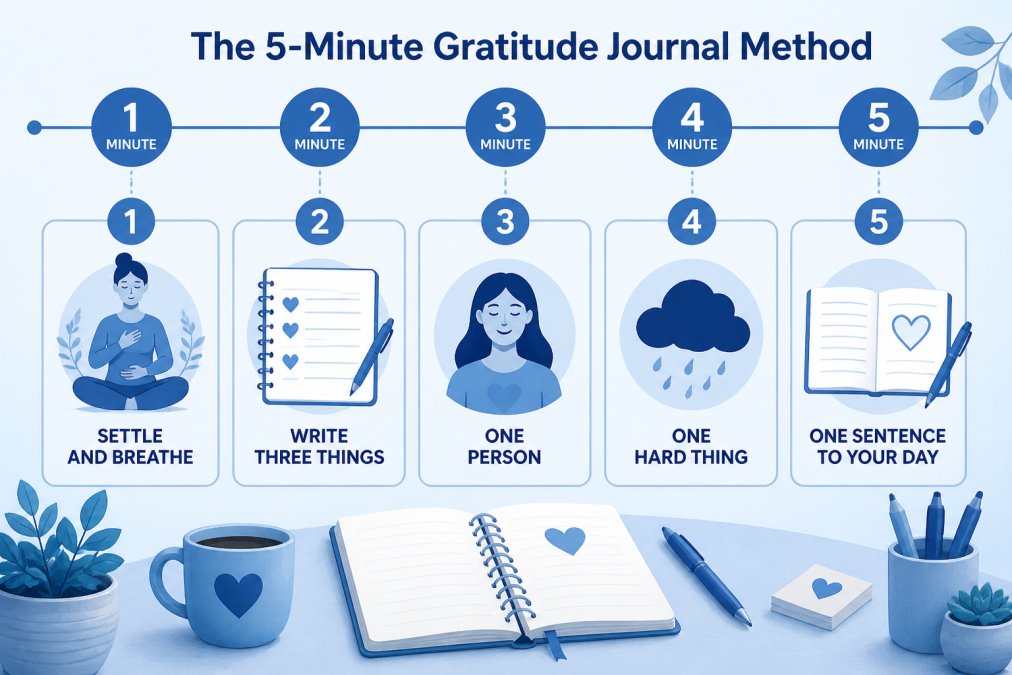
- Minute 1: Settle and breathe. Three slow breaths, phone face down.
- Minute 2: Write three things. Any three, no ranking.
- Minute 3: Name one person. Someone who made today easier.
This structure is why a 5-minute gratitude journal for moms sticks: no blank-page paralysis, and a clear finish line.
A Sample Five-Minute Entry
Here's what a real entry might look like:
Minute 1: Breathed. Shoulders down. Minute 2: Coffee was hot. Kid ate breakfast. Found the missing shoe. Minute 3: My neighbor took the kids for twenty minutes. Minute 4: Work deadline is still looming. Minute 5: Today was loud, but we made it.
That's a full practice. No perfect handwriting, no deep insight required.
Choosing a Gratitude Journal for Moms
A gratitude journal for moms should match your actual life. The best journal is the one you'll open tomorrow.
Ask yourself:
- Does it fit in my bag or car?
- Does it ask for less than five minutes?
- Does it have prompts, or do I have to invent them?
The 10-Minute Manifestation Journal for Busy Moms from SSBGMARKETINGINC. is built around this exact idea: a bite-sized daily gratitude and visualization tool for hectic schedules. It's one option among many, and the right pick is the one you'll use.
Making Daily Gratitude Stick When Your Schedule Changes
Most gratitude advice assumes the same five minutes every day. Busy moms don't have that. A practice that only works on calm days isn't a practice, it's a hobby.
The fix is to build three versions of the same routine: a 1-minute version, a 3-minute version, and a 5-minute version. You pick based on the day, not the other way around.
The 1-Minute Version (For the Worst Days)
Use this when you're running on fumes. No journal, no timer, no setup.
- Morning: Name one thing you're glad exists before you check your phone.
- Midday break: Name one thing that went right in the last hour.
- Bedtime: Name one thing your body did for you today.
That's it. One sentence. The point isn't depth, it's keeping the thread unbroken so tomorrow's version is easier to start.
The 3-Minute Version (For Normal Days)
This is the workhorse. It fits in a coffee break, a school pickup line, or the walk from your car to the office.
- Minute 1: Three slow breaths. Phone face down or in your pocket.
- Minute 2: Name three specific things, not "my family," but "my son's laugh at breakfast."
- Minute 3: Name one hard thing from today and one person who made it lighter.
The hard-thing step is what separates this from toxic positivity. You're not pretending the day was good. You're holding both.
The 5-Minute Version (For When You Have Room)
This is the full journal method described earlier. Use it on weekends, work-from-home days, or any time you have five uninterrupted minutes. Don't force it on chaotic days, that's what the 1- and 3-minute versions are for.
When to Run Each Version
| Time of day | Best fit | Why |
|---|---|---|
| Morning, before anyone's up | 3-minute | Sets the tone before the day's demands start |
| Midday break | 1-minute | Short enough to actually do between tasks |
| Bedtime | 1- or 5-minute | Matches your energy level, not an ideal |
| Weekend morning | 5-minute | Room for the full journal method |
The Cue-and-Routine Plan
Habit researchers find new behaviors stick when attached to an existing cue rather than a clock. Pick one daily anchor and attach your gratitude practice to it:
- First sip of coffee → 1-minute morning version
- Buckling your seatbelt after drop-off → 3-minute version
- Plugging in your phone at night → 1-minute bedtime version
Pick one cue. Not four. One. Add a second only after the first has held for two weeks.
What to Do When You Miss a Day
You will miss days, that's the normal shape of habit formation. The rule: never miss twice in a row.
- Missed one day? Do the 1-minute version the next day. Don't try to "make up" the missed entry.
- Missed a week? Restart with the 1-minute version for three days, then move back to your normal version.
- Missed a month? Treat it as a fresh start. Pick a new cue if the old one stopped working.
The moms who keep a gratitude practice long-term aren't the ones who never miss. They're the ones who restart without drama.
A Backup Plan for Chaotic Weeks
Keep a fallback that requires zero setup. A 20-second voice memo counts as a full practice. A shared family ritual also works: at dinner, each person names one good thing from their day. That version models the habit for your kids and survives weeks when solo practice falls apart.
Common Mistakes That Kill a Gratitude Habit
Most gratitude habits don't fail because of motivation. They fail because of a few predictable traps.
- Going too big. Long entries feel like homework by week two.
- Repeating the same three items. Rotate prompts to keep it fresh.
- Skipping hard days entirely. A two-word entry still counts.
One more: don't wait for the "right" mood. Gratitude often shows up after you start, not before.
Motherhood rarely slows down, and the days that need a pause most are usually the ones with no room for one.
Frequently Asked Questions
How can busy moms practice gratitude every day?
Pick one anchor you already do, like the first sip of coffee or the school pickup line, and attach a 60-second practice to it. Name three specific things you are thankful for, then one person who helped you that day. Keeping the routine under five minutes makes it realistic on chaotic mornings and easy to repeat. A small notebook by the bed or a notes app both work.
What can I write in a gratitude journal when I feel overwhelmed?
Start smaller than feels impressive. Write one thing that went right, one person who made the day easier, and one physical comfort you noticed, like hot water or a quiet room. On hard days, gratitude list examples like 'the dishwasher ran' or 'my daughter texted back' count. The goal is noticing, not performing. A five-minute gratitude journal entry can be three short lines.
How much time should I spend on a gratitude practice?
Five minutes is enough for most people. Research on gratitude journaling typically uses weekly or a few-times-weekly writing rather than a long daily session, so a short, consistent routine beats an occasional long one. If five minutes feels tight, do two. The point is a repeatable daily habit, not a perfect entry.
How do I make daily gratitude a habit when my schedule is unpredictable?
Stop tying it to a fixed time. Instead, pair it with something that already happens every day: buckling your seatbelt, waiting for the kettle, or lying down at bedtime. Keep the format identical each time so you do not have to decide anything. If you miss a day, restart the next day without adding penance. Consistency over weeks matters more than any single entry.