 blog
How to Start Manifestation Journals for Skeptical Moms
Last Updated: October 25, 2026
Quick Summary
Manifestation journals for skeptical moms work best as a structured thinking tool, not a magic spell: name what you want, pick one small action, and log one win in three lines. Choose an undated guided journal, write one entry tonight, and cap each session at ten minutes.
- Undated journals are usually the safer buy for parents with unpredictable weeks.
- Most paper guided journals run roughly $10 to $25; blank notebooks cost under $10.
- If unsure, buy the cheapest undated guided journal and use it for two weeks.
- When you miss days, write today's entry only and don't backfill or apologize.
- Once a month, read four weeks of entries in one sitting to spot patterns.
Table of Contents
- Manifestation Journals for Skeptical Moms: What Actually Works
- How to Write a Manifestation Journal When You Don't Buy the Hype
- Guided vs. Blank Manifestation Journals: Which Format Sticks
- Manifestation Journal Prompts for Moms Who Have Ten Minutes, Not an Hour
- Manifestation Journal Examples You Can Copy Tonight
- Inside a 10-Minute Manifestation Journal: A Realistic Walkthrough
- Tracking Progress Without Turning It Into Another Chore
- Pick Your Journal and Write Your First Entry Tonight
- Frequently Asked Questions
Manifestation Journals for Skeptical Moms: What Actually Works
If the word "manifestation" makes you roll your eyes, you're not the target audience for most of what's sold under that label. That's exactly why manifestation journals for skeptical moms need a different pitch.
Here's the honest framing first. Writing down intentions and reviewing them regularly is a well-established habit in goal-setting research, and the American Psychological Association's guidance on goal setting describes written goals and progress monitoring as practical supports for follow-through.
The 10-Minute Manifestation Journal for Busy Moms exists because most journals ask for an hour you don't have. Ours asks for ten minutes and three steps.
How to Write a Manifestation Journal When You Don't Buy the Hype
Strip out the mystical language and a manifestation journal is a goal-and-reflection log.
A common mistake is treating the journal as a wish list. Wishes don't move. What moves is the middle column: the small action you commit to.
If the spiritual framing puts you off entirely, the practical mindfulness approach explained by Mindful offers a secular entry point that pairs well with journaling.
A Three-Step Entry You Can Finish Before the Coffee Cools
- Name it. One sentence on what you want more of this week. Specific beats poetic.
- Pick one action. A single step you can take today, small enough that skipping it would feel silly.
- Log one win. Something that already went right, however minor. This is the gratitude layer without the greeting-card tone.
That's the whole method. Three lines, most days.
Guided vs. Blank Manifestation Journals: Which Format Sticks
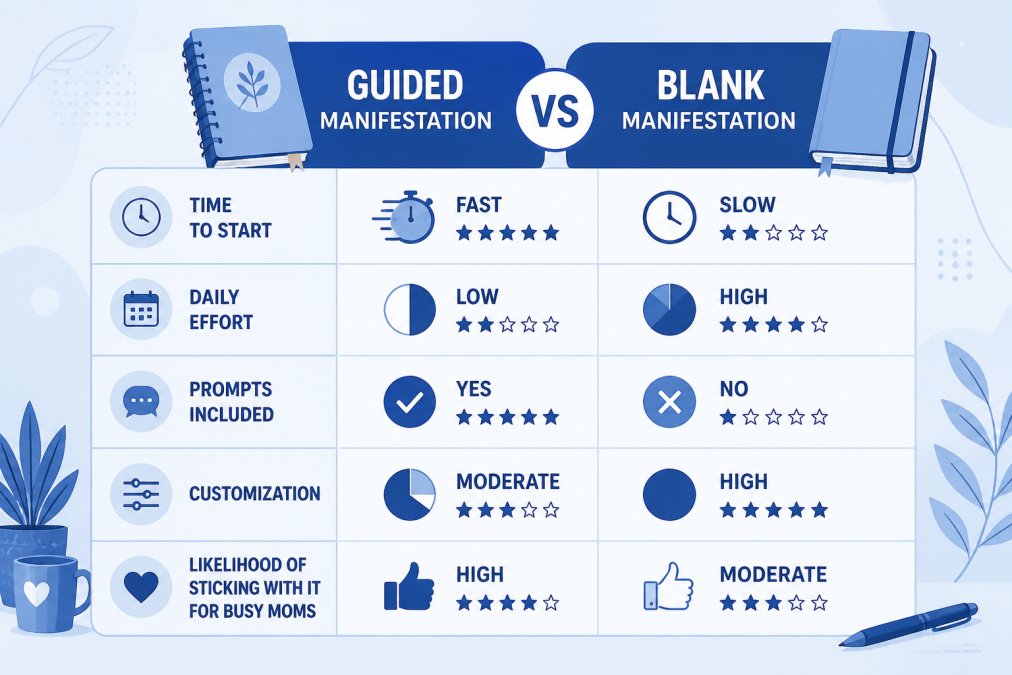
A guided journal wins for beginners and busy parents because the prompts remove the blank-page stall. A blank journal wins once you know your own rhythm and want room to improvise.
The Criteria That Actually Predict Whether You'll Stick
Most roundups compare journals on vibe and cover design. Those don't predict use. These do:
- Dated vs. undated pages. Dated journals (a page per calendar day) create a visible gap when you miss a week, and that gap is the single most common reason people quit. Undated journals let you skip three days and pick up on page 41 without a record of failure. For a parent with an unpredictable week, undated is usually the safer buy.
- Session length the layout implies. A page with twelve prompt lines is asking for twenty minutes whether it says so or not. A page with three lines and a checkbox is asking for five. Match the layout to the window you actually have, not the window you wish you had.
- Portability and where it lives. A 6-by-9-inch softcover fits in a diaper bag or a work tote; an 8.5-by-11 hardcover stays on the nightstand. The journal you'll use is the one that's within arm's reach at the moment you have ten minutes, usually the kitchen counter or the car line, not a desk.
Quick Comparison: Format, Time Cost, and Who Each One Suits
| Format | Time to Start | Daily Effort | Prompts Included | Best For |
|---|---|---|---|---|
| Guided, dated | Under a minute | Low | Yes, structured | People with a stable daily routine |
| Guided, undated | Under a minute | Low | Yes, structured | Busy moms and anyone who misses days |
| Blank notebook | Several minutes | Medium | No | Experienced journalers |
| Hybrid (prompt plus free space) | Under a minute | Low to medium | Partial | Moms who want structure and room |
| Digital template | Under a minute | Low | Yes, reusable | Fragmented schedules, phone-first users |
If you're weighing formats more broadly, our guide to manifestation journals for busy parents walks through the trade-offs in more detail.
Manifestation Journal Prompts for Moms Who Have Ten Minutes, Not an Hour
Good prompts are short, answerable in one or two sentences, and tied to your actual day. Skip anything that asks you to visualize a mansion. Start with these:
- What do I want this week to feel like, in one word?
- What is one thing I keep saying I'll do "someday"?
- What went right in the last 24 hours that I didn't stop to notice?
- Where did I spend energy today that didn't return anything?
Notice the pattern: every prompt produces a sentence you can act on. For a fuller ten-minute method, our step-by-step manifestation routine for busy moms breaks the practice into seven short moves.
Manifestation Journal Examples You Can Copy Tonight
Here's what a real entry looks like, not a polished one. Yours should be messier than this.
Want: A morning that doesn't start in a panic. Action: Lay out clothes and pack lunches tonight before bed. Win: Got through the school run without raising my voice.
And a second, for a harder day:
Want: To stop carrying the mental load alone. Action: Ask my partner to own Tuesday dinners. Win: Asked for help once this week instead of stewing.
That's the entire format. If you want a quick practice to pair with it, this five-minute gratitude routine for busy moms slots in neatly before the action line.
Get the 3-step manifestation ebook now →
Inside a 10-Minute Manifestation Journal: A Realistic Walkthrough
Ten minutes sounds generous until you're actually sitting down. Here's how it breaks down in practice: about two minutes to write what you want, three to choose and phrase your one action, three to log the win and anything that got in the way, and two to close the book and leave it.
The thing nobody tells you about journaling is that stopping on time is the skill. A session that runs long becomes a session you dread. Cap it.
Watch out: the common failure is turning the entry into a second to-do list. If your action line is three items long, you've rebuilt the overwhelm you came to escape. One action, one line.
Tracking Progress Without Turning It Into Another Chore
Progress tracking works when it takes less effort than the habit itself. A weekly glance at your entries beats a color-coded spreadsheet you'll abandon by Thursday. Once a week, flip back and ask two questions: did I take the actions I wrote down, and did anything shift?
That's the whole review. If you want habits that hold without becoming another obligation, our three-step daily habits for manifesting while busy keeps the system deliberately small.
What a Skeptical Review Actually Looks Like
Here's the part most manifestation content skips: a journal cannot demonstrate that your thoughts caused an outcome. What it can do is show you a paper trail of what you decided, what you did, and what followed. That's a planning and attention record, not evidence of attraction. Treat it that way and the practice survives contact with your skepticism.
A realistic weekly review has three questions, not two:
- Did I take the action I wrote down? Yes or no. If no, the action was too big or the week was too full, shrink it next week rather than scolding yourself.
- What changed, and can I connect it to anything I did? Sometimes the answer is "nothing" and sometimes it's "I asked for help and got it." Both are useful. Resist the urge to credit the journal for a good week or blame it for a bad one.
- What am I noticing that I wasn't noticing before? This is the plausible benefit most worth tracking. Reflective writing tends to surface patterns, where your energy goes, which commitments you keep resenting, and noticing a pattern is a real outcome even when nothing mystical happened.
The Restart Protocol (Because You Will Miss Days)
Skip streaks. A missed day is data, not failure. Moms miss days; the journal should still be there when you come back.
A better rule: when you come back after a gap, don't backfill and don't apologize on the page.
A common pattern among parents who keep the habit past a month is that they lower the bar after a disruption rather than raising it.
A Two-Minute Monthly Check
Once a month, read back four weeks of entries in one sitting. You're looking for two things: actions you committed to repeatedly and never took (a sign the goal is wrong or the step is too big), and actions that became automatic (a sign you can drop them from the journal and make room for something else). That's the entire maintenance system. It costs two minutes and it's the difference between a journal you finish and one you find in a drawer next spring.
Pick Your Journal and Write Your First Entry Tonight
Choose guided if you're starting out or short on time, blank if you already know what you want to write, and hybrid if you can't decide.
If you're still unsure whether the practice fits your worldview, this non-spiritual take on practical mindfulness is worth five minutes before you commit.
At SSBGMARKETINGINC., we built the 10-Minute Manifestation Journal for Busy Moms around exactly this three-step structure: name it, act on it, log the win.
Frequently Asked Questions
Can manifestation journaling work if you don't believe in the law of attraction?
Yes. The journaling habit itself, writing down goals, noticing what went well, and reviewing progress, overlaps with goal-setting and self-reflection practices that don't require any spiritual belief. Skeptical moms can treat it as a structured planning tool: name what you want, note one small action, and check back weekly. Skip the affirmations if they feel forced and keep the parts that produce clear plans and follow-through.
How can a busy mom start a manifestation journal without adding another chore?
Anchor it to something you already do, like the first sip of coffee or the five minutes after school drop-off. Keep the entry to three lines: one thing you're grateful for, one goal for the day, and one action you'll take. A 10-minute manifestation journal format works well here because the prompts do the thinking for you. Miss a day and start again the next morning; consistency matters more than a perfect streak.
What should you write in a manifestation journal each day?
A practical daily entry covers three things: something specific you're grateful for, one desired outcome stated in plain language, and one concrete step toward it. For example: grateful the school run went smoothly, goal is a calmer evening, step is phones in the kitchen at 7 p.m. Manifestation journal examples like this keep the practice grounded in actions you control rather than outcomes you can't force.
What is the best diary to use for manifestation if I've abandoned journals before?
The one with the least friction. Guided journals with dated or numbered prompts beat blank notebooks for most busy moms because there's no blank-page hesitation. Digital versions you can open on your phone remove the hunt for a pen. Look for short daily entries, a weekly review page, and prompts that fit real parenting life. If a format asks for 30 minutes, it will likely collect dust like the last one.
Your calendar isn't going to open up on its own, and the blank page will still be blank tomorrow. Start with one entry, three lines, ten minutes. Get the 3-step manifestation ebook from SSBGMARKETINGINC. and give yourself a practice that fits the life you actually have.