 blog
How to Find Matrescence Alternatives for Personal Growth
Last Updated: November 4, 2026
Quick Summary
The best matrescence alternatives for growth match the format to your real constraint: books build understanding, guided journals build daily processing in about 10 minutes, habit frameworks build structure, and coaching builds accountability. Score each option on goal, time, cost, evidence, and family fit, then pick the highest total.
- Matrescence education explains what is happening to you, while a growth tool gives you a repeatable action to take this week.
- Patrescence is the parallel developmental transition into fatherhood, so a growth approach should leave room for a partner.
- A 10-minute daily journal survives a chaotic Tuesday, while a 40-minute weekly session often does not.
- Compare the three-month total cost, since one-time purchases and recurring coaching are not comparable line items.
- If you have persistent low mood or intrusive thoughts, contact a clinician or the 988 Suicide and Crisis Lifeline.
Table of Contents
- Why Matrescence Alternatives Fill a Real Gap
- Quick Comparison: Growth Tools for Mothers
- matrescence and patrescence: Two Sides of the Same Transition
- When a matrescence book Is the Right Fit
- Journaling for Mothers: The 10-Minute Option
- Building Intentional Parenting Habits That Stick
- How to Choose Your Growth Approach: A Decision Framework
- Start Your 3-Step Reset Today
- Frequently Asked Questions
Why Matrescence Alternatives Fill a Real Gap
Matrescence, the developmental transition into motherhood, describes a shift that touches identity, emotions, the brain, and the body all at once. The term is useful because it gives that upheaval a name. But naming a transition and supporting someone through it are different jobs. That gap is where best Matrescence alternatives for growth earn their place. Mothers rarely need another concept to read about. If you are unsure whether alternatives are worth trying, realistic self-help strategies for skeptical moms show what actually works. They need something they can finish before the school run.
Here is the honest distinction. Matrescence education explains what is happening to you. A growth tool gives you a repeatable action to take this week. Most mothers we hear from already understand the theory. What they lack is a ten-minute practice that survives a chaotic Tuesday.
Below, we compare four approaches, show where each one fits, and give you a decision framework you can apply in one sitting. But first, here's what most guides get wrong: they treat these options as competitors when they actually solve different problems.
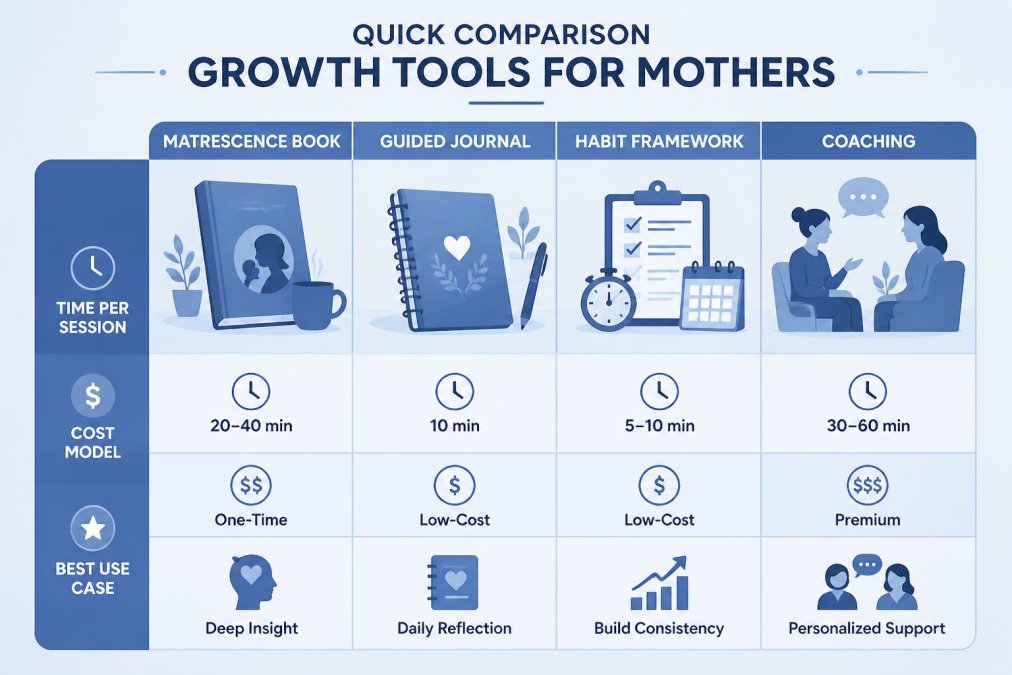
Quick Comparison: Growth Tools for Mothers
The fastest way to choose is to match the format to your real constraint. For a head-to-head look at two popular options, see Mindfulmazing vs Momlifecoach. Most mothers overbuy education and underbuy practice.
| Approach | Time Per Session | Cost Model | Best For |
|---|---|---|---|
| Matrescence book | 20-40 min reading | One-time purchase or library | Understanding the transition |
| Guided journal | 10 min daily | One-time digital purchase | Daily emotional processing |
| Habit framework | 5-10 min daily | Free to low cost | Building routines that stick |
| Coaching program | 30-60 min weekly | Recurring subscription | Accountability and guidance |
matrescence and patrescence: Two Sides of the Same Transition
Patrescence is the parallel developmental transition into fatherhood, and pairing the two terms reframes a private struggle as a shared family event. The concept matters because it changes who you invite into the conversation. When a partner understands that both parents are being reshaped, support stops feeling like a favor and starts feeling like maintenance.
In practice, this means a growth approach should leave room for a partner, not just the mother. It also means the maternal identity shift is not a solo project. Many families find that naming the transition out loud, for both parents, lowers the friction around household duties and expectations.
When a matrescence book Is the Right Fit
A matrescence book is the right first step if you want language for what you are feeling before you want a routine. Books suit the early months, when understanding the emotional changes and mixed emotions matters more than optimizing a morning. They also suit readers who process by reading rather than by doing, and they are the cheapest way to test whether the concept resonates before you spend on anything else.
What a good one actually delivers is a map, not a method. Expect chapters on identity reconstruction, the push-pull of ambivalence, sleep and body changes, and the social invisibility of early motherhood. What you should not expect is a daily practice, a feedback loop, or anyone checking in on you. That is the structural limit of the format, not a flaw in any particular title.
On cost and access, the range is wide and worth knowing before you buy. Public libraries lend most of the well-known titles for free, including as e-books and audiobooks through apps like Libby. Book prices vary by format and seller, so check current retail or library listings for the latest figures.
A short list of titles that come up repeatedly in this space: Matrescence by Lucy Jones, What No One Tells You by Alexandra Sacks and Catherine Birndorf, Like a Mother by Angela Garbes, and To Have and to Hold by Molly Millwood. Each takes a different angle, evolutionary and ecological, psychiatric, bodily and political, and couples-focused, so the right pick depends on which part of the transition is loudest for you right now.
Evidence quality matters here. Much of this genre blends reporting, interviews, and the author's own experience with research summaries. That is useful for normalization and language, but it is not clinical guidance, and it is not a substitute for care if you are experiencing symptoms of postpartum depression or anxiety. A book can tell you that ambivalence is normal; it cannot assess whether what you are feeling needs treatment.
Inclusive framing is where most book lists fall short. Adoptive parents, foster parents, surrogate and gestational-carrier families, non-birthing partners, and parents who came to parenthood through loss will find that many titles assume a biological pregnancy and birth. If that is your path, look for books on adoptive family identity and on parenting after infertility, and treat the pregnancy-centered titles as partial rather than universal.
Where books fall short is follow-through. A common mistake is finishing a book, feeling seen, and changing nothing. If you have already read one and still feel stuck, the missing piece is usually practice, not more information. That is the moment to switch formats rather than buy another title. A simple test: if you can describe the transition in your own words but cannot point to one thing you did differently this week, you have enough theory and need a practice.
Journaling for Mothers: The 10-Minute Option
Journaling for mothers works when it is small enough to survive a bad day. A short daily entry is often easier to keep than a longer weekly session you keep postponing. If you are weighing formats, this guide to digital journals for mental clarity helps you pick the right one.
Get the 3-step manifestation ebook now →
The 10-Minute Manifestation Journal for Busy Moms is a short daily gratitude and visualization tool built for hectic schedules. Watch out: the most common failure is treating the journal as a mood diary. Keep it forward-facing and the practice stays useful.
Building Intentional Parenting Habits That Stick
Intentional parenting habits start with one behavior, not a system. Pick a single anchor, attach it to something you already do, and repeat it for two weeks before adding anything else.
The short version: choose one habit, tie it to an existing cue, and make it embarrassingly easy.
How to Choose Your Growth Approach: A Decision Framework
Most guides to this topic stop at describing matrescence. This section does something the top results do not: it compares the alternatives on the criteria that actually determine whether you will stick with one, goal, time, cost, evidence, and fit for your family structure. To finalize your decision, compare the top Manifestive alternatives for busy moms.
1. What is your goal? Understanding, processing, structure, accountability, and shared growth are five different jobs. A book or education resource builds understanding. A guided journal builds processing. A habit framework builds structure. Coaching builds accountability. A shared practice builds connection. Choosing a format that does not match your goal is the most common reason mothers abandon a tool in week two.
2. How much time can you realistically protect? Be honest about the worst day, not the best one. A 20-to-40-minute reading session is realistic in the early months only if someone else is handling the household. A 10-minute daily journal survives a chaotic Tuesday; a 40-minute weekly session often does not. If your protected time is under 15 minutes, rule out anything that requires a sitting.
3. What is the real cost over three months? One-time purchases (a book, a digital journal) front-load the cost and then cost nothing. Recurring options (coaching, memberships, therapy) are priced per session or per month and add up. A one-time book purchase and a recurring coaching arrangement are not comparable line items; compare the three-month total.
4. How strong is the evidence? Sort options into three tiers. Strongest: therapy approaches with a research base, such as cognitive behavioral therapy and interpersonal therapy, which are commonly recommended for perinatal mood concerns. Middle: structured practices like journaling, mindfulness, and behavioral habit-building, which have modest but real support and low risk. Emerging: concepts like matrescence itself, which are valuable for meaning-making but are descriptive frameworks rather than tested interventions.
5. Does it fit your actual family? Ask whether the option assumes a biological mother, a partnered household, or a certain income. Adoptive and foster parents, non-birthing partners, single parents, and parents in multigenerational households often need to adapt or skip motherhood-specific material. A shared practice with a partner or an older child can matter more than a solo one.
A worked example. Suppose you are four months postpartum, have 10 minutes a day, want to stop replaying the same worries, and have insurance that covers therapy with a copay. Your goal is processing, so a journal scores high; your time budget rules out a weekly class; your evidence tier points to therapy as the stronger option for clinical-level worry.
When an approach is not enough: if you have persistent low mood, intrusive thoughts, trouble sleeping when the baby sleeps, or feel unable to care for yourself or your baby, skip the framework and contact a clinician. If you are in crisis, contact the 988 Suicide and Crisis Lifeline by call or text (Contact Us). No journal, book, or habit tracker is a substitute for clinical care.
Start Your 3-Step Reset Today
The hardest part of any growth approach is the first ten minutes, and most mothers spend months reading about the transition instead of practicing inside it. We built Clarity in 3 Steps for that exact moment: a 10-Minute Manifestation Journal for Busy Moms with short gratitude and visualization prompts, and a Teen Girl Glow Up Journal for mothers who want to grow alongside their daughters. Both use the same minimalist three-step structure, so the practice fits a chaotic schedule rather than competing with it.
Get started with SSBGMARKETINGINC. and turn ten minutes a day into a habit your family can see.
Frequently Asked Questions
How long can matrescence last?
Matrescence is often described as lasting well beyond the first postpartum year, with many researchers framing it as an ongoing developmental process rather than a fixed phase. Some mothers notice the identity shift most sharply during pregnancy and the first 12 to 18 months, while others experience waves of adjustment as children move through new stages. Because there is no single end date, matrescence alternatives for growth tend to work best as repeatable habits you can return to, not one-time fixes.
Is mom brain scientifically proven?
The popular term mom brain is not a clinical diagnosis, and how any individual mother feels or performs can vary widely. If memory or focus concerns feel severe or persistent, talk with a healthcare provider. Everyday tools like a short daily journal can help you track patterns and reduce mental clutter.
What is the difference between matrescence and patrescence?
Matrescence describes the transition to becoming a mother, including the emotional, physical, and identity changes that come with it. Patrescence is the parallel transition for fathers and non-birthing partners. Both terms frame parenthood as a developmental process rather than a single event. Understanding matrescence and patrescence together helps couples recognize that both partners are adapting, which can make shared routines and intentional parenting habits easier to build.
How can journaling for mothers support personal growth?
Journaling for mothers creates a short, structured pause to name what you are feeling and choose one next step. A 10-minute gratitude and visualization practice can fit before school pickup or after bedtime, and it gives you a written record of patterns you might otherwise miss. Over time, that record can help you notice patterns you might otherwise miss.