 Comparison
Gratitude Journal vs Habit Tracker for Busy Parents
Last Updated: November 21, 2026
Quick Summary
The gratitude journal vs habit tracker choice comes down to whether you want to change how you feel or what you do. A gratitude journal asks for three to five minutes of reflection on what went right, while a habit tracker logs completed actions and streaks in one to two minutes. Start with the one that matches your actual problem.
- A gratitude journal targets emotional well-being, while a habit tracker targets routine building and accountability.
- Start with one tool, run it two weeks, then add the second only if the first feels automatic.
- Track two habits maximum, since tracking fatigue is a common reason busy parents abandon trackers.
- Combining both works when the journal prompt and tracker habit address the same thing, like patience at bedtime.
- On hard days, ask what got you through today instead of forcing gratitude.
Table of Contents
- Gratitude Journal vs Habit Tracker: The Core Difference
- Gratitude Journal Prompts for Parents Who Have No Time
- Simple Habit Tracker Ideas for Moms Juggling Everything
- Why a Five Minute Gratitude Journal Fits a Real Day
- Daily Habits for Intentional Parenting: Where Both Tools Meet
- Using Both Without Doubling Your Workload
- Pick Your Starting Tool and Begin This Week
- Frequently Asked Questions
Gratitude Journal vs Habit Tracker: The Core Difference
The gratitude journal vs habit tracker decision comes down to one question: do you want to change how you feel, or change what you do? A gratitude journal asks you to notice and record what went right. A habit tracker asks you to log whether you followed through on a specific action.
A gratitude journal is a short daily writing practice, usually three to five minutes, recording things you feel thankful for. A habit tracker is a logging system, often a checklist or app, that records whether you completed a behavior and shows streaks over time. One targets emotional well-being; the other targets routine building.
Most parents we hear from have tried one, abandoned it, and blamed themselves. The tool was rarely the problem. The mismatch was.
What Each Tool Actually Asks of You
A gratitude journal asks for reflection and a few written lines. There is no pass or fail. A habit tracker asks for a checkmark and a decision about what counts as done. That second part trips people up more than they expect.
The tracker check-in takes under two minutes; the gratitude practice takes slightly longer but demands more attention. Neither is hard, both require you to remember they exist.
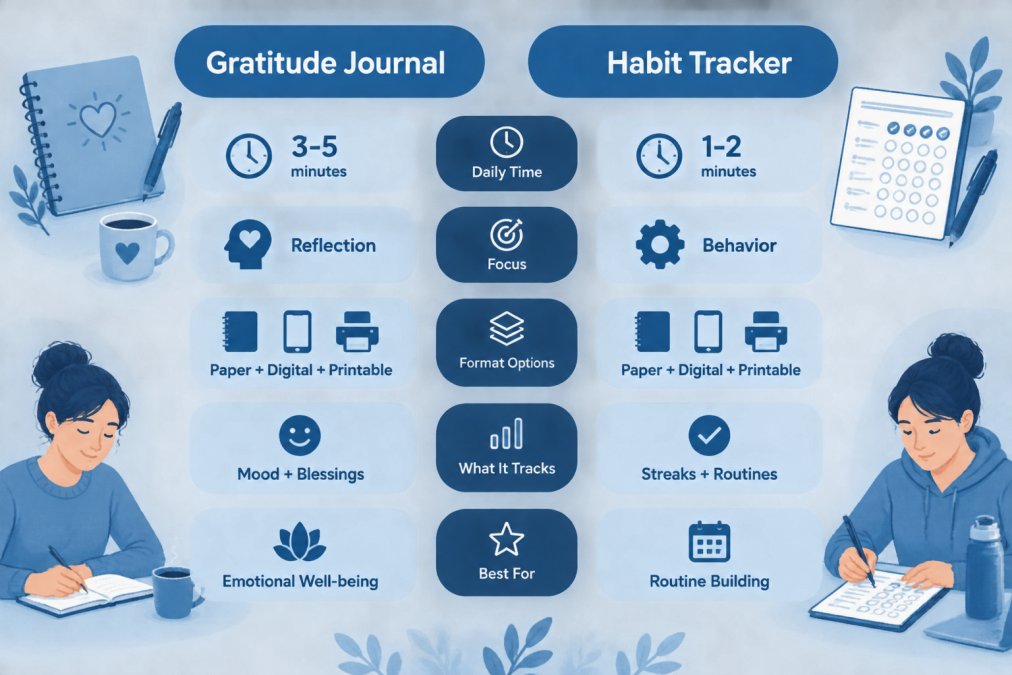
Side-by-Side Comparison Table
| Feature | Gratitude Journal | Habit Tracker |
|---|---|---|
| Daily time needed | 3-5 minutes | 1-2 minutes |
| Primary focus | Reflection and mood | Behavior and streaks |
| Format options | Paper, digital app, printable | App, planner, printable sheet |
| What it tracks | Blessings, mood, intention | Routines, completion, streaks |
| Best for | Emotional well-being, calm | Routine building, accountability |
| Failure mode | Feels forced on hard days | Tracking fatigue, missed-day guilt |
The Trade-Offs Nobody Puts in the Table
Setup time. A gratitude journal needs almost none, a notebook and pen tonight.
Daily time. The tracker wins on raw minutes. A checkmark takes seconds.
Missed-day recovery. A gratitude journal has no streak to break; miss a week and you pick up the pen with no penalty.
Maintenance burden. A gratitude journal stays the same size forever.
What each tool is bad at. A gratitude journal will not make you exercise, sleep earlier, or put the phone down.
Which Tool Fits Which Parent
A simple way to decide, based on the goal rather than the personality:
- If the last month felt heavy and you want to feel steadier, the gratitude journal is the better first tool. It has no failure state, so it survives unpredictable weeks.
- If you keep promising yourself you will do a specific thing and keep not doing it, the habit tracker is the better first tool. It makes the promise visible.
- If you want both but have no spare time, combine them on one page rather than running two systems. The section below shows how.
Watch out: the most common mistake is starting both tools at full size in the same week, leaving parents with two abandoned systems and fresh self-blame. Start with one, run it two weeks, then add the second only if the first feels automatic.
If you want a ready-made structure for the gratitude side, our daily gratitude practice for busy moms walks through a five-minute version you can start tomorrow. If the tracker side is the gap, these minimalist habit tracking ideas are built for parents who have already quit one grid.
Gratitude Journal Prompts for Parents Who Have No Time
The best gratitude journal prompts for parents are specific, short, and answerable in one sentence. Vague prompts like "what are you grateful for" produce vague answers. Narrow prompts produce real ones.
Try these when you have three minutes and no patience:
- Name one moment today you want to remember.
- What did someone do for you this week that you did not ask for?
- Which small thing went right before 9 a.m.?
Guided questions beat open-ended writing for tired brains: a blank page invites procrastination, a single question invites an answer. For a ready-made daily structure, our daily gratitude practice for busy moms walks through a five-minute version you can start tomorrow.
Simple Habit Tracker Ideas for Moms Juggling Everything
The habit tracker ideas that actually stick are the boring ones. Track two habits, not ten. Track actions you already half-do. Track things you can complete in under five minutes on your worst day.
Here is what works in practice:
- One anchor habit. Pick a single daily action, like drinking water before coffee or reading one page.
- A printable tracker on the fridge. Visible beats buried in an app you forget to open.
- Weekly review instead of daily scoring. Fewer check-ins, less tracking fatigue.
Watch out: a common mistake is building a twelve-habit grid in week one, since systems that demand more attention than the habit itself are often abandoned.
Why a Five Minute Gratitude Journal Fits a Real Day
A five minute gratitude journal works because it fits inside the gaps a real day already has. The three minutes while the coffee brews. The two minutes waiting in the school pickup line. The pause before you open your laptop.
Short-form journaling removes the two things that kill journaling habits: setup time and decision fatigue. You do not choose a topic, find a pen, or settle into a mood. You answer one prompt and move on.
The trade-off is honest. Five minutes will not produce the long, searching entries a weekend journal session might. What it produces is consistency, and consistency is what changes how a week feels.
Daily Habits for Intentional Parenting: Where Both Tools Meet
Daily habits for intentional parenting sit at the overlap of both tools. You use the gratitude journal to notice what kind of parent you were today.
That pairing is not extra work. It is one reflection and one action. The reflection tells you what to keep. The tracker keeps it.
For parents raising teenagers, the overlap gets more useful. If that is the goal, our practical guide to daily habits for intentional parenting goes deeper on building the routine around your family's actual schedule.
Using Both Without Doubling Your Workload
Running both tools takes about five minutes total if you stop treating them as separate projects. The trick is to attach the tracker to the journal. One page, two fields: what went right, and did I do the thing.
A starter template you can copy tonight:
Date: ______ One thing that went right today: ______ One thing I want to repeat tomorrow: ______ Did I do it yesterday? [ ] Yes [ ] No If no, my recovery move: ______
That is the whole system: the journal field feeds the habit field. You are not maintaining two habits, just one two-minute check-in that does both jobs.
If you would rather use a guided format than build your own, the 10-Minute Manifestation Journal for Busy Moms from SSBGMARKETINGINC. is a bite-sized daily gratitude and visualization tool built for hectic schedules.
Pick Your Starting Tool and Begin This Week
Choose based on your goal, not your personality. If the last month felt heavy and you want to feel steadier, start with the gratitude journal. If you keep promising yourself you will exercise, sleep earlier, or put the phone down, start with the habit tracker.
A simple decision rule:
- Goal is emotional: gratitude journal, one prompt, three minutes.
- Goal is behavioral: habit tracker, two habits maximum.
- Goal is both: the one-page template above.
- Goal is connection with your teen: a shared daily check-in, one sentence each.
Whichever you pick, keep the first week deliberately small: one prompt, two habits, no app shopping, no printable redesigns, no new planner. If you want a structured starting point, this 10-minute habit reset guide sets up either tool without overcomplicating it, and if the real blocker is feeling buried, this guide on how to stop feeling overwhelmed daily addresses the root before the routine.
A Decision Framework for Real Parents
The four-bullet rule above is a starting point, but most parents do not have one clean goal, they have three, and a schedule that changes week to week.
**1.
2. How predictable is your week? A gratitude journal tolerates chaos, pickup line, red light, two minutes before sleep.
**3.
4. Do you want to share it with your family? A gratitude journal can be private or a dinner-table ritual where each person says one sentence.
When Combining Both Is Useful, and When It Is Redundant
Combining the tools is useful when the reflection and the action are about the same thing. For example: you want to be more patient at bedtime.
Combining is redundant when the two tools track unrelated things. A gratitude journal about your marriage plus a habit tracker about flossing is two separate projects wearing one label. You will maintain one and drop the other, and the dropped one will feel like a failure.
A practical test: if you cannot write the journal prompt and the tracker habit on the same line of a sticky note, they do not belong in the same routine.
The Downsides Nobody Mentions
Both tools have failure modes, and naming them in advance is the best protection against quitting.
Tracking fatigue. The more you track, the more time you spend tracking and the less you spend doing.
Forced positivity. A gratitude journal can tip into pressure to feel thankful on days that were genuinely bad.
The hardest part is not choosing between a gratitude journal and a habit tracker.
Frequently Asked Questions
What is the difference between a gratitude journal and a habit tracker?
A gratitude journal asks you to write down what went well and what you appreciate, usually through guided prompts or a short gratitude list. A habit tracker records whether you did a specific behavior, like drinking water or reading with your kid, and shows streaks over time. The first targets emotional well-being and positive mindset; the second targets consistency and behavior tracking. Many parents find the gratitude journal changes how they feel, while the habit tracker changes what they do.
Can you use a gratitude journal and a habit tracker together?
Yes, and it takes less time than most people expect. Pair them in one sitting: open your habit tracker, mark the two or three habits you finished, then spend three to five minutes on a gratitude journal prompt. Keep both in the same place, paper or digital, so it stays one daily check-in instead of two separate routines. The habit tracker handles accountability; the journal handles reflection. Together they cover both the doing and the feeling.
How much time does a five minute gratitude journal take each day?
A five minute gratitude journal is designed to take three to five minutes, which is why it suits busy moms with time constraints. A typical entry is three things you are grateful for plus one line about how the day felt. You do not need open-ended writing or long reflection sessions. Set a timer for five minutes, write until it rings, and stop. Short-form journaling done daily beats a long entry done once a month.
Which is better for building consistent parenting habits?
Start with a habit tracker if your goal is consistency. It gives you streaks, a daily check-in, and visible progress tracking, which helps with habit formation over roughly 66 days of repetition. Choose a gratitude journal first if your goal is calm, intention setting, or emotional well-being, since reflection and guided questions work on mindset rather than behavior. If you want both, track one or two daily habits for intentional parenting and add a short gratitude entry after.